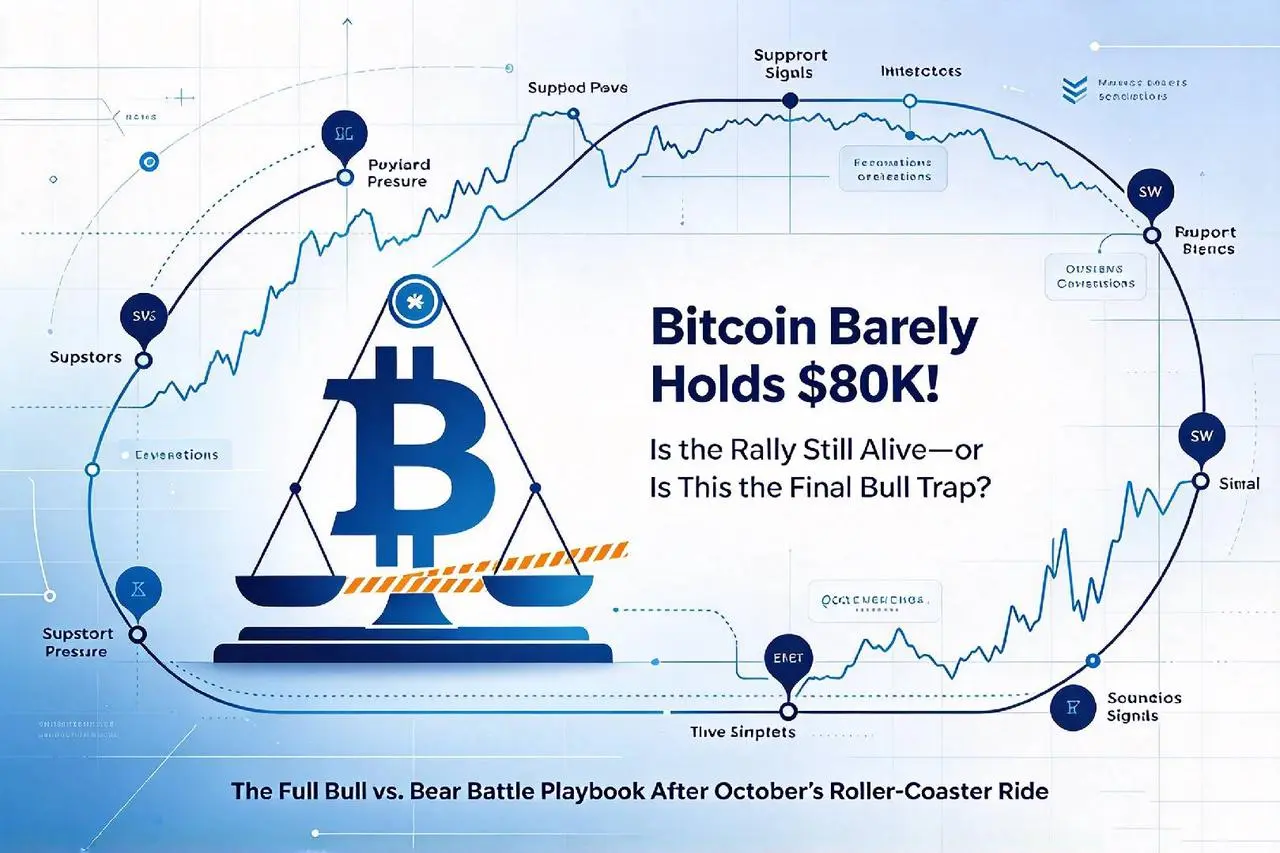
Bitcoin Barely Holds $80K! Is the Rally Still Alive—or Is This the Final Bull Trap? The Full Bull vs. Bear Battle Playbook After October’s Roller-Coaster Ride

Over the past ten days, starting with Chinas National Day holiday, crypto traders have been on a wild roller-coaster ride. Bitcoin first surged through $86,000, fueling bullish expectations, only to be slapped back down toward the $80,000 abyss. Some traders made a fortune overnight, while others suffered devastating liquidations.  The market now resembles a giant powder keg, with bulls and bears locked in an intense tug-of-war around the $83,000–$84,000 battleground.  So, where is the market heading next? Up or down? Is the bull market still alive?  Today, well look beyond the candlestick charts to uncover the capital battles unfolding beneath the surface—and lay out a practical, cost-effective trading playbook for crypto futures traders.Act I: Ten Days of Fire and Ice  October 1–4 | The Prelude to Euphoria  U.S. nonfarm payrolls came in surprisingly weak, prompting market cheers that the Federal Reserve might hold off on further rate hikes. Bitcoin seized the opportunity and surged toward $87,000, while Ethereum climbed above $2,700.  October 5–8 | A Cold Shower  The Feds meeting minutes delivered a series of hawkish signals. Bitcoin ETF flows suddenly reversed into outflows, while rising tensions in the Middle East and rumors of U.S. government Bitcoin sales added to the pressure. More than $1 billion in
35 منٹ پہلےگہرا غوطہ

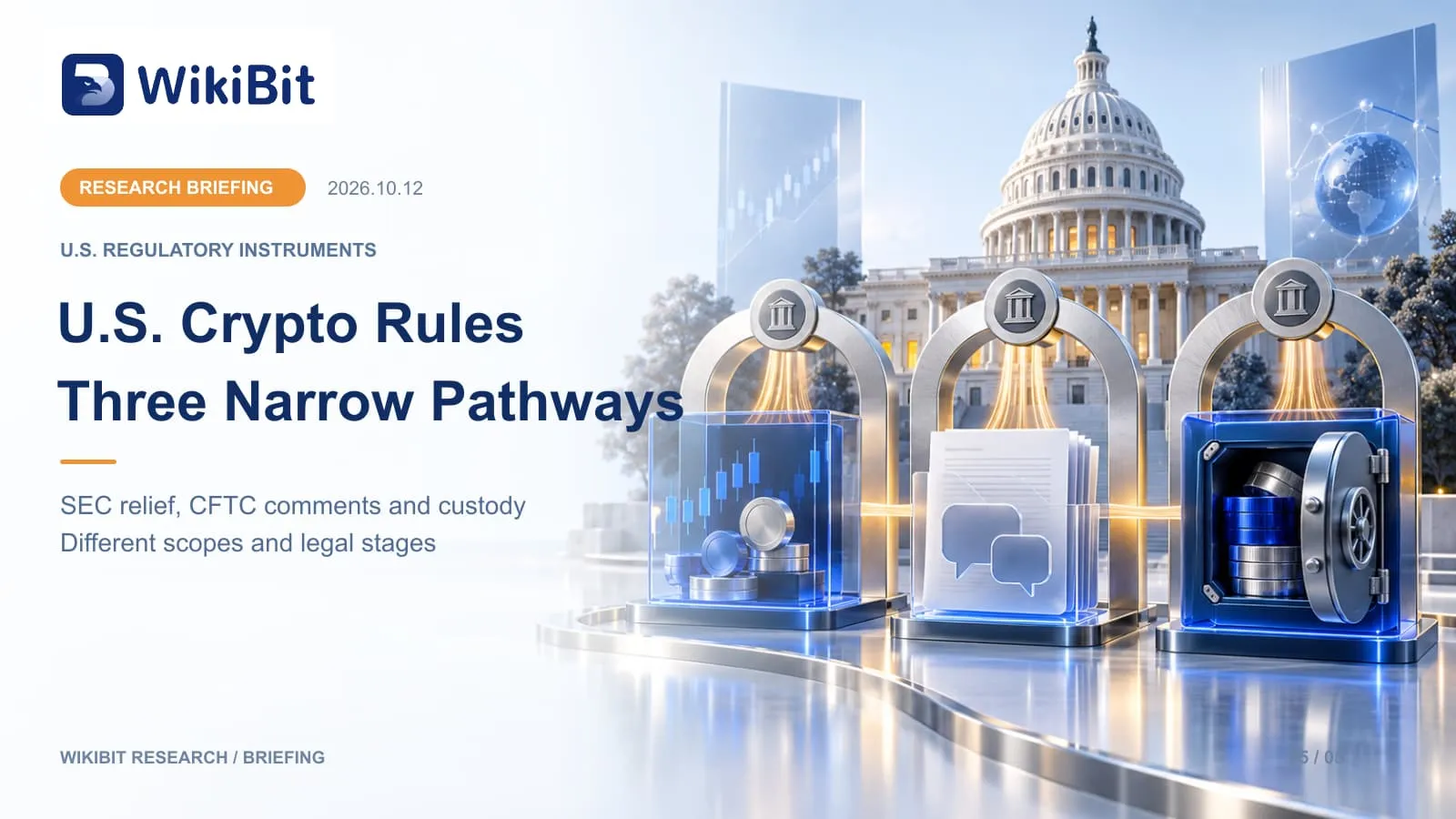
After the CLARITY Act Stalled: SEC Tokenization Exemption, CFTC Proposal and Spot Gaps

Two U.S. regulators are continuing to build pieces of a digital-asset framework after the Digital Asset Market CLARITY Act failed to advance in the Senate. But the most important pieces are at different legal stages: one has already taken effect as limited relief, another is a request for comment, and a comprehensive statutory framework for ordinary spot markets is still missing.  The distinction was highlighted in new October 11 interviews with industry executives and legal scholars. Some expect agencies to enable products faster than Congress could. Others warn that executive-agency changes cannot create the durable boundaries a statute would have established.The SECs tokenized-stock exemption is real—and narrow  On September 17 the Securities and Exchange Commission approved a temporary, conditional Innovation Exemption for limited trading in tokenized National Market System stocks on qualifying tokenized-securities venues. The published conditions include permissioned trading, transaction transparency, restrictions on symbols and volumes, protections around trading halts, records and systems controls.  A venue still has to satisfy those conditions. The exemption does not mean any decentralized exchange can trade any security without other obligations, nor does it certify the economic value of a particular token. The SEC describes the mechanism as a controlled way to learn from live onchain

2 گھنٹے پہلےانڈسٹری ریسرچ

Zcash’s Transparent-Wallet Plan: Address Rotation, Private Queries and Unfinished Signature Migration

A transparent blockchain address can reveal more about its owner after the first spend than before it. Zcash developer Zakura wants wallets to rotate transparent addresses without giving a wallet synchronization server an easy way to link those addresses together. Its engineering explanation, revisited in October 11 reporting, also sketches a future hash-based signing option.  The distinction between these pieces is important. Zakura describes an experimental private-query function in its Vizor wallet and a planned January arrival for post-quantum signature opcodes. It has not announced that Zcash mainnet has universally adopted a new quantum-safe transaction signature system.The security issue begins when a public key is exposed  A conventional transparent Zcash address contains a hash derived from a public key. Merely displaying that address does not necessarily reveal the full public key. But spending from the address can publish the public key as part of signature verification. If some future cryptanalytic advance made the relevant elliptic-curve problem tractable, already-exposed public keys would be a different category of risk from previously undisclosed ones.  Rotating to a new derived address after a transaction limits reuse of the same exposed key. One seed phrase can generate multiple distinct addresses, so rotation does not ordinarily require maintaining a

2 گھنٹے پہلےانڈسٹری ریسرچ

Bitcoin and Russia–Ukraine Energy Ceasefire Claims: What Was Confirmed on Oct. 11

Bitcoin rose during Sunday, October 11 reporting after President Donald Trump claimed an immediate Russia–Ukraine “energy ceasefire” and Kyiv offered conditional support for a reciprocal halt to attacks. The political announcement and the markets reaction were real. Whether an enforceable bilateral ceasefire had actually begun was not confirmed.  President Donald Trump posted that both sides had agreed to stop attacks on energy infrastructure. Ukrainian President Volodymyr Zelenskyy said Ukraine was ready to refrain from striking Russian energy facilities if Russia made the same commitment, but requested details from Washington and continued to report Russian attacks. Reuters said Moscow had not confirmed the arrangement at the time of its coverage.  The key status is therefore claimed agreement / Ukrainian conditional support / no confirmed Russian acceptance, not “the war has ended” and not “peace deal finalized.”Why a ceasefire headline can move cryptocurrency  Energy infrastructure has been a significant channel through which the conflict affects oil and fuel supply expectations. Investors can quickly translate news of possible de-escalation into assumptions about energy prices, inflation pressure and interest-rate expectations. Crypto trades during the weekend even when U.S. equities and much of the conventional commodity market are closed.  CoinDesk reported that bitcoin was initially little changed after the

2 گھنٹے پہلےانڈسٹری ریسرچ

IMF Tokenized Stocks Study: 24/7 Demand, 80% Fractional Trades and Liquidity Risks

More than half of trading in the tokenized equities examined by the International Monetary Fund occurred outside regular U.S. equity-market hours. Approximately 80% of transactions were smaller than one conventional share. Those are substantial signals of what users want from a tokenized stock: a way to trade when U.S. exchanges are closed and a way to buy a fraction of an expensive share.  The same study finds that these markets are considerably less liquid and roughly 1.5 times as volatile as the equivalent traditional stocks. That matters for anyone assuming that round-the-clock access necessarily improves execution quality.  The results appear in Chapter 3 of the IMFs October 2026 Global Financial Stability Report, Scaling Tokenization: New Efficiencies, New Vulnerabilities, publicly discussed ahead of the full report release. Public discussion intensified in October 11 reporting. The IMFs empirical observations deserve close reading because they answer a different question from recent exchange launches: how do tokenized stocks actually trade after they exist?What the IMF measured  The IMF compared five liquid tokenized U.S. equity-linked instruments with corresponding conventional assets, using products from Ondo Finance and xStocks. The exercise covered 11 centralized and decentralized trading venues, 365 trading days, and more than two million five-minute observations of prices

2 گھنٹے پہلےانڈسٹری ریسرچ

Papertrade Price-Feed Manipulation: $1.28M Wallet, ETH Midpoint and LP Risk

A wallet withdrew about $2.48 million from Papertrade after depositing approximately $1.2 million, according to transaction records reviewed by The Block on October 11. The roughly $1.28 million difference became the focus of an unusually concrete dispute over how a new 1,000x perpetuals venue prices its trades. The activity centered on ETH orders placed on Hyperliquid while the same wallet held much larger synthetic positions on Papertrade.  The earlier October 11 analysis of Papertrade examined an estimated $11 billion of open notional, roughly $54 million of trader margin in one snapshot, and the difference between open interest and funds available to honor winners. The new evidence is about how a trader may influence the price that determines those winners and losers. It calls for an update to that existing analysis, not a second general introduction to leverage.A price move of 0.12% can matter enormously at 1,000x  Papertrade settles synthetic trades against a pool rather than matching each customer with a second trader. Its reference price comes from the midpoint between Hyperliquids best bid and offer. A synthetic position can therefore be highly sensitive to changes at the top of a separate venues order book.  The Block reported that, between 6:01 and 6:02 p.m.

2 گھنٹے پہلےانڈسٹری ریسرچ

Ledger CryptoBilis Update: Confirmed Hardware Implant, Loss Estimates Still Unverified

The Ledger–CryptoBilis investigation has moved beyond a hypothetical supply-chain compromise. On October 10, Ledger confirmed that an affected customers device contained an unauthorized hardware implant. That is substantially different from the companys initial October 9 request for the Southeast Asian reseller to stop selling and shipping wallets while it investigated reports of missing funds.  The physical finding matters because it establishes that at least one affected device was modified. It does not establish how many devices were altered, how the implant entered the distribution chain, whether it caused every reported theft, or how much money the perpetrators ultimately controlled. Those are distinct questions. The companys reported implant finding is stronger evidence than the original rumors; it is not an audited final incident report.What the company has confirmed  Reporting on Ledgers October 10 support-account update says the company identified an unauthorized implant inside one users device. CryptoBilis suspended sales of hardware wallets while the investigation continued. Ledger also said it had found no indication that its own security infrastructure, systems or services had been compromised. That last assertion is a statement of the companys current investigation, not independently established proof that every step of its manufacturing and distribution chain has been cleared.  The original

2 گھنٹے پہلےانڈسٹری ریسرچ

Kraken October 2026 Delistings: 13 Assets, Trading and Withdrawal Deadlines

Krakens October 2026 delisting notice places 13 assets on a path toward forced liquidation in February 2027. Customers who leave their holdings on the venue after withdrawals close may receive far less than recent quoted prices, and Kraken expressly warns that some residual positions could produce minimal or no proceeds.  The exchanges English notice, last updated October 8, gives three dates: trading and deposits end October 23, 2026 at 14:00 UTC; withdrawals end January 29, 2027 at 15:00 UTC; and remaining balances are subject to automatic liquidation February 1–12, 2027. These are different operational events. A coin can still appear as a custodial balance after trading stops, but that does not mean a holder can later choose a market exit or expect a guaranteed conversion price.Which assets are in the official batch?  The current English notice names BMB, ELX, APU, BDXN, DUCK, BOS, U, OBOL, IDEX, FIS, UXLINK, ALTHEA and NOBODY. That is 13 assets. The current accessible Norwegian and Chinese language pages contain the same list.  The matching language versions provide useful corroboration of the current batch. They do not establish what a future asset-specific notice might say, and they cannot replace checking account-specific venue restrictions. The confirmed October list should not

2 گھنٹے پہلےانڈسٹری ریسرچ

COLDCARD’s X Phishing Post: What Was Compromised and What Remains Unknown

Bitcoin hardware-wallet maker COLDCARD said an unauthorized phishing post appeared on its official X account on October 11, 2026. The post was removed. The company told users not to follow or interact with the malicious link and said it had contacted X while examining account access. The immediate verified exposure is an official-channel impersonation incident—not proof that the current event compromised device firmware, wallet keys or the vendors infrastructure.A trusted account carried an untrusted instruction  Hardware-wallet users often rely on vendor announcements to identify firmware updates, security emergencies and device setup guidance. An attacker who can place a post on a verified-looking official channel can turn that trust into a route to a phishing site. Even a person who owns a genuine, uncompromised hardware wallet may be harmed if they manually disclose the recovery phrase or sign an unrelated transaction after following such a message.  COLDCARD said it had used offline two-factor authentication and tightly restricted access for its X account since 2017. Its representatives said the account logs and authentication records did not show a corresponding suspicious session, and asked X to investigate. This does not establish that Xs internal administration tools were breached; platform-side access is a hypothesis that the

2 گھنٹے پہلےانڈسٹری ریسرچ

XRPL Batch Wrapper Bug: A Consensus and Indexer Failure Prevented

XRPLs October 9 security report describes a second, independent flaw in the Batch transaction feature. Unlike the payment-engine overflow, this bug threatened ledger availability and data compatibility, not the supply of XRP. A crafted inner-transaction wrapper could have been interpreted differently by servers on different versions. The developers say Batch had not been activated on Mainnet when the bug was found, and no funds were lost and no consensus failure occurred.Why a field name could split a network  Batch allows a group of signed transactions to be submitted together. Each inner transaction is supposed to be carried inside a field called RawTransaction. The faulty validation logic accepted other object-type wrapper fields if that field had no restrictive template.  Older xrpld 3.3.0 and newer 3.4.0 defined different object fields. A deliberately nonstandard Batch payload could be accepted and relayed by one version but fail deserialization in another. If enough validators ran the incompatible combinations, the trusted validator group could disagree on the contents of a ledger and potentially stop validating new ledgers.  The technical issue is distinct from private-key theft. Every inner transaction still required ordinary valid signatures and balance checks. The attacker could not simply authorize another users payment without that users signature.

2 گھنٹے پہلےانڈسٹری ریسرچ
2345
...
1000