Ledger implant tests Bitcoin ETFs as safer custodial solutions than hardware wallets

The newly discovered Ledger exploit has stirred broad industry debate over the safety of hardware wallets compared to effectively custodying Bitcoin holdings through exchange-traded funds (ETFs).  Bitcoin analyst Plan B said his then-controversial decision to move his Bitcoin (BTC) holdings to ETFs in 2025 was the right call in light of the recent Coldcard and Ledger exploits. “Zero regrets” about my ETF decision, wrote the analyst in a Monday X post.  Large holders have been converting self-custodied assets to ETFs for “enhanced security” for years, which is one of the main “selling points” for ETFs, 21Shares co-founder Ophelia Snyder told Cointelegraph in an email on Monday, adding that the recent exploits made this phenomenon part of the “public discourse.”  The remarks follow the discovery of a compromised Ledger wallet that contained an unauthorized hardware implant. Some blockchain investigators estimated that losses from these implants could top $86 million, raising questions about the security of self-custodial cold wallets.  Related: Standard Chartered plans institutional crypto custody in Singapore  Hardware wallets are still safe, but providers need better threat modelling: Adam Back  To be sure, hardware wallets can still be secure custodial options, but providers need a better understanding of the emerging threat landscape, according to Blockstream CEO and


7 hours agoIndustry

Strategy adds 250 Bitcoin as holdings reach 848,250 BTC

Strategy bought 250 Bitcoin for $21.5 million last week, marking a second consecutive weekly decline in purchases as its Bitcoin holdings reached 848,250 BTC.  The company funded $21 million of the purchases through sales of its common stock and the remaining $500,000 with existing cash between Monday and Sunday, according to an announcement published on Strategys website.  Strategy also continued repurchasing shares of its STRC preferred stock, spending $192.4 million during the week, up from $176.3 million the previous week.  The company‘s Nasdaq-traded common stock, MSTR, was up less than 1% ahead of Monday’s market opening, according to Yahoo Finance. The preferred stock was poised to open at $99.68 a share.  The company said it maintains a $4.88 billion US Reserve to support preferred stock dividends and debt interest payments. Its separate USD Cash balance stood at $640.5 million as of Sunday.  The purchase followed a Sunday post by founder and executive chair Michael Saylor, who signaled another Bitcoin purchase with the message, “Theres always room for more orange.” Strategy typically reports its Bitcoin purchases in filings with the US Securities and Exchange Commission, which is closed Monday for the Columbus Day holiday.  Strategys Bitcoin accumulation has slowed in recent months. Its holdings grew just 0.2%

7 hours agoIndustry

Australia moves to bring crypto settled CFDs under retail trading rules

Australias securities regulator has proposed bringing certain crypto settled derivatives under existing retail trading safeguards after reporting more than $458 million in losses among contracts for difference traders.  The Australian Securities and Investments Commission (ASIC) said on Monday that it wants to update the definition of contracts for difference, or CFDs, to cover eligible products settled through digital asset transfers, while keeping existing restrictions on leverage and investor losses.  ASIC has proposed keeping its CFD product intervention order in place for another 10 years, subject to ministerial approval. The current order took effect on March 29, 2021, and is scheduled to expire on May 23, 2027.  The regulator has invited public feedback on the proposed changes until Nov. 9.  ASIC wants crypto settled CFDs covered by existing safeguards  CFDs allow investors to speculate on changes in the value of an asset without owning it. Traders can take positions on cryptocurrencies, stocks, commodities and other financial instruments, often using borrowed funds to control positions larger than their initial deposits.  Australias existing CFD rules generally cover contracts settled in cash or through the offsetting of obligations between counterparties.  Under ASICs proposal, the definition would include qualifying contracts settled through transfers of digital assets, even when the underlying exposure relates

7 hours agoIndustry

Bitcoin, Ether ETFs Lose $1.2 Billion as Institutional Demand Cracks

U.S. crypto ETF demand reversed sharply in the week through Oct. 9, with bitcoin and ether funds losing more than $1.2 billion combined. Solana also snapped a 14-week inflow streak, while XRP and NEAR emerged as rare pockets of demand.  Key TakeawaysBitcoin and ether exchange-traded funds (ETFs) lost over $1.2B through Oct. 9 as institutional demand reversed sharply.Solana snapped a 14-week inflow streak, while XRP and NEAR remained rare pockets of demand.The key test is whether Blackrock-led bitcoin buying can revive broader institutional support.  Bitcoin ETFs Lose $681M as 3-Week Inflow Streak Ends  The institutional bid that supported crypto through late September finally cracked.  Bitcoin ETFs recorded $681 million in net outflows, ending three consecutive positive weeks. Ether funds lost another $542 million, their largest weekly withdrawal since January.  The timing was striking. Oil climbed back above $100 a barrel, Treasury yields pressed higher, and concerns over inflation returned to the center of global markets. Bitcoins price briefly fell below $81,000 before recovering above $82,000 as investors cut risk.  Monday opened with $89.90 million leaving bitcoin funds. Tuesday produced a temporary $118.86 million rebound before selling accelerated. Wednesday delivered the week‘s biggest blow: $487.07 million in bitcoin ETF outflows, followed by another $244.13 million on Thursday.

7 hours agoIndustry

Arthur Hayes Thinks FLOP Could Outgrow Bitcoin. Its Testnet Is Weeks Away

Arthur Hayes says Flop Labs will ship the FLOP testnet within weeks. The 90-day trial is the only route to the projects genesis airdrop, so miners, validators, and AI agents must earn their share.  Yet Flop Labs own testnet page sets no launch date. Instead, it ties the start to readiness criteria and allows an extension if the team misses them.  Sponsored  Sponsored  What Happens on the Testnet?  What a great @token2049. I got some youthful energy with cellular medicine from @VeritaHealthHQ and then dropped the thinking behind @flop_labs all week. Now its back on the grid so we can ship FLOP Testnet in a few weeks.  Yachtzee  — Arthur Hayes (@CryptoHayes) October 11, 2026  Hayes, the BitMEX co-founder who left retirement to lead Flop Labs in August, posted the update after TOKEN2049 Singapore.  The startup is building a blockchain where AI agents rent computing power. Agents would pay in FLOP whenever they need a model to answer a request or storage for their data.  The miners here are GPU owners. These are people or data centers with graphics processing units (GPUs), the chips that also run AI models like ChatGPT.  Bitcoin miners spend electricity guessing numbers to secure their network, and that work has no other use. By contrast, Flops

7 hours agoIndustry

Australia proposes leverage caps for crypto-settled derivatives

Australias securities regulator wants to extend leverage limits and other retail investor safeguards to certain trading contracts settled in crypto.  On Monday, the Australian Securities and Investments Commission (ASIC) proposed expanding the rules for contracts for difference (CFDs), which let traders bet on price movements without owning the underlying asset.  The rules generally cover contracts settled in cash or by offsetting obligations between the parties. ASIC wants to add contracts settled by transferring digital assets, including those tracking non-crypto assets, provided they meet the other criteria for a CFD.  ASIC said that certain crypto futures and options with fixed expiration dates would remain outside the CFD rules.  Australia‘s existing framework, introduced in 2021, caps leverage and requires providers to close positions when account funds fall below specified levels. Negative balance protection also limits losses to the funds in a client’s CFD trading account.  The regulator is seeking feedback on the proposed extension and amendments until Nov. 9.  Separately, Australia passed legislation in April to bring crypto exchanges and tokenized custody platforms under its financial services licensing framework, with the new regime taking effect on April 9, 2027.  ASIC also required crypto firms relying on temporary enforcement relief under existing financial services law to apply for licenses by

8 hours agoIndustry

EUR/USD Hits 17-Month Low Near. Why the Euro Keeps Losing to the Dollar

The euro has fallen to a 17-month low against the US dollar. EUR/USD touched 1.1161 on Oct. 5, its weakest level since May 2025.  The pair has lost more than 3% in five weeks and traded near 1.1182 on Monday. Analysts increasingly see the slide as a euro problem rather than a dollar story.  Sponsored  Sponsored  Why the Euro Keeps Losing to the Dollar  Four pressures are hitting the single currency at once.  According to KBC, euro weakness has taken over from dollar strength as the main driver. A hawkish Federal Reserve (Fed) started the drop in mid-September, but European problems carried it further.  France sits at the center. The gap between French and German 10-year yields has widened to levels last seen in the 2012 debt crisis, as investors doubt the 2027 budget.  The stress is also spreading. Italy plans a wider deficit, while Spain heads to a snap election on Nov. 29.  French bond spread up, euro down!  EURUSD now below 1.12.  But France still wont default.  This is not disorderly enough for the ECB.  So the euro will take the hit.  Pushing up inflation.  So what about your savings account earning 1-2% yield? pic.twitter.com/mk7T0zta3H  — jeroen blokland (@jsblokland) October 7, 2026  Sponsored  Sponsored  Meanwhile, the Fed raised rates in September and signaled another hike this year.

8 hours agoIndustry

Why Are Buyers Disappearing From the US Housing Market?

US home sellers outnumbered buyers by a record 57.9% in August. This is because 7% mortgage rates pushed buyers out. Meanwhile, more families are missing loan payments, and a top mortgage lender hit a record low.  A buyers market usually signals relief for house hunters. This time, however, shrinking demand reflects stretched household budgets rather than cheaper homes.  Sponsored  Sponsored  Why Are Buyers Disappearing From the US Housing Market?  Redfin estimates that about 1.53 million sellers were active in August, the most since early 2020.  Buyers, in contrast, fell to roughly 972,300. That is the lowest count in data going back to 2013.  BREAKING ????: Housing Market  Home Sellers now outnumber Home Buyers by the largest margin ever recorded ???? ???? pic.twitter.com/sS1rqZQ4k6  — Barchart (@Barchart) October 12, 2026  The reversal is stark. In early 2022, at the height of pandemic-era bidding wars, buyers outnumbered sellers by around 35%.  Rising borrowing costs explain much of the retreat. The average 30-year fixed mortgage rate reached 7.28% on Oct. 1, its highest level since November 2023.  Sellers are adjusting. Redfin data show 21.1% of listings had a price cut in the four weeks to Sept. 20, a seasonal high since tracking began in 2022.  Sponsored  Sponsored  Are American Households Running Out of Room?  The weakness extends beyond home sales.

8 hours agoIndustry

EU targets MiCA loophole that lets crypto exchanges serve 27 countries with one license

EU finance ministers agreed to shift oversight of major crypto companies to a central watchdog, reshaping supervision under MiCA.  Related Law EU AML Package: Regulation (EU) 2024/1624 and Directive (EU) 2024/1640 European Union · In force  The Council of the European Union reached a political agreement on Oct. 9 to give the European Securities and Markets Authority (ESMA) direct responsibility for the blocs most significant crypto-asset service providers, as part of a wider package to integrate European financial markets.  The proposed overhaul addresses a weakness in the Markets in Crypto-Assets Regulation (MiCA), which allows firms licensed in one member state to serve customers across the 27-country bloc while remaining primarily supervised by their home-country regulator.  The compromise, however, is considerably narrower than the European Commissions original plan to move all crypto service providers under ESMA. Officials estimate that only 10 to 15 of roughly 360 providers would qualify for centralized supervision, Reuters reported.  The agreement sets the Councils negotiating position rather than changing the law immediately. The Council must still negotiate the proposal with the European Parliament.  National licenses expose gap in EU-wide oversight  MiCAs passporting system was designed to provide crypto firms with a single route into the European market. Under the regulation, a provider authorized

8 hours agoIndustry

Bitcoin Price Walks a Tightrope as Bears Circle the $82K Zone

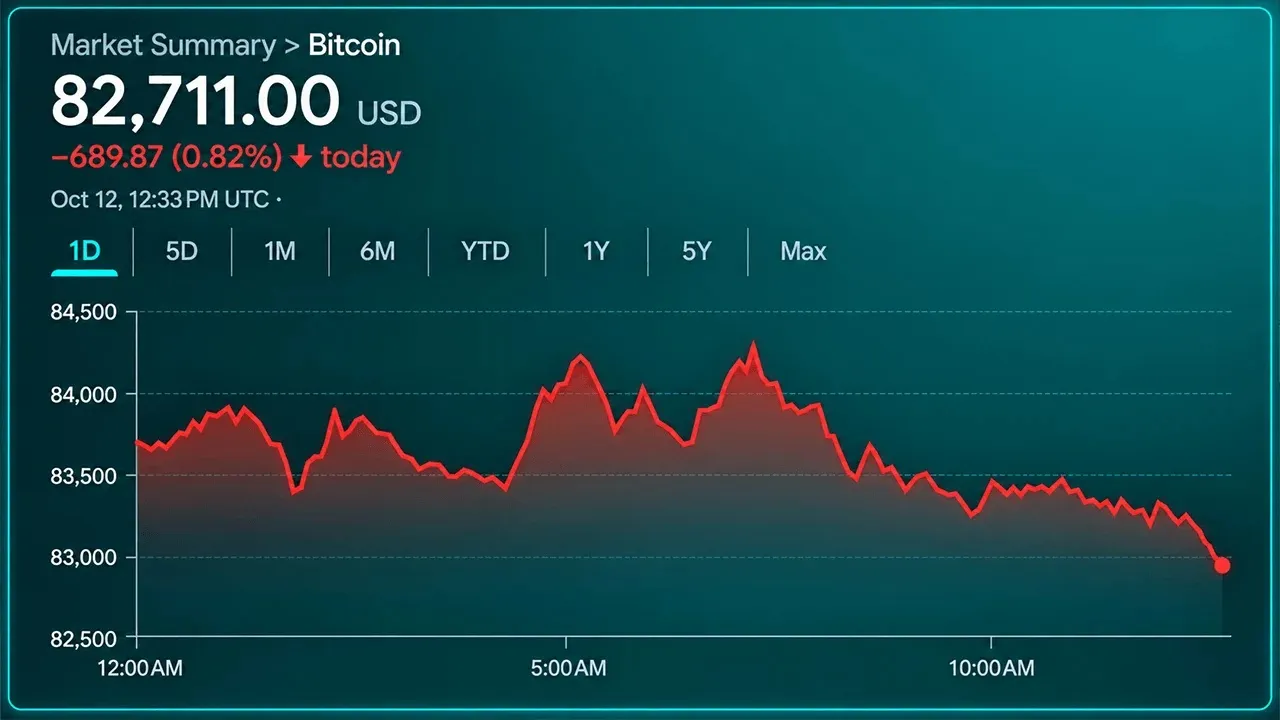
Bitcoins price hovered around $82,550 to $83,000 on Monday, Oct. 12, 2026, as technical indicators painted a largely neutral picture with a modest bearish tilt. The cryptocurrency traded within a 24-hour range of $82,550 to $84,231, while repeated failures to reclaim $84,000 kept bullish momentum in check. Despite near-term weakness, bitcoin remains above several longer-term moving averages, suggesting its broader recovery structure is still intact.  Key TakeawaysBitcoins price trades near $82,550 and $83,000 as neutral indicators and weakening momentum give bears a slight advantage.Bitcoin faces resistance around $84,000 to $85,000, while $82,500 remains an important support level.Bitcoins longer-term moving averages remain positive despite short-term uncertainty and fading momentum.  Bitcoin Price Stalls Near $83K as Bears Test Markets Resolve  Bitcoins price is caught in a technical tug-of-war, hovering around $83,000 on Monday, Oct. 12, 2026, as short-term weakness clashes with a longer-term recovery that has yet to unravel.  With a market capitalization near $1.673 trillion and approximately $23 billion in daily trading volume, bitcoin has struggled to establish momentum above $84,000, leaving traders to decipher a mixed collection of technical signals that favor neither side decisively, although recent price action gives bears a modest advantage heading into the next potential directional move.  Bitcoins Hourly Chart Shows

8 hours agoIndustry
2345
...
1000