Bitcoin buyers and bagholders are both selling into the rebound below $70,000

Bitcoins recent price rebound faltered as the advance gave long-term holders and recent buyers an opportunity to sell before the cryptocurrency reached its next major resistance zone.  Data from CryptoSlate shows that the largest digital asset crossed $65,000 on Wednesday for the first time in about a month, then retreated under $63,000 as of press time. The move followed softer US inflation data and marked Bitcoins strongest response to favorable economic news in weeks.  The retreat came even as several market indicators turned more constructive, setting up a test of whether recovering demand can absorb the supply emerging during rallies and carry Bitcoin above $70,000.  Long- and short-term holders constrain Bitcoins recovery  Bitcoins failure to hold above $65,000 showed how quickly the rebound was drawing supply from investors on both sides of the recent downturn.  Bitcoin has traded below the realized price of the 18-month-to-two-year UTXO cohort since early June, according to CryptoQuant data. The measure estimates the average price at which coins in the group last moved and serves as a proxy for their break-even level.  Bitcoin Realized Price Across UTXO Age Bands (Source: CryptoQuant)  That moving cost basis has since risen to about $80,800 as coins enter and leave the cohort, leaving many of its


07-17Industry

Bitcoin $DOG Mode proposal targets Bitcoin Core policy restrictions

Bitcoin Ordinals advocate Leonidas has proposed a new open-source Bitcoin client that would raise transaction size limits and reduce the dust threshold, seeking to remove policy restrictions affecting Ordinals and Runes transactions.  SummaryLeonidas has proposed a new Bitcoin client that raises transaction size limits and lowers the dust threshold for Ordinals and Runes.Bitcoin $DOG Mode is intended to remove policy restrictions enforced by Bitcoin Core and Bitcoin Knots rather than Bitcoin consensus rules.The proposal comes months after Ord.io shut down, as Leonidas continues to push for wider support for Bitcoin native digital assets.  In a Friday post on X, Bitcoin Ordinals advocate Leonidas introduced a proposal for an alternative Bitcoin client called Bitcoin $DOG Mode, describing it as software designed to remove limits enforced by existing Bitcoin clients rather than by the Bitcoin protocol itself.  I am very excited to announce the launch of a new open source Bitcoin client called Bitcoin $DOG Mode.  Bitcoin Core and Bitcoin Knots have spent years enforcing rules that Bitcoin itself does not have.  A transaction can be fully valid under consensus and still be blocked from…  — Leonidas ???? $DOG (@LeonidasNFT) July 17, 2026  The proposed client would increase the maximum individual transaction size to 3.9 million weight units (WU)

07-17Industry

Ethereum's Binance Buyers Just Flipped a Switch No One Was Watching

Ethereum CVD on Binance jumped to a three-month high near 64,700 as ETH holds near $1,900, with buy-side order flow pointing to real demand.  The number showed up quietly, buried inside a note CryptoQuant analyst Arab Chain posted just two hours before this went out, and almost nobody outside a handful of trading desks caught it right away.  Sixty four thousand seven hundred. That is roughly where Ethereums Cumulative Volume Delta on Binance sits now, its highest reading in three months. ETH itself has been parked near $1,900, which on its own barely qualifies as news.  CVD measures the gap between aggressive buy orders and aggressive sell orders on an exchange. When that number climbs alongside price, traders usually read it as real demand showing up, not just a thin order book letting price drift higher on fumes.  Source: CryptoQuant (Arab Chain), Binance: ETH CVD Momentum & Price Correlation (30D)Binance Order Flow Turns Positive  The 30-day correlation between ETH‘s price and its CVD reading sits at roughly 0.87. CryptoQuant’s number, posted two hours ago. That is a tight relationship for two series that do not always move in step.  A similar Binance buying spike showed up last week too. Cooler than expected U.S. CPI data sparked

07-16Industry

SBI taps Ondo to bring Japanese stocks onchain with JPYSC stablecoin

SBI Group has partnered with Ondo Finance to tokenize Japanese stocks and use its yen-backed JPYSC stablecoin for settlement and collateral.  SummarySBI has partnered with Ondo to bring tokenized Japanese stocks into its financial ecosystem.JPYSC will support settlement and collateral for Ondos tokenized financial products.The deal follows SBIs launch of a tokenized Japanese equity fund on Solana.  According to the companies, the agreement will bring Ondo‘s tokenized financial products into SBI’s financial ecosystem while connecting Japanese assets with international markets for tokenized securities. The partnership will also use SBIs customer network to offer the products to millions of investors.  Were excited to announce a partnership with SBI Group, one of Japans leading financial institutions.  The collaboration covers tokenizing Japanese assets with distribution across the SBI ecosystem, and settlement using the JPYSC stablecoin.  Ondo CEO Ian De Bode on the… pic.twitter.com/Kp4twvDeZo  — Ondo Finance (@OndoFinance) July 16, 2026  Under the agreement, Ondo Global Markets (BVI) Limited will issue tokenized financial products linked to Japan. SBI, a long-time Ripple partner, will distribute the products through its financial platforms and introduce them to existing customers.  Both companies will also conduct joint marketing and explore distribution through strategic partners. SBI and Ondo did not disclose a launch date, the first assets planned

07-16Industry

Robinhood tackled Coinbase head-on then immediately inherited Bases biggest problem

Coinbase is reshaping its Ethereum layer-2 network, Base, around trading, payments and tokenized assets as Robinhoods new blockchain rapidly gains users and liquidity in many of the same markets.  On July 15, Base creator Jesse Pollak acknowledged that the network‘s earlier emphasis on social products had allowed it to lose ground in several of crypto’s fastest-growing financial categories.  Pollak wrote on X:  “The entire social side of the market that many of us had been building towards — Farcaster, Zora, mini apps, and yes, creator coins — disintegrated completely.”  Base will now concentrate on trading, payments and tokenized assets, bringing Coinbase into closer competition with companies building blockchain infrastructure for financial settlement.  Pollak identified Robinhood and Stripe as formidable rivals as both expand their roles in tokenization and stablecoin payments.  Base loses ground during its social push  Over the past years, Base had bet that Farcaster, Zora, mini apps and creator coins could form the foundation of a consumer-focused crypto economy.  The strategy sought to turn posts, profiles and other online content into tradable assets, allowing creators to develop direct financial relationships with their audiences.  The model initially generated substantial activity. At its peak, Base became the leading blockchain for daily token launches, briefly overtaking Solana for the first

07-16Industry

Crypto Trading Volumes Sink To Weakest Levels In Two Years As Traders Step Back

Trading activity across the largest crypto assets has slipped to a two-year low, a sign that retail and institutional traders alike are losing the conviction to chase moves in a market stuck between macro uncertainty and rangebound price action.  According to an on-chain update from Santiment, top cap crypto volumes have been consistently fading since July 2024. The downtrend has now pushed average trading activity to levels not seen since the depths of the previous bear cycle, reflecting a market where aggressive sector rotation has largely stopped. Bitcoins extended stall near the low-to-mid $60,000 range, combined with heavy macro pressure, geopolitical tensions, and erratic ETF flow swings, has sapped trader appetite for risk.  The volume fade is not simply a lull. It reveals a structural shift in how participants are deploying capital. Rather than rotating profits from Bitcoin into altcoins—a hallmark of earlier risk-on phases—traders are sitting on their hands. Spot demand has weakened, and confidence that altcoins can sustain follow-through rallies has eroded. When that rotation engine breaks down, trading volumes across major tokens dry up noticeably, often before social chatter and sentiment metrics register the same chill.  Why the Volume Collapse Reshapes the Trade Setup  Low volume is a double-edged signal. On

07-16Industry

Keyrock closes deal for BlockFills institutional trading and brokerage assets

Quick TakeKeyrock announced the acquisition of BlockFills institutional trading and brokerage operations, including its trading technology, institutional client relationships and regulatory licenses.The Brussels-based firm was selected as the buyer for $3.25 million in BlockFills Chapter 11 bankruptcy process entered into following a February 2026 crypto market crash.  Crypto infrastructure and capital markets firm Keyrock has completed its acquisition of BlockFills institutional trading and brokerage operations.  The deal brings Keyrock BlockFills‘ trading technology, institutional client relationships, and a team of experienced derivatives traders. It also expands Keyrock’s regulatory footprint with a CIMA-registered entity in the Cayman Islands and a proposed FCA-authorized entity in the United Kingdom, according to the announcement.  “This acquisition represents an exceptional opportunity to further strengthen our team with outstanding talent and accelerate our global reach in serving institutional counterparties,” Juan David Mendieta, co-founder and chief strategy officer of Keyrock, said. “The BlockFills team has built impressive technology and demonstrated exceptional expertise in institutional derivatives.”  Keyrock‘s announcement does not disclose the purchase price. According to earlier court filings and reporting, Keyrock was selected as the buyer for $3.25 million in BlockFills’ Chapter 11 bankruptcy process.  Chicago-based BlockFills filed for Chapter 11 bankruptcy earlier in 2026 after suffering significant losses from a February crypto

07-16Industry

ARK pushes back against a16z‘s ’TradFi wants blockchain, not DeFi claim

ARK Invest‘s director of research pushed back against investor a16z crypto’s thesis that traditional finance will adopt blockchain through permissioned infrastructure rather than decentralized finance (DeFi).  Lorenzo Valente said in a Wednesday X post that public blockchains have already outperformed private blockchain initiatives, citing the growth of tokenized assets on Ethereum and other open networks.  He added that crypto-native firms such as Circle and Coinbase, rather than incumbent financial institutions, are best positioned to build the next generation of financial infrastructure.  A day earlier, a16z crypto had argued that traditional financial institutions are not embracing DeFi but selectively adopting blockchain technology that fits existing compliance, governance and operational requirements.  The venture capital firms X post said banks and asset managers will build “programmable financial infrastructure” that borrows blockchain primitives such as tokenization and atomic settlement while remaining permissioned and institutionally controlled.  Sentora co-founder Jesus Rodriguez also pushed back against a16z‘s thesis, saying institutions are likely to adopt DeFi’s underlying infrastructure while layering compliance, custody and other enterprise controls on top.

07-16Industry

Ostium pauses trading as security firms report multimillion-dollar oracle exploit

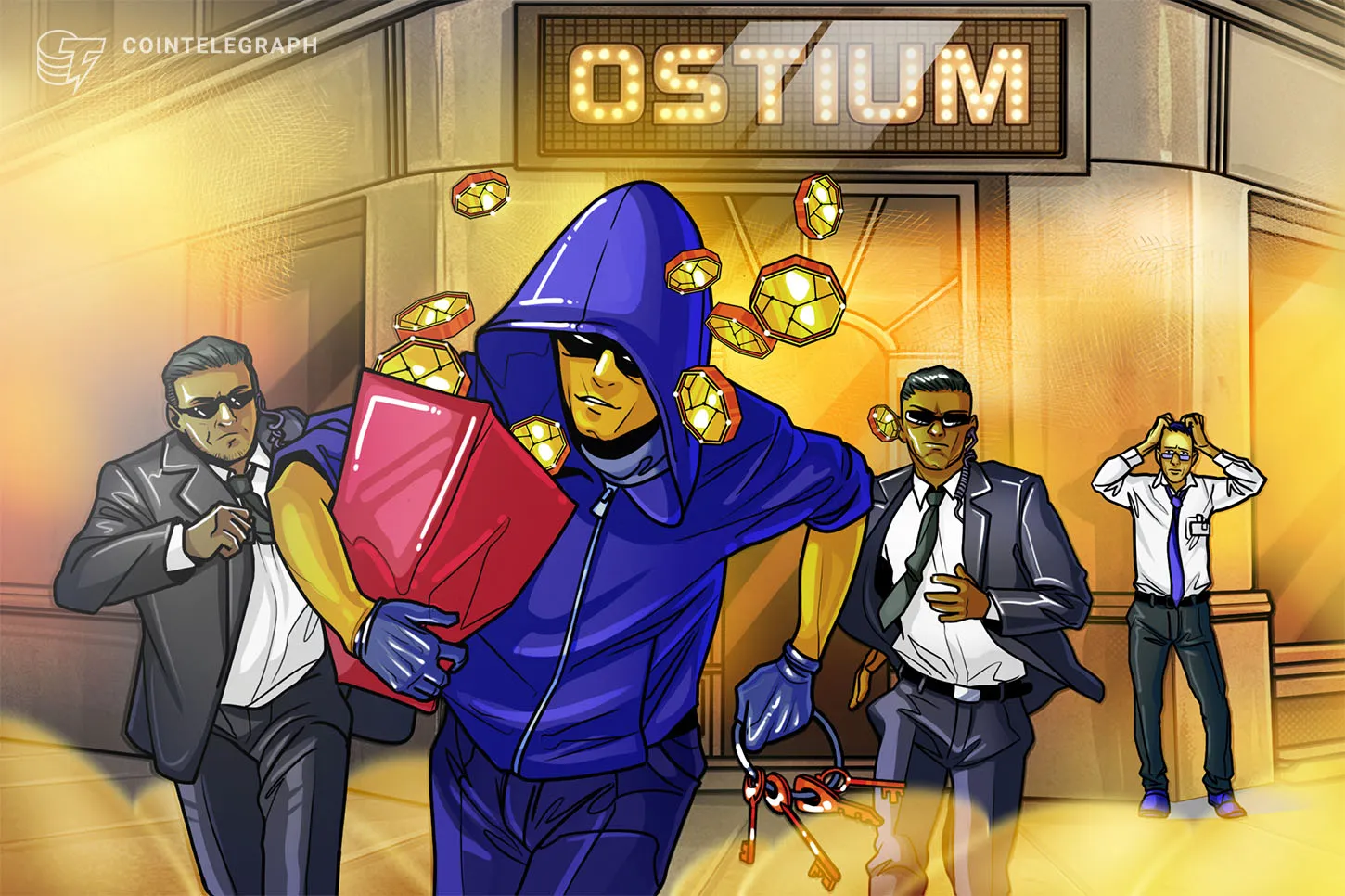
Decentralized trading protocol Ostium paused trading Wednesday after blockchain security firms Blockaid and CertiK reported an apparent exploit of its OLP liquidity vault.  Blockaid estimated the exploit resulted in $18 million in losses, while CertiK placed the figure at about $22 million. Both firms attributed the incident to an apparent compromise of Ostiums oracle system, which supplies external price data to the protocol.Source: Ostium  Ostium announced on X that it paused all trading after identifying an issue affecting the vault. It subsequently said: “With user security being our first concern, we recommend that all users temporarily revoke approvals for our contracts until we can further investigate the recent incident.”  The protocol said its team is investigating and has not yet confirmed the cause of the incident or the estimated losses reported by blockchain security firms.  Built on Arbitrum, Ostium is an onchain perpetuals trading platform offering leveraged exposure to 75 trading pairs spanning stocks, ETFs, commodities, indices, foreign exchange and cryptocurrencies.Source: CertiKAlert  Related: Crypto hacks fell 47% in H1 but ecosystem is no safer: CertiK  DeFi hacks remain persistent challenge  The incident is the latest in a series of high-profile attacks targeting decentralized finance protocols this year, despite broader efforts to strengthen security across the sector.  According to

07-16Industry

Crypto equities gained 23% while crypto tokens fell 36% this year – Is value shifting?

Bitwise reported that publicly traded crypto companies gained 23% in the first half of 2026, while crypto assets fell 36%, creating a 59-percentage-point gap.  Equities could be pricing in a recovery that sits above where the tokens currently trade, or they could also be capturing revenue crypto adoption generates for companies through fees, yield, and services that exist whether tokens rise, fall, or sit still.  Across recent crypto cycles, crypto equities and major tokens have generally moved in the same direction. When Bitcoin and other large-cap assets rallied, exchanges earned more, miners expanded, venture funding returned, and much of the industry benefited.  Whether that link still holds is one of the points Bitwises report raised.  Bar chart showing crypto equities gained 23% in H1 2026 while crypto assets fell 36%, creating a 59-percentage-point gap.What the equity basket is made of  Bitwises crypto-equity theme (BITQ) recently listed Coinbase, Strategy, IREN, BitMine, MARA, Galaxy, Figure, Cipher, Hut 8, and Riot among its top holdings.  That mix spans fee-based platforms, Bitcoin treasury companies, and miners whose valuations remain highly sensitive to BTC, so the 23% gain compresses several distinct exposures into one figure.  Stablecoins make the clearest case, as DeFiLlama puts the total stablecoin market cap near $310 billion, with

07-16Industry
1
...
541543
...
1000