SEC proposes crypto custody framework for investment advisers and funds

The U.S. Securities and Exchange Commission has proposed an Oct. 1 crypto custody framework under two federal investment laws, allowing conditional self-custody and state trust company custody for investment advisers and regulated funds.  SummaryThe proposal covers registered investment advisers, registered investment companies and business development companies.Advisers could hold crypto themselves when no permitted custodian is available, subject to conditions.State trust companies would face checks on their authority and safeguards before serving as custodians.Public comments will remain open for 60 days after publication in the Federal Register.  SEC Chairman Paul Atkins said in the statement shared in his Oct. 3 X post that the proposal addresses uncertainty over how advisers and funds can legally hold crypto assets for clients. The SEC published the same statement on Oct. 1, alongside its proposed rules.  According to the commissions announcement, the framework would remove custody barriers that restrict crypto-related investment advice. The agency said it would also let regulated funds offer more crypto investment strategies, identifying registered investment companies and business development companies among the funds covered.  SEC crypto custody proposal would permit conditional self-custody  Under the SECs proposal, advisers could hold client and fund crypto assets themselves in limited circumstances. Commissioner Hester Peirce explained that an adviser must


Within 1 weeksIndustry

Bullish: Bitcoin Exchange Reserve Drops to 2023 Lows

After Bitcoin witnessed a brief price recovery recently, reclaiming its previous high around $87,000, the sharp price rally has driven demand for the asset.  As such, Bitcoin has seen traders increasingly scoop up its tokens from exchanges as demand appears to have spiked, causing its reserve across all exchanges to drop sharply.  2.68 million Bitcoin left to buy  Per recent data from crypto analytics platform CryptoQuant, Bitcoin exchange reserves have suddenly dropped to a fresh multi-year low after its price rebounded briefly a few days ago.  Following this sharp drop in the metric, there are now about 2.68 million BTC held across exchanges as of Saturday, October 3.  Although decreases in exchange reserves are often perceived as a potential sign of accumulation or long-term holding, analysts have also warned that the case this time may not entirely confirm a bullish outlook for Bitcoin, as increases in outflows from major exchanges like Binance could be attributed to several other factors.  Bitcoin supply is shrinking  Additional data provided by the source shows that Bitcoin exchange reserves have been trending lower across several Bitcoin market cycles.  The last time Bitcoin reserves peaked was in early 2024, when they reached a high of around 3.2 million BTC, at a time when Bitcoin

Within 1 weeksIndustry

Crypto gainers and losers: Quant jumps 158%, Lighter sinks

Bitcoin traded near $84,600 on Oct. 3 as Quant and Midnight led the weeks top crypto gainers, rising 158.3% and 96.5%, respectively. Lighter fell 28.7%, while MemeCore, Ethena and Zcash posted double-digit losses.  CoinGeckos seven-day top-100 rankings for Oct. 3 placed Bitway and Pump.fun behind Quant and Midnight among the leading gainers. Its separate Bitcoin data showed BTC up about 0.6% over seven days, against a 0.3% decline across the broader crypto market.AssetPriceSeven-day changeQuant (QNT)$261.42+158.3%Midnight (NIGHT)$0.04988+96.5%Bitway (BTW)$1.44+66.7%Pump.fun (PUMP)$0.005462+19.5%Lighter (LIT)$3.49−28.7%MemeCore (M)$1.03−16.7%Ethena (ENA)$0.232−14.7%Zcash (ZEC)$1,313.37−14.4%  Prices and weekly changes: CoinGecko, Oct. 3.Quant leads crypto gainers after U.S. payments deal  Quant‘s rally followed The Clearing House’s Sep. 24 announcement that it had selected the company to power its On-Chain Money Initiative, a network for clearing and settling tokenized commercial-bank deposits.  The payments operator said the network would connect with existing U.S. infrastructure, including RTP and CHIPS. Availability for participating financial institutions is expected in the first half of 2027.  Gold analyst Jan Nieuwenhuijs posted on X on Sep. 26 that buying one QNT carried the risk of losing $120 against the potential to earn $10,000.  His post did not set a date for that outcome. The comment came before the Oct. 3 price of $261.42 and represents a speculative upside

Within 1 weeksIndustry

Arbitrum pauses new Stylus activations over AI-assisted attack risks

Arbitrums Security Council temporarily blocked new Stylus contract activations on Arbitrum One and Nova in an October 2 emergency action, restricting programs and app updates that require fresh activation. Already-active Stylus applications can keep running, while ordinary Solidity contract deployment and execution remain unaffected, according to the Councils action report.  Related Asset Ethereum #2 ETH · $2,681.24 24-hour change: down 0.44% Loading price history… 24H Down 0.44% 7D Down 0.39% 30D Up 6.79%  Arbitrum attributed the precaution to increasingly sophisticated AI-assisted attacks involving hand-crafted WebAssembly programs outside the standard Stylus compiler toolchain. It said known Stylus bugs primarily threaten chain liveness, including denial-of-service risks, and that no attack permitting theft of user funds had been discovered.  The linked Ethereum, Arbitrum One and Nova transaction records show successful execution on October 2, around 15:30 to 15:31 UTC.  For builders, the distinction is between storing code and making it usable. Stylus contracts run WebAssembly programs, which need activation to become executable. Arbitrums documentation distinguishes that step from deployment, which stores code onchain. New contract instances using identical program code can reuse an existing activation, provided it is still valid.  A new application version requiring fresh activation cannot become executable during the pause. Reactivating an expired program, or

Within 1 weeksIndustry

Hackers use Microsofts X account to push unofficial Clippy token

Hackers have used Microsofts official X account to promote an unauthorized Clippy-themed token, with the promotional activity removed roughly 30 minutes later, according to The Verge.  SummaryMicrosoft confirmed unauthorized access and said it had secured its account and removed the posts.A deleted statement rejected any connection between the Clippy token and ownership of Microsoft shares.Token promoters claimed liquidity exceeded $200,000 and alleged share backing, without verified evidence.Previous account breaches targeted Robinhood CEO Vlad Tenev and accounts associated with SpaceX and Starlink.  The Verge reported that Microsoft confirmed the breach after its account promoted an unofficial cryptocurrency associated with Clippy, the paperclip assistant from earlier versions of Microsoft Office.  In its response to the publication, Microsoft said the account had been secured and the unauthorized posts removed. The company also said it was investigating how the access occurred.  “We have confirmed unauthorized access to our account on X, including posts that did not come from Microsoft.”  According to the report, a separate statement briefly appeared on Microsoft‘s account after the promotional activity ended. The message rejected the token’s use of Microsoft branding and said the company would pursue legal action to remove the token and related marketing.  You might also like:  Bitget hacker moves $6.3 million into Bitcoin

Within 1 weeksIndustry

NEAR co-founder pitches AI pets, private trading and cross-chain payments

NEAR co-founder Illia Polosukhin has outlined 13 application ideas spanning AI pets, private trading, and cross-chain payments, alongside five suggestions for helping developers reach users.  Illia Polosukhin, in an Oct. 3 X post, said new and returning developers had been building on NEAR over the preceding couple of weeks, while development itself had become easier.  With fewer obstacles to building, he framed product selection and distribution as the questions developers now need to address.  “Building itself got easier too, so its really about what to build and how stand out to get distribution.”  NEAR payment ideas connect checkout and event deposits  For merchants and application developers, Polosukhin proposed a universal checkout widget that would let customers pay through NEAR Intents using the wallet and blockchain they already hold assets on.  Under his suggested approach, developers would offer the button directly to merchants and seek to bring it into Shopify. His post presented Shopify as a potential distribution target for the proposed widget.  For event organizers, he suggested a registration system that would hold attendees deposits in escrow until the host checks them in. Participants who attend would then divide the contributed funds, according to his outline.  Drawing on an earlier project called Kickback, he proposed extending the model

Within 1 weeksIndustry

XRP ETF Investors Are Now $133M Under Water on Their Bets

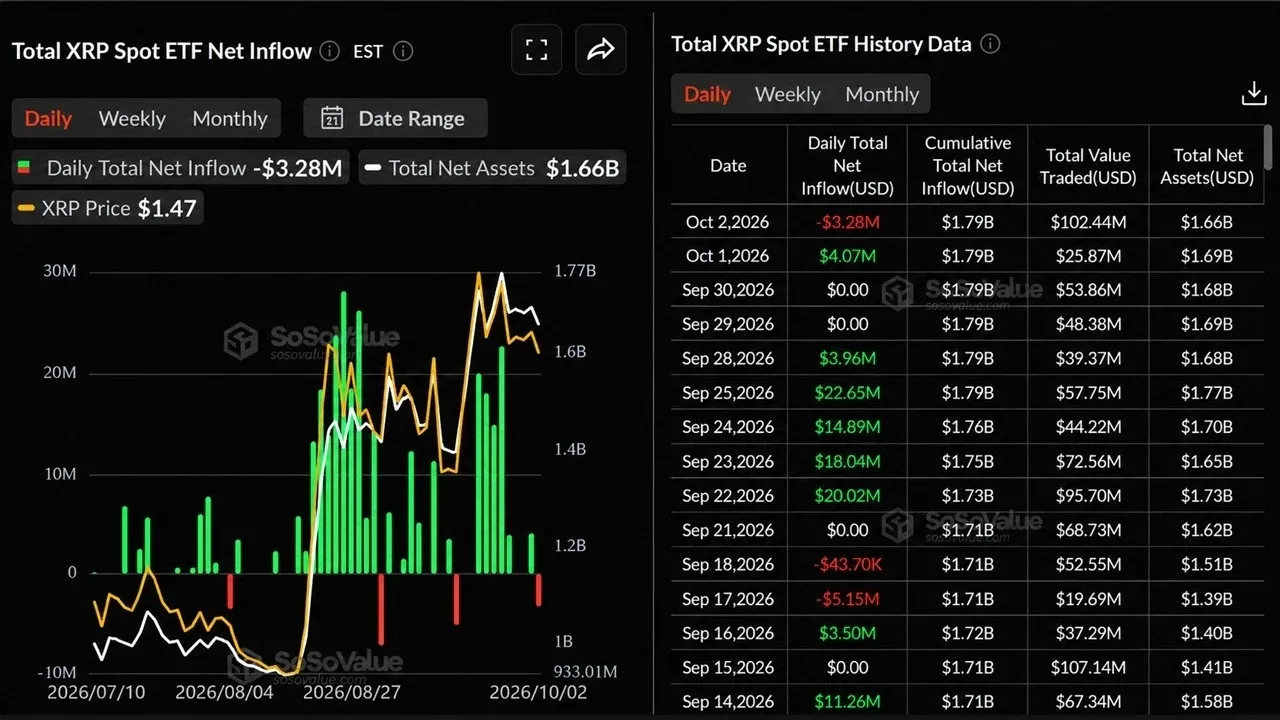
Spot XRP exchange-traded funds (ETFs) logged a $3.28 million net outflow on Oct. 2, all from Bitwise, while their combined assets dropped about $37 million.  Key TakeawaysBitwises XRP fund was the only mover on Oct. 2, shedding $3.28 million while rivals sat flat.XRP ETF net assets slid to $1.66 billion, about $133 million below $1.791 billion in lifetime inflows.XRP fell as low as $1.44 before recovering while BTC dropped from $87,220 to around $84,500.  The Breakdown  According to Sosovalue data, U.S. spot XRP ETFs ended Oct. 2 with total net assets of $1.658 billion. One session earlier, on Oct. 1, that figure was $1.695 billion, so roughly $37 million disappeared from the scoreboard while only $3.28 million actually walked out.  The rest came from the token itself, as XRP traded as high as $1.55 on Oct. 2 before dropping to $1.44 during the late U.S. session. The token is now trading between $1.47 and $1.49.  In terms of who sold, only the Bitwise XRP ETF (trading under the ticker XRP) accounted for the full $3.28 million outflow, and the rest of the field netted zero that day. Bitwise is still the category‘s biggest magnet by cumulative inflows at about $677 million, ahead of Franklin Templeton’s

Within 1 weeksIndustry

Bitcoin reaches for $87K as short liquidations top $120M

Bitcoin (BTC) neared $87,000 on Friday as BTC short liquidations topped $120 million over 24 hours.  Key points:Bitcoin broke through sell orders around $85,000, reaching its highest price since Sept. 23 at $86,857.CoinGlasss heatmap showed a cluster of potential liquidations above $87,000 following the breakout.Glassnode analysis said that more robust Bitcoin ETF inflows would help confirm broader support for the BTC price uptrend.  Bitcoin buyers battle liquidity walls below $87,000  Data from TradingView showed BTC/USD reaching $86,857 on Bitstamp before pulling back below $86,000.  BTC/USD four-hour chart. Source: Cointelegraph/TradingView  The move, which marked Bitcoins highest since Sept. 23, followed fresh fluctuations in exchange order-book liquidity. A concentration of sell orders around $85,000 had kept price action rangebound through the week, but buyers broke through that barrier, per data from onchain analytics platform Glassnode.  “With reduced ask liquidity above, this should allow price to move up faster,” it wrote on X, adding that the remaining sell orders “seem to have been removed.”  BTC/USDT order-book heatmap (Binance). Source: Glassnode  Earlier in the week, Cointelegraph reported that more than $30 million in sell orders had appeared around $85,700. Data from CoinGlass showed a cluster of potential liquidations above $87,300 following the initial breakout, suggesting that liquidation exposure was concentrating at higher

Within 1 weeksIndustry

Trump is expected to appoint Jay Clayton as new AI czar: Reports

President Donald Trump is expected to appoint Jay Clayton, US director of national intelligence, as the new AI czar, CNN and other media reported Friday, citing unidentified sources.  Cointelegraph reported Sept. 20 that Trump planned to create an “AI Force” modeled after the Space Force and appoint an artificial intelligence czar. The president posted on Truth Social that his new project would manage the fast-growing AI sector without adding regulations that could slow innovation.  Trumps actions followed several public warnings about the potential dangers of AI.  Cointelegraph reported on Sept. 12 that Anthropic CEO Dario Amodei had written a three-step proposal to pace the speed of AI development that if left unchecked, might “outrun our ability to understand and control these systems.”  Anthropic chief urges slowdown in AI development to safer pace  Subsequently, Anthropic said it had chosen Accenture as an embedded evaluator to help moderate the pace of AI development, moving ahead with the first step outlined in Amodeis proposal, Cointelegraph said.  OpenAI CEO Sam Altman and SpaceX CEO Elon Musk responded positively to Amodeis proposal, although Nvidia CEO Jensen Huang did not, arguing that such regulation was not necessary.  On Tuesday, Trump gathered AI and technology chiefs at the White House to sign a new

Within 1 weeksIndustry

Plunging GPU prices threaten AI hosts, and new hedges step in

Companies building AI applications can rent powerful computers instead of buying the equipment themselves, paying for access to the graphics processing units, or GPUs, that run their software.  Related Asset Bitcoin #1 BTC · $84,851.68 24-hour change: down 0.47% Loading price history… 24H Down 0.47% 7D Up 0.85% 30D Up 4.37%  Lower rental prices make those applications cheaper to operate, but they can also make life harder for the company that bought the machines and needs the rent to pay its debts.  If youve financed a room full of GPUs assuming customers will pay a certain hourly rate, a cheaper competitor can upset the calculation long before youve paid off the equipment. Your machines might still work perfectly, and demand for AI might still be strong, but the amount you earn from each hour could start falling below what the business needs.  Financial contracts could let you protect part of that income by arranging a payment when rental prices fall, in exchange for taking on your own obligations. Thats the basic idea behind AI compute derivatives, which let businesses trade their exposure to computing prices separately from renting the computers themselves.  Luxor, a company that provides services and financial products to Bitcoin miners, included these

Within 1 weeksIndustry
1
...
3234
...
1000