TD Bank Fined $3 Billion for Failing to Report Suspicious Cryptocurrency-Related Activities

On October 10, 2024, TD Bank was fined $1.8 billion by the U.S. Department of Justice and $1.3 billion by the Financial Crimes Enforcement Network (FinCEN), totaling $3.09 billion, for violations of the Bank Secrecy Act (BSA) and deficiencies in its anti-money laundering (AML) programs. This marks the largest fine ever under the BSA. TD Bank admitted to failing to meet its AML obligations, which led to significant illicit money flows, resulting in this substantial penalty after a nine-month investigation.Suspicious Transactions  FinCEN reported that TD Bank processed over 2,000 transactions for a company labeled as “Client Group C,” purportedly involved in financial and real estate sales. Client Group C falsely claimed its annual sales wouldnt exceed $1 million, but it transacted over $1 billion through TD Bank. Notably, 90% of the funds came from UK-based cryptocurrency exchanges and were transferred to digital asset providers in Colombia, involving high-risk sectors and countries. Despite numerous suspicious transactions and red flags, TD Bank failed to report this activity until multiple law enforcement inquiries regarding Client Group C were raised.Significant Crypto Sector Penalties  This case is not isolated. In 2022, Kraken was fined $30 million by the U.S. Securities and Exchange Commission (SEC) for not registering
2024-10-15Deep Dive

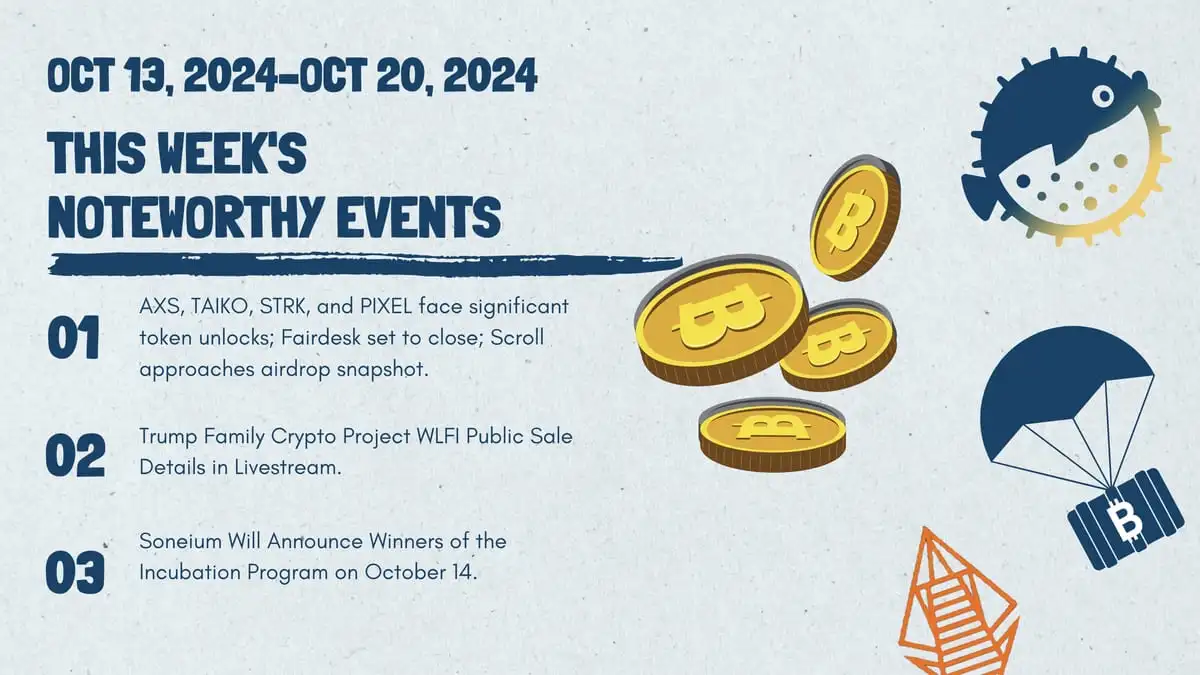
This Week's Noteworthy Events(Oct 13, 2024–Oct 20, 2024)

Token Unlocks  Axie Infinity (AXS) will unlock approximately 9.25 million tokens on October 14 at 13:10 UTC, accounting for 6.08% of its circulating supply, valued at around $43.1 million.  Taiko (TAIKO) will unlock around 12 million tokens on October 14 at 00:00 UTC, making up 14.99% of the circulating supply, with a value of approximately $18.7 million.  CYBER (CYBER) will unlock approximately 890,000 tokens on October 14 at 08:00 UTC, representing 3.81% of the circulating supply, valued at approximately $2.6 million.  Starknet (STRK) will unlock around 64 million tokens on October 15 at 00:00 UTC, representing 3.3% of the circulating supply, with an estimated value of $26 million.  ApeCoin (APE) will unlock approximately 15.6 million tokens on October 17 at 12:30 UTC, accounting for 2.31% of the circulating supply, valued at around $11.2 million.  Echelon Prime (PRIME) will unlock 750,000 tokens on October 17 at 00:00 UTC, representing 1.57% of the circulating supply, with a value of approximately $6.1 million.  Pixels (PIXEL) will unlock around 54.38 million tokens on October 19 at 10:00 UTC, making up 7.05% of the circulating supply, valued at approximately $7.2 million.Trump Family Crypto Project WLFI Public Sale Details in Livestream  The Trump familys crypto project, World Liberty Financial (WLFI), will hold a livestream

2024-10-14Deep Dive

WikiBit Industry Insight: Multiple Institutions Release Crypto Industry Reports

Market Observations  Decline in Primary Market Financing  The primary market remains pessimistic. According to RootData, in Q3 2024, Web3 primary market funding activities declined. There were 321 financing rounds, down 25.7% from the previous quarter, with total funding amounting to $2.406 billion, a 15% decrease from the prior quarter. Venture capital transaction activity (measured by monthly deal count) fell to the lowest in four years.  Security Incidents  The blockchain sector continues to face severe security challenges. According to Certiks Q3 security report, there were 155 security incidents during this period, with total losses amounting to $753.09 million. Although the number of incidents decreased by 27 compared to Q2 2024, the total loss increased by 9.5%.  Industry Challenges  The issue of high token valuations and low initial circulation ratios has been a subject of intense debate since its introduction. Binance, in its latest industry observation report, again mentioned the problem of overvaluation in primary market projects. Additionally, the report highlighted that projects still have significant room for improvement in transparency, centralization, and token distribution during their operations.  Market Share of Centralized Exchanges  According to CCData, overall trading volume in the crypto sector in September fell to its lowest level since June. Last month, Binances combined market share for spot

2024-10-12Deep Dive

Certik Releases Q3 Security Report for the Web3 Industry

The blockchain industry continued to face significant security challenges in the third quarter of 2024. According to Certiks Q3 Security Report, there were 155 security incidents during this period, resulting in total losses of $753.09 million. Compared to Q2 2024, although the number of incidents decreased by 27, the amount of losses increased by 9.5%. These figures indicate that while the frequency of security incidents has decreased, the average loss per incident has risen, reflecting the increasing complexity and sophistication of attack methods. Large-scale phishing attacks and private key leaks, in particular, have caused substantial losses for users and businesses, raising widespread concerns within the industry regarding security issues.Analysis of Security Incident Types and On-Chain Distribution  In the third quarter, phishing attacks were the most prevalent, involving 65 incidents and causing approximately $343.09 million in losses. These attacks often exploit user negligence, impersonating legitimate websites or wallets to steal users private keys and sensitive information. Additionally, private key leaks represented another significant threat, resulting in $324.4 million in losses from just 10 incidents, each with considerable financial damage, highlighting their high destructive potential. Besides these primary types, other attack methods, including smart contract exploits and exchange hacks, also impacted the market

2024-10-11Deep Dive

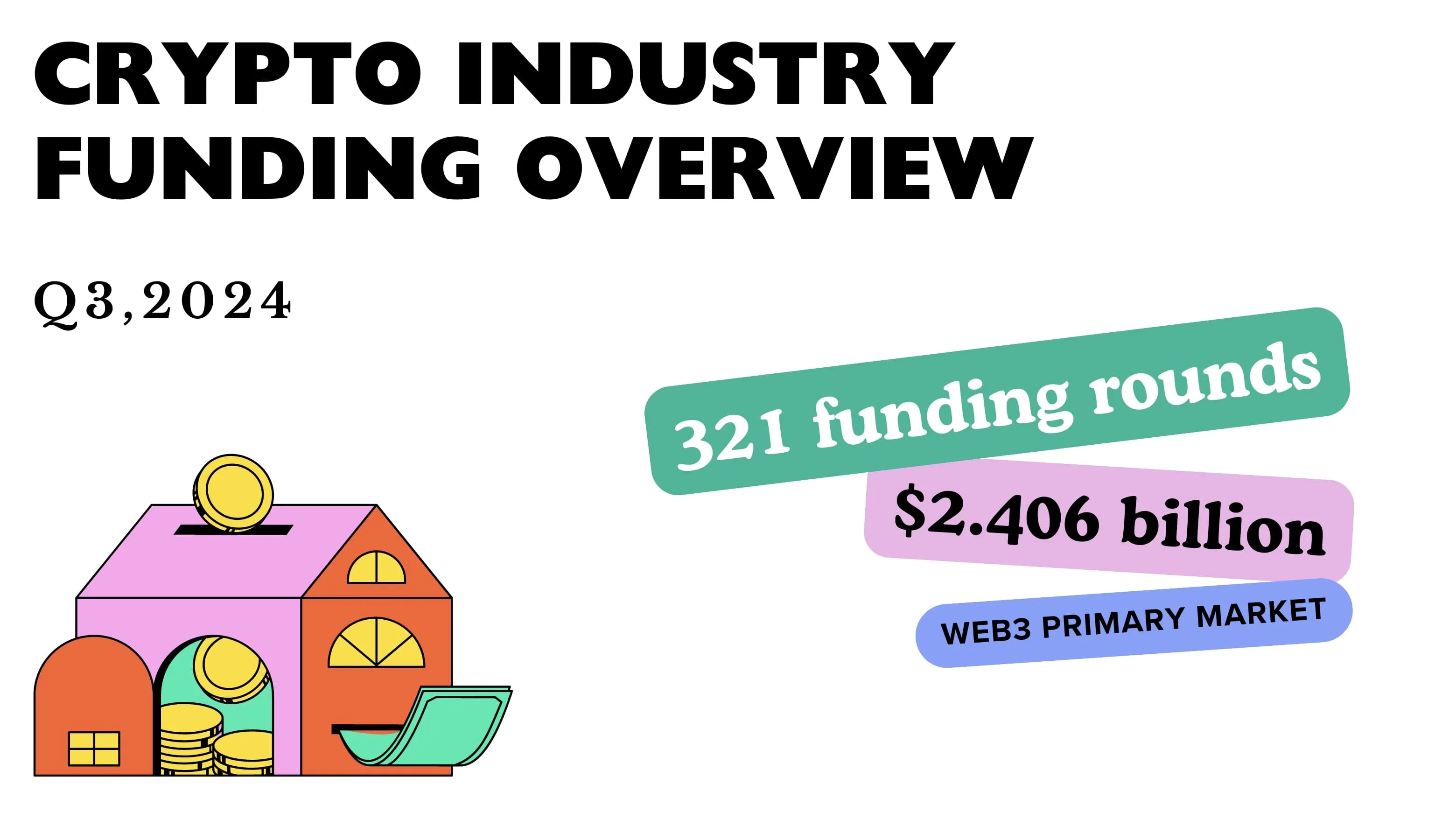
Q3 2024 Crypto Industry Funding Overview

Overall Situation  According to data from RootData, Q3 2024 showed a downward trend in Web3 primary market funding activities. The quarter saw 321 funding rounds, a decrease of 25.7% from the previous quarter, with a total funding amount of $2.406 billion, down 15.0% compared to the last quarter.  The infrastructure sector continued to lead, with total funding of $745 million, accounting for 30.9%. Notably, the “Others” category (excluding infrastructure, DeFi, NFT, gaming, CeFi, DAO, social, and tools) reached a total funding amount of $453 million, making up 18.8% of the total. This trend was driven by several factors, including the sustained popularity of the Meme sector this quarter, the rise of AI-Web3 integration projects, and the continuous expansion of DePin and the Bitcoin ecosystem. Investors and the market are seeking new narratives and innovation.  The largest single funding round this quarter came from Bitcoin mining company Iris Energy, raising $413 million. Notably, among the top 10 funding projects, M&A transactions accounted for a total of $681 million, making up 57.5% of the total.Investment Institutions  Robot Ventures was the most active investor this quarter, with 22 investments. Among the 12 institutions that made more than 10 investments, infrastructure remained the most favored sector, with DeFi-related

2024-10-10Deep Dive

FTX Reorganization Plan Approved, Creditors May Receive Compensation Before Year-End

On October 7, 2024, FTX Trading Ltd. (operating as FTX.com) and its affiliate debtors announced that the U.S. Bankruptcy Court for the District of Delaware confirmed their reorganization plan, less than two years after their historic bankruptcy filing.Asset Value  In filings on May 8, FTX reported that since filing for bankruptcy, they have recovered and liquidated assets valued between $14.5 billion and $16.3 billion. Under the reorganization plan, approximately 98% of creditors will receive around 119% of their approved claims within 60 days after the plan becomes effective, subject to KYC requirements. The distribution includes assets managed by FTXs Chapter 11 debtors and various partners like FTX Digital Markets, Ltd. (Bahamas) and FTX Australia.  Read more on WikiBitPayment Timeline  With the plans approval, FTX aims to compensate 98% of users within 60 days post-activation of the plan. While the plan is approved, the effective date is not yet determined. FTX creditor Mr. Purple has suggested two timelines: an activation on October 31, potentially allowing payments before year-end, or delays extending payments to early 2025 due to the reserve fund motion expected in November or December.Impact on FTT  Following the plans approval, FTT surged past $3.4, reaching a peak of $3.43 before stabilizing at $2.49.Broader

2024-10-08Deep Dive

IcomTech Founder David Carmona Sentenced to 10 Years for Cryptocurrency Ponzi Scheme

IcomTech founder David Carmona was sentenced to close to 10 years in prison after prosecutors called the firm a crypto Ponzi scheme and said he “preyed upon working-class people.”  Carmona, 41, was sentenced on Friday to 121 months in prison by U.S. District Judge Jennifer L. Rochon, according to a statement released by the U.S. Attorneys Office for the Southern District of New York. Carmona previously pleaded guilty to one count of conspiracy to commit wire fraud.  Carmona started IcomTech in 2018 along with others and said it was a crypto mining and trading company. The firm promised to garner profits for investors if they bought certain “purported cryptocurrency-related investment products,” prosecutors said. That didnt happen. Instead, prosecutors say IcomTech did not participate in mining or trading for its investors and instead used the money to pay other investors and to use for themselves.  “David Carmona masterminded the IcomTech cryptocurrency Ponzi scheme, which preyed upon working-class people by promising them complete financial freedom in exchange for parting with their hard-earned money,” said U.S. Attorney Damian Williams in a statement.  Carmona and others “hosted lavish expos,” tried to get people interested in investing and bragged about how much money they were earning, prosecutors said.  “IcomTech promoters

2024-10-06Deep Dive

Diamante—A Quantum-Resistant Layer 1 Hybrid Blockchain

Diamante is an innovative blockchain project that employs a hybrid consensus mechanism combining Delegated Proof of Stake (DPoS), Asynchronous Byzantine Fault Tolerance (aBFT), and Proof of History (PoH) to enhance transaction efficiency and network security.  In light of the potential threat posed by quantum computing, which could break traditional encryption algorithms used in existing blockchains, Diamante integrates quantum-resistant cryptographic algorithms. This approach aims to future-proof the network, ensuring long-term security against quantum attacks. Diamantes vision is to create a secure, quantum-resistant network that supports decentralized applications and drives innovation in the digital economy.Blockchain DesignThree-Layer Consensus Mechanism  Diamantes triple-layer consensus mechanism integrates DPoS, aBFT, and PoH, each bringing its own strengths and weaknesses:  Diamante combines the strengths of each consensus algorithm, ensuring a balance between speed, security, and efficiency. DPoS enables fast block creation, aBFT ensures fault tolerance in malicious environments, and PoH reduces overhead on the consensus process, collectively boosting network performance and resilience.Quantum-Resistant Encryption Algorithms  The crypto industry has long been concerned about quantum attacks, primarily targeting blockchain encryption algorithms, especially digital signatures and key encapsulation mechanisms.  Current blockchain encryption methods are vulnerable to quantum attacks due to their reliance on traditional public key cryptography, such as the Elliptic Curve Digital Signature Algorithm (ECDSA)

2024-09-30Deep Dive

Hong Kong Launches Second Phase of e-HKD Pilot, Exploring Innovative Use Cases for e-HKD

On September 23, the Hong Kong Monetary Authority (HKMA) officially announced the launch of the second phase of the “e-HKD” pilot program, further exploring innovative use cases of the digital currency for individuals and businesses.  The trial from the first phase indicated that “e-HKD” could provide unique value to Hong Kongs existing payment ecosystem in three areas: programmability, tokenization, and real-time settlement. “e-HKD” has the potential to facilitate faster, more cost-effective, and inclusive transactions while fostering new types of economic activities.  In its statement, the HKMA mentioned that the project has been renamed from the “e-HKD Plan” to the “e-HKD+ Plan.” The second phase of the “e-HKD” pilot will conduct a more comprehensive exploration of the digital currency ecosystem.  The second phase aims to explore innovative use cases for the e-HKD and tokenized deposits around three main themes: tokenized asset settlement, programmability, and offline payments. The HKMA has selected 11 companies from various industries to participate, including the Bank of China, Hang Seng Bank, HSBC, Aptos Labs, and Visa. Over the next 12 months, the HKMA will work closely with these companies, with plans to share the key outcomes of the second phase with the public by the end of 2025.  The findings from

2024-09-25Deep Dive
1
...
1416
...
743