What Are Mention Markets and Why Is the CFTC Targeting Them?

Commodity Futures Trading Commission (CFTC) staff told exchanges on September 22 that mention markets may be presumptively open to manipulation. Exchanges are expected to address four factors to list them, but no ban followed.  Mention markets are yes-or-no contracts on whether a person says a word during a speech, earnings call, or social post. Consequently, the outcome can rest in the speakers hands.  Sponsored  Sponsored  Why Does the CFTC Presume Mention Markets Can Be Manipulated?  The agencys Division of Market Oversight (DMO) addressed the advisory to designated contract markets (DCMs), which are CFTC-registered exchanges.  Core Principle 3 of the Commodity Exchange Act bars exchanges from listing contracts readily susceptible to manipulation.  A CFTC release on Mention Markets: Image Source: CFTC  Most prediction market event contracts settle on outcomes no single person controls, such as election results or economic data releases.  A mention contract, by contrast, settles on one persons conduct. That person, or someone close to them, may sway the result or learn it early.  The CFTCs label also covers contracts on event attendance and interactions such as handshakes.  Sponsored  Sponsored  For example, the advisory cites a livestreamed podcast host and a catchphrase. A trader could tilt the outcome by paying for a shout-out.  In practice, the risk has materialized once already. On August
1 ہفتوں کے اندرانڈسٹری

Stablecoins can drain from banks and nations at lightning speed

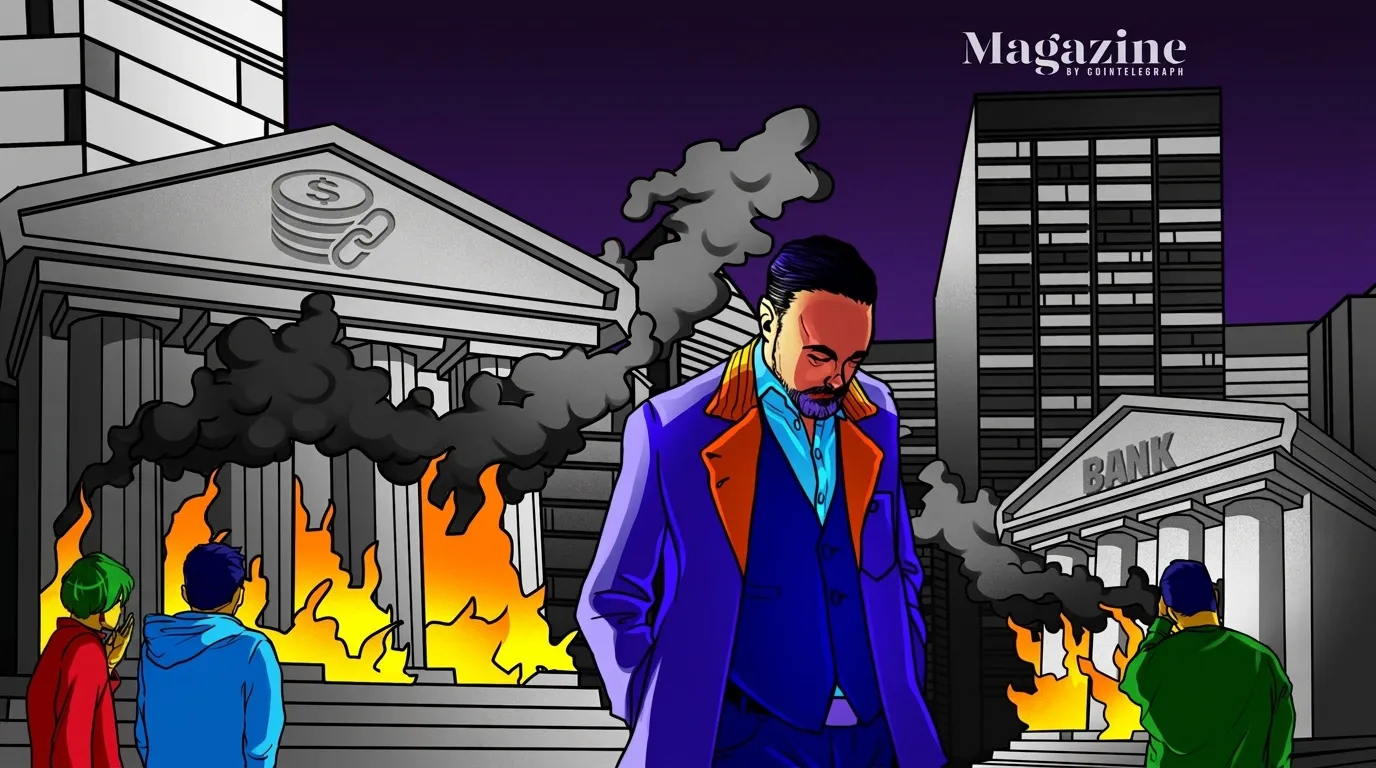
Anyone whos ever sent a bank transfer overseas is familiar with the painful process of waiting for things like working hours, correspondent banks and settlement times.  In many cases, it would be faster, cheaper and just more efficient to strap the physical cash to a homing pigeon, or slap it in an envelope and send it via DHL.  Stablecoins can move money across borders around the clock, without waiting for the legacy system to fire up its steam engines.  They can settle transactions 24/7, cut out layers of intermediaries and give people access to digital dollars without even needing a traditional bank account.  So do we even need banks any more? And what are the ramifications of stablecoins offering a faster, cheaper and easier way to move money?  The two clocks  Anthony Vassallo, director of crypto at Silicon Valley Bank, which failed in March 2023 and now operates as a division of First Citizens Bank, tells Magazine competition from stablecoins will show up across two time frames:  “Two clocks matter. One is slow: currency substitution, deposit erosion, and weakening policy transmission building over months or years. One is fast: a depeg, issuer shock, or banking event that can move capital at software speed within hours.”  The European Central

1 ہفتوں کے اندرانڈسٹری

Ethereums zkAPI brings privacy-preserving API payments to mainnet

The Ethereum Foundation announced on Thursday that zkAPI, a system built with the Open Anonymity Project to let users pay for AI and other API services without revealing their billing identities, has gone live on Ethereum mainnet.  Users deposit funds into an Ethereum vault, then use zero-knowledge proofs to prove they have enough credit to pay for API requests without revealing which deposits are theirs, according to a post from Vittorio Rivabella, AI coordinator at the Ethereum Foundations dAI team.  One of the immediate use cases of the system is paying for the use of AI without linking the payment to a user. zkAPI issues short-lived API keys with predefined spending limits. Prompts are sent directly to the AI provider, while usage is settled separately through the payment layer. The project has also released a local client and software development kit, along with a browser-based AI chat implementation.  The launch follows a February proposal by Ethereum Foundation researcher Davide Crapis and Ethereum co-founder Vitalik Buterin for ZK-based API usage credits. The new release turns that design into a working mainnet implementation.  The concept was presented as a way to give users private, prepaid access to AI and other metered APIs. However, zkAPI does not

1 ہفتوں کے اندرانڈسٹری

PropAMMs lower Solana trade costs, and public pool returns crash

A trader can get a better Solana (SOL) swap price while a passive pool depositor remains exposed to traders picking off stale quotes, and a Sept. 29 preprint measures that divide.  Related Asset Solana #7 SOL · $120.25 24-hour change: up 1.65% Loading price history… 24H Up 1.65% 7D Up 3.05% 30D Up 19.93%  For quiet-market SOL/USDC fills, propAMMs, pools controlled by professional operators, had a reference-relative execution cost proxy of 0.26 basis points versus 2.59 for public automated market makers (AMMs).  The study covers Sept. 1, 2025, through Aug. 31, 2026, with shorter Base and Monad samples. It weights fills by notional against Bybits size-weighted top-of-book USDT microprice, converted with its USDC/USDT midpoint. Its authors list ETH Zurich and Category Labs affiliations.  Related Asset USDC USDC · Stablecoin  A swapper wants more tokens for the same input, while a depositor supplies the inventory others trade against and needs compensation for the risks that inventory carries. Low execution cost can attract the first participant without being a sufficient investment case for the second.  Related Company Bybit Cryptocurrency derivatives exchange  Swap prices and depositor returns on Solana  Across its Solana sample, the paper reports two-second gross maker markouts of +0.37 basis points for propAMMs and −0.22 for public AMMs.

1 ہفتوں کے اندرانڈسٹری

Tokenized assets dont always mirror traditional markets, Dune finds

Tokenized markets show different trading and investment patterns from traditional markets, according to a new Dune report comparing onchain and off-chain activity across equities, credit, commodities and cash-equivalent products.  Dune found the difference pronounced in equities, where single stocks accounted for 81% of tokenized equity spot supply while exchange-traded funds (ETFs) made up 19%.  Armand Khatri, head of ecosystem at Ondo Finance, said tokenization gives investors more control over asset selection by reducing their dependence on local intermediaries offerings.  “The investor decides which they want,” he said, referring to the choice between single-company and index exposure.  Dune put the value of tokenized real-world assets at $34.5 billion as of Aug. 31, up more than 140% from a year earlier, with cash equivalents still dominating supply while equities were the most actively traded segment.  Related: Base completes Cobalt upgrade, adds new tools for tokenized assets  Tokenized equities remain a fraction of global markets  Separate Binance Research data cited by Binance co-CEO Richard Teng put the tokenized equity market at $4.43 billion as of Sept. 15, up 390% in 2026 but equivalent to just 0.0029% of the $151.9 trillion global listed-equity market.  Binance Research projected tokenized equities could reach about $349 billion by 2030 under its base-case scenario. Teng said

1 ہفتوں کے اندرانڈسٹری

Bitget restores $300M fund after absorbing $388M security breach

Bitget said on Sept. 30 that it had restored its Protection Fund to more than $300 million after absorbing the Sept. 24 security breachs financial impact. The exchange describes the fund as an additional safeguard for customers, separate from reserves backing their account balances.  In its announcement, Bitget says the fund absorbed approximately $388 million in impact from the incident, while customer balances remained accurate and unaffected. It says it fulfilled a Sept. 28 pledge to bring the fund back to at least $300 million within a week, completing the replenishment two days after that commitment.  The release does not quantify the new capital contributed, and Bitgets fund page says its displayed valuation uses prices at midnight UTC each day.  Related Company Bitget Trading platform for crypto products  What the restored backstop covers  Under Bitgets published fund conditions, users may submit claims when accounts are compromised, or assets are stolen or lost through platform-wide events not attributable to their own actions or trading behavior.  The exchange retains the right to assess claims and investigate affected accounts or assets, with outcomes subject to its findings.  Eligibility to submit a claim does not guarantee reimbursement of a particular loss. The reported replenishment does not remove that assessment process or

1 ہفتوں کے اندرانڈسٹری

Bitcoin trapped below $86K as PCE changes cloud inflation reading

Bitcoin (BTC) held above $83,000 on Thursday after giving back gains following lower-than-expected US inflation data.  Key points:Bitcoin remained rangebound after its latest rally stalled at $85,600.US PCE inflation data came in lower than expected at 3.4% year-on-year, but methodology changes complicated the reading.BTC-denominated open interest fell almost 20% while its price rose 35% from its August low.  Bitcoin gives back gains after PCE release  Data from Coinbase showed BTC/USD flat on the day after a brief bout of volatility ahead of Septembers monthly and third-quarter close.BTC/USD one-hour chart. Source: Cointelegraph/TradingView  Bitcoin began Q4, historically its strongest quarter, at around $83,550, after posting third-quarter gains of 42.7%, according to data from CoinGlass — its best Q3 performance since 2017.BTC/USD quarterly returns (screenshot). Source: CoinGlass  CoinGlass‘s liquidation heatmap showed potential liquidation clusters above and below Bitcoin’s market price.  On Thursday, a new $60 million cluster of estimated liquidation exposure appeared near $83,000, close to key support at $82,500 — a level that analysis marked as critical for Bitcoins broader rebound from June lows.BTC liquidation heatmap. Source: CoinGlass  Bitcoin‘s latest rally stalled Wednesday, with BTC/USD reversing at $85,600. The advance followed a lower-than-expected US inflation reading. The Personal Consumption Expenditures (PCE) price index, the Federal Reserve’s preferred inflation gauge,

1 ہفتوں کے اندرانڈسٹری

SEC moves to clear custody hurdle for advisers offering crypto

The US securities regulator has proposed easing rules governing how investment advisers and funds hold crypto, potentially clearing a regulatory hurdle that has held some businesses back from offering clients digital asset investments.  The proposal, published on Thursday, would let investment advisers hold clients crypto assets themselves when no eligible crypto custodian is available, with conditions. It would also allow state trust companies to serve as crypto custodians.  “The crypto asset market has grown from a niche curiosity into a multi-trillion-dollar asset class to which investors actively seek exposure. Unfortunately, our rules and regulations have not kept pace,” US Securities and Exchange Commission Chair Paul Atkins said in a statement.  The proposal targets a practical barrier to crypto investment: investment advisers can struggle to find a qualified custodian for a particular token, limiting the investments they can offer clients.  The Digital Chamber has previously raised concerns about the lack of qualified crypto custodians. In a May 2025 submission to the SEC, the Digital Chamber said some advisers had declined token allocations or asked portfolio companies to retain them until custody became available.  In a statement on Thursday, SEC Commissioner Hester Peirce likened the uncertainty to a regulatory “roller coaster,” saying advisers have been “gritting their

1 ہفتوں کے اندرانڈسٹری

US Treasury Buys $6 Billion of Bonds as Bitcoin Battles 24-Year-High Yields

The US Treasury used its full $6 billion limit in Thursdays bond buyback, retiring older long-term debt early. The move came as the 10-year Treasury yield touched 5.342%, its highest since April 2002.  A yield is the return investors demand to lend to the government. When it climbs, mortgages, business loans, and federal borrowing all cost more, and Bitcoin (BTC) has struggled to hold its gains.  Sponsored  Sponsored  Bitcoin Price Performance and US Treasury Yields. Source: TradingViewWhat Did Treasury Actually Buy in Its $6 Billion Bond Buyback?  In a buyback, the government repays some of its bonds before they mature.  Investors offered $46.4 billion of bonds, according to Treasurys results. Treasury took $6 billion, spread across just two of 41 eligible bonds.  Both pay low interest and mature in 2041 and 2042. Treasury paid about $67 and $76 for every $100 of face value.  At those prices, retiring $6 billion of debt cost roughly $4.47 billion in cash.  BREAKING: ???????? The US Treasury just bought back $6 billion in long term bonds today. pic.twitter.com/0cGO0RYZUO  — Bull Theory (@BullTheoryio) October 1, 2026  Recent operations fell short of the cap, Reuters reported. That sparked debate over whether the program supports trading or targets cheap pandemic-era bonds.  Sponsored  Sponsored  Why Yields Keep Climbing Despite Bigger Treasury Buybacks  Treasury

1 ہفتوں کے اندرانڈسٹری

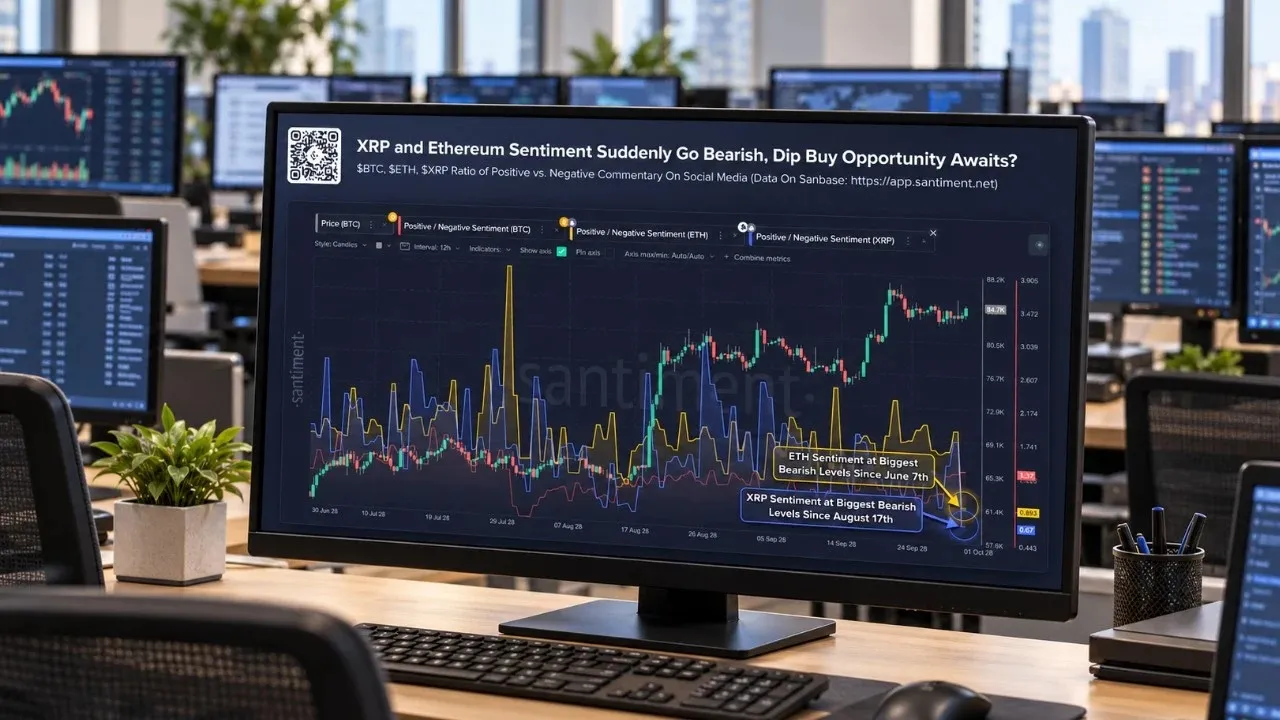
XRP Sentiment Turns Bearish as Bullish-to-Bearish Ratio Hits 0.67

XRP social sentiment has fallen to its lowest level since August, with bearish comments outnumbering bullish discussion as October begins. Santiment views the pessimism as a potential contrarian setup, while cautioning that an immediate rebound is not guaranteed.  Key TakeawaysXRPs bullish-to-bearish commentary ratio fell to 0.67.The tokens sentiment reading was its weakest since Aug. 17.The tracked discussions span X, Reddit, Telegram, and other communities.  XRP Pessimism Reaches Its Strongest Level Since Aug. 17  XRP, the XRP Ledgers native token, entered October with its most negative balance of social discussion since Aug. 17. The crypto analytics firm Santiment shared its Ethereum and XRP sentiment readings on X on Oct. 1, writing:  “Ethereum and XRP sentiment has suddenly turned very negative to kick off October.”  “Ethereum and XRP sentiment has suddenly turned very negative to kick off October.”  The XRP ratio stood at 0.67 bullish comments for every bearish comment, equivalent to about 67 optimistic remarks for every 100 pessimistic ones. Bullish language anticipates rising prices, while bearish comments express expectations of declines. Santiment stated: “A ratio below 1.0 means negative commentary is the MAJORITY across X, Reddit, Telegram, and other crypto communities.”  The token‘s reading was weaker than the 0.89 ratio for ether, Ethereum’s native cryptocurrency. ETH sentiment

1 ہفتوں کے اندرانڈسٹری
1
...
4850
...
1000