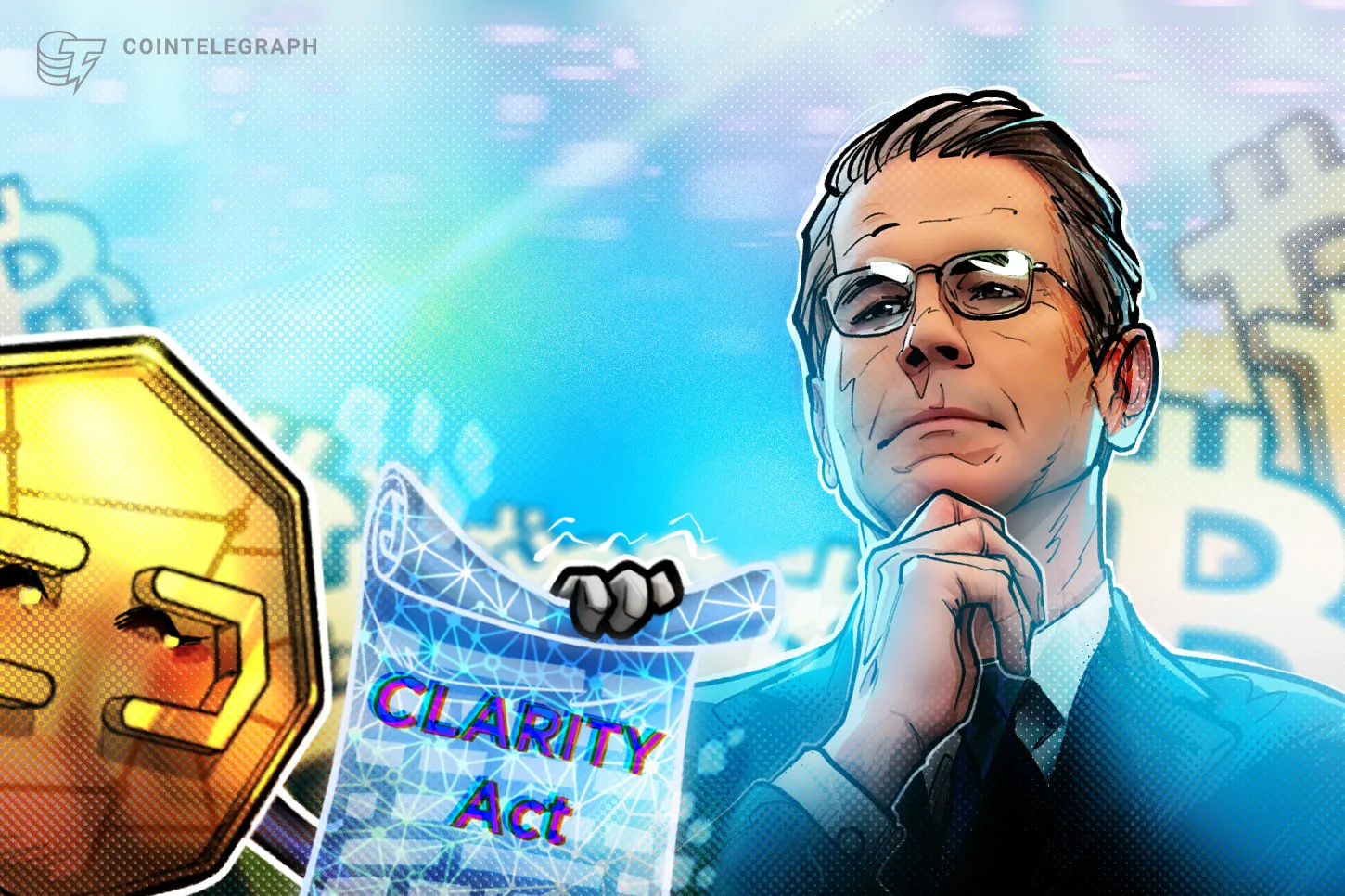
Treasury Secretary Bessent urges CLARITY Act passage after Senate returns

US Treasury Secretary Scott Bessent urged lawmakers to pass the Digital Asset Market Clarity (CLARITY) Act when the Senate returns from its August recess next week.  “I strongly urge everyone to remain at the negotiating table, agree to the motion to proceed, and continue the legislative process,” wrote Bessent in a Wednesday X post, warning that failing to pass the bill would send a “troubling signal” about Americas leadership in the digital asset industry.  The Senate is scheduled to return from its August recess next Monday, according to its legislative schedule. The CLARITY Act seeks to establish the first comprehensive regulatory framework for digital assets in the US.  The remarks come a week after the National Sheriffs Association dropped its opposition to the crypto market structure bill on Sept. 3, changing its position on the bill to “neutral.”  Galaxy has reduced its odds on the CLARITY Act‘s passing in 2026 several times over recent months. Now at 10%, that’s down from 75% set on May 22.  While the CLARITY Act cleared the Senate Banking Committee in May, most Democrats and the banking industry pushed back, arguing that it would allow crypto firms to offer yields on stablecoins without facing the same requirements as banks.

09-10Industry

Is MemeToro a scam? Key accusations about the project and $MT presale examined

MemeToro is another speculative memecoin and prediction-market project wrapped in an AI narrative. Its trust scores sit between just 25% and 50% across automated website-checking platforms. The smart contracts meant to handle MemeToro‘s future funding rounds and token launches haven’t been audited yet. MemeToros favorable media coverage has been distributed as paid PR.  That, more or less, is the case a handful of websites are making against MemeToro. At first glance, it can leave the project looking far more questionable than the full picture suggests.  At the same time, MemeToro has also been covered over the past few months by names like CoinGape, Invezz, Business Insider and many more, without the project being treated there as fraud.  Much of that attention has focused on its AI Agent, which is being built to scan trends, filter possible meme ideas, and make the reasoning behind future launches more transparent. Just as importantly, MemeToros development is open-source, with the framework already taking shape on GitHub and regular code updates that anyone can follow.  Theres an obvious irony in calling a project like this an outright scam without much stronger evidence. The claims are still worth checking, but against what MemeToro actually does, not just the headline.  What is

09-10Industry

Robinhood Chain Deep Dive: TradeFi + Crypto — Can It Replicate and Surpass the SOL and BSC Wealth Stories?

The next major wealth-creation narrative in the public-chain space may have officially shifted from SOL and BSC to Robinhood Chain.  Veteran crypto traders know that every crypto bull market tends to produce a blockchain that creates extraordinary wealth. Solana previously rode high-performance infrastructure and the Meme narrative, while BSC leveraged low fees and retail-user traffic, creating countless 100x and even 1,000x wealth stories.  Robinhood Chain, officially launched in July 2026, enters the market with the massive user base of a traditional brokerage and a new TradeFi + Crypto combination. It brings U.S. equities and real-world assets, DeFi, and Meme culture together on a single blockchain, seemingly following the path taken by SOL and BSC while attempting to break through the ceiling of traditional public-chain models and trigger a new wave of wealth creation.  From its launch on July 1 to today, just two months in, the chain has delivered numbers that have left the entire crypto market stunned:  Daily revenue has surpassed $4 million — roughly twice that of Hyperliquid and five to six times that of Tron and Solana. Daily fee revenue even briefly reached an all-time high of $6 million.  TVL has surpassed $1 billion, daily DEX trading volume is approaching $1 billion,

09-10Deep Dive

U.S. Treasury Secretary pushes for CLARITY Act passage as Senate returns from recess

U.S. Treasury Secretary Scott Bessent has urged senators to advance the CLARITY Act as lawmakers prepare to return from their August recess for a procedural vote that will test whether the crypto market structure bill has enough support to move forward.  Bessent, in a Wednesday post on X, called on lawmakers to stay in negotiations and support the motion to proceed, arguing that failure to move the legislation forward would send a “troubling signal” about U.S. leadership in digital assets.  In July, I called on the Senate to advance the Clarity Act — a bill to establish a comprehensive regulatory framework for digital assets and upgrade our ability to prevent bad actors from exploiting these critical technologies.  When the Senate returns from August recess, I…  — Treasury Secretary Scott Bessent (@SecScottBessent) September 9, 2026  “I strongly urge everyone to remain at the negotiating table, agree to the motion to proceed, and continue the legislative process,” Bessent wrote.  His intervention comes days before the Senate reconvenes on Sept. 14, with a cloture vote on the motion to proceed to the Digital Asset Market Clarity Act scheduled for Sept. 15. The procedural vote would not pass the legislation but would determine whether the Senate can move toward considering

09-10Industry

Bitcoin holds near $78K as markets confront the macro shocks they may have underpriced this week

Bitcoin needs the outcomes of the next macro events to be no worse than the assumptions already priced into rates, oil, and policy-probability markets.  Related Asset Bitcoin #1 BTC · $77,965.88 24-hour change: down 1.06% 24H Down 1.06% 7D Up 0.17% 30D Up 21.28%  Brent crude has moved above $100, the US 10-year Treasury yield was 4.80% on Sept. 8, and futures traders recently leaned toward another Federal Reserve rate hike. Yet Bitcoin remains above Glassnodes $76,600 True Market Mean and just below a dense set of cost-basis and liquidation levels.  The decisive test is what inflation, the Fed, the Bank of Japan, or the Strait of Hormuz would have to deliver to change the markets information set enough to push Bitcoin into a different regime.  Infographic maps Bitcoin thresholds from $86,000 to $62,000–$65,000 against priced-in macro conditions and potential CPI, Fed, oil and geopolitical surprises.Bitcoin is already inside the decision zone  Glassnodes Sept. 9 report identifies $83,000 to $86,000 as the overhead band where long-term-holder cost basis, modeled short-liquidation exposure and US spot exchange-traded fund break-even levels converge.  Over 1 million BTC was acquired in that range, and Glassnode also said the modeled short-liquidation shelf from $82,000 to $86,000 grew 21% after Aug. 19, while

09-10Industry

Arya.ag puts Indias $2B grain network onchain

Arya.ag has begun putting records connected to approximately $2 billion in stored crops on an Avalanche-based blockchain for agricultural lenders in India.  SummaryArya.ag has deployed an Avalanche-based ledger covering grain deposits, receipts and agricultural loan status records.The company holds around $2 billion in crops across its Indian warehouse network at present.Three major banks are joining Arya.ags dedicated blockchain, though their identities remain undisclosed for now.Arya.ag facilitates roughly $1.3 billion in annual loans and directly issues around $230 million itself.Tokenized records do not transfer grain ownership or guarantee faster approvals and cheaper credit access.  Reports on Sept. 10 said the system records grain deposits, electronic warehouse receipts and loan status, enabling authorized lenders to verify crops offered as collateral. Infosys co-founder Nandan Nilekani announced the project at the Global Fintech Festival in Mumbai.  ???????? INDIA is taking blockchain beyond crypto.  Arya(.)ag, one of Indias largest agricultural warehousing companies, is using Avalanche technology to put grain deposits, warehouse receipts and loan status onchain.  The scale is notable: around $2B worth of crops are held across… pic.twitter.com/UuFrU47MJB  — Wise Advice (@wiseadvicesumit) September 10, 2026  The $2 billion figure covers the estimated value of crops held across Arya.ags warehouse network. It does not represent the value of loans already recorded on

09-10Industry

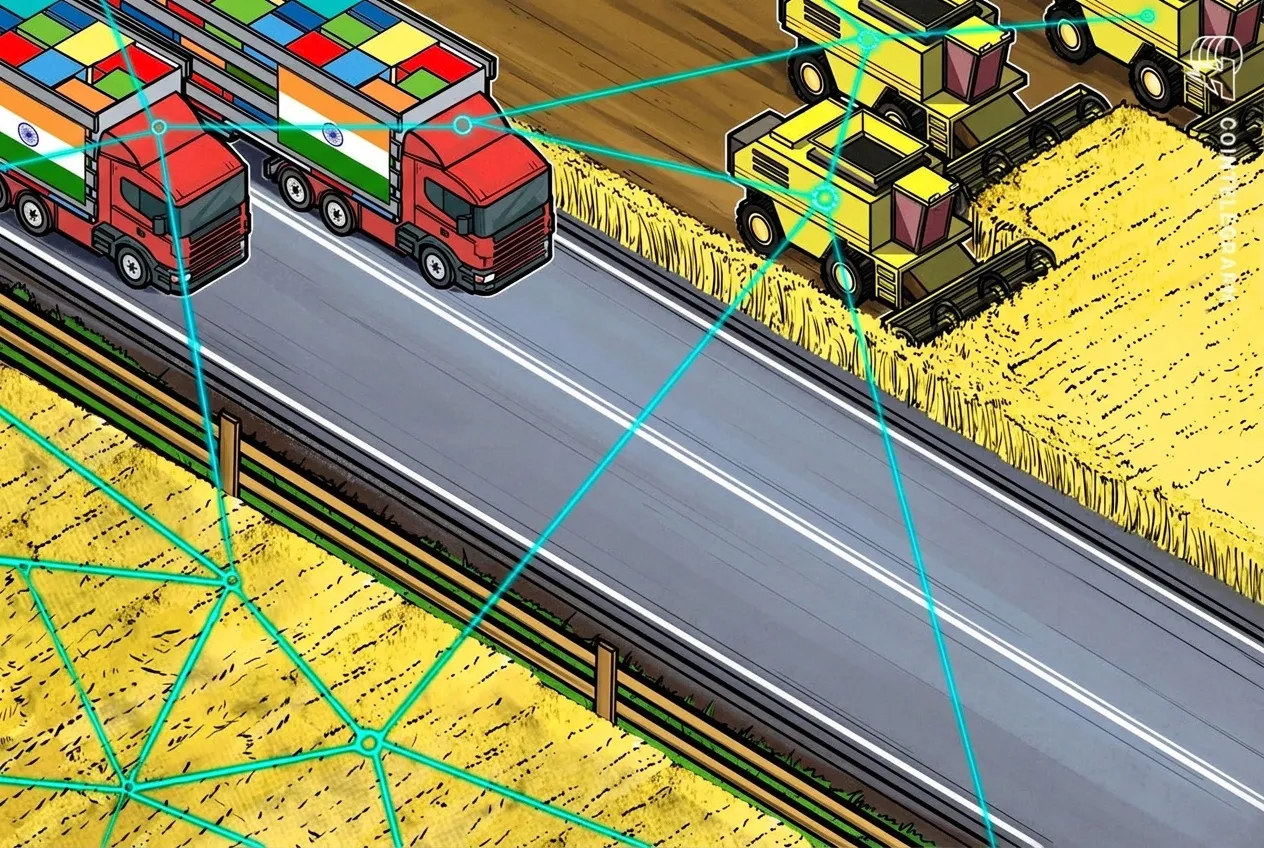
Indias Arya.ag to put grain ownership records on Avalanche

Indian agricultural warehousing and lending company Arya.ag is testing a system to tokenize warehouse receipts for stored grain on a dedicated Avalanche layer-1 blockchain.  Arya.ag is working with Finternet to connect grain deposits, warehouse receipts, collateral commitments and loan status through the network.  Devika Mittal, Ava Labs head of India, told Cointelegraph that testing was underway and said each tokenized receipt would represent ownership of the stored commodity. The companies did not disclose an expected launch date or how much grain or lending the initial deployment would cover.  Sanmesh Kalyanpur, a director at Finternet Labs, said Arya.ag‘s samplers collect information about stored grain and enter it into the company’s portal. Finternet will combine farmer, commodity, warehouse and insurance information into what Kalyanpur called a “composite token” that banks can use when assessing collateral risk.  Arya.ag stores about $2 billion in agricultural commodities across its warehouse network and supports approximately 120 billion Indian rupees (about $1.26 billion) in loans annually, according to the announcement. Its lending arm, Arya Dhan, issues about $230 million in loans each year.  The figures describe Arya.ags existing business and do not represent assets or loans already brought onchain.  Related: Pineapple Financial puts $1B in mortgage records on Injective  Finternet concept traces back to

09-10Industry

Bitcoin sell-side risk returns to rare lows as $80K sellers fade from view

Bitcoin (BTC) sell-side risk remains near historic lows as August profit-taking cools, new data shows.  Key points:Bitcoins sell-side risk ratio fell to seven from 16 in September, placing it among its lowest-ever readings.Selling pressure eased while Bitcoin held most of its 25% August gains.Bitcoin ETF investors have spent 229 sessions below their aggregate breakeven level near $86,000.  Bitcoin hodlers are “selling less” in September, Glassnode says  In the latest edition of Glassnodes The Week Onchain newsletter, the crypto analytics platform said Bitcoins sell-side risk ratio (SSRR) had reset lower.  Sell-side risk sums total onchain realized profits and losses and divides that figure by Bitcoins realized market cap. The result is a snapshot of the US dollar value realized over a given period relative to realized cap.  Glassnode describes lower values as signals of “macro market bottoms, accumulation phases and relatively low sell-side risk environments.”  SSRR reached 16 as Bitcoins price hit multimonth highs above $80,000 in late August. As of this week, however, the metric has more than halved to 7, one of the lowest readings on record.  Bitcoin SSRR data. Source: Glassnode  Glassnode said the August Bitcoin price rebound had “drawn little supply,” as measured by onchain activity.  “At the July 2025 and October 2025 highs the same

09-10Industry

Paolo Ardoino says 650 million people decentralized US debt, but Tether still controls the T-bills

Paolo Ardoino offered a striking answer to a familiar U.S. debt problem: replace concentrated foreign buyers with hundreds of millions of stablecoin users.  Related Asset Tether USDT · Stablecoin  In an Aug. 31 episode of The Wolf of All Streets, the Tether CEO said the company had created “the decentralized ownership of the US debt” through 650 million people who were “basically holding some US Treasuries.” His point was about concentration risk. Unlike a foreign government, hundreds of millions of users are unlikely to decide together to sell U.S. debt in a single morning.  The macroeconomic intuition has force. Demand for USDT gives Tether funds that it can place in a Treasury-heavy reserve portfolio. But calling token users owners of government debt collapses several different relationships into one. Tethers own documents say users own USDT, eligible verified customers have a personal contractual right to redeem, and Tether International owns and manages the reserve assets.  Related Person Paolo Ardoino CEO · Tether Limited  The 650 million figure is also attributable to Tether, not an independently established count of Treasury investors. In an Aug. 13 audit announcement, the company said more than 650 million users across emerging markets rely on Tether daily, without publishing a methodology for

09-10Industry

XRP Ledger Targets 2028 Quantum Readiness, Outpaces Ethereum

XRP Ledger (XRPL) developers have joined the global technology race, officially aiming to make the ledger fully quantum-resistant by 2028. According to Vet, an XRPL Foundation contributor and validator on the decentralized Unique Node List (dUNL), major progress and the launch of a hybrid deployment of new security protocols are expected as early as 2027.  The announced timeline puts XRP Ledger ahead in the industry-wide race: the network plans to complete the transition one year earlier than its key competitor, Ethereum, whose equivalent roadmap extends through 2029.  Experts point to three key architectural features as XRPLs main technological advantage in this migration:Native key rotation:XRPLs architecture will allow cryptographic keys to be updated while fully preserving existing r-addresses. This eliminates the risk of panic and confusion among custodians. On most other blockchains, the transition to post-quantum standards will require users to manually transfer their assets to new wallets.The “Quantum-Day” emergency response protocol: In the event of an unexpected technological breakthrough by quantum computer developers, XRP Ledger and RippleX developers have introduced a contingency plan. It will allow vulnerable accounts to be instantly isolated and moved into a secure mode without shutting down the ledger itself.Active cryptography testing: Developers have already begun practical testing

09-10Industry
1
...
311313
...
1000