Polygon CEO Triggers Crypto Community With Vacation Take and Schools Critics

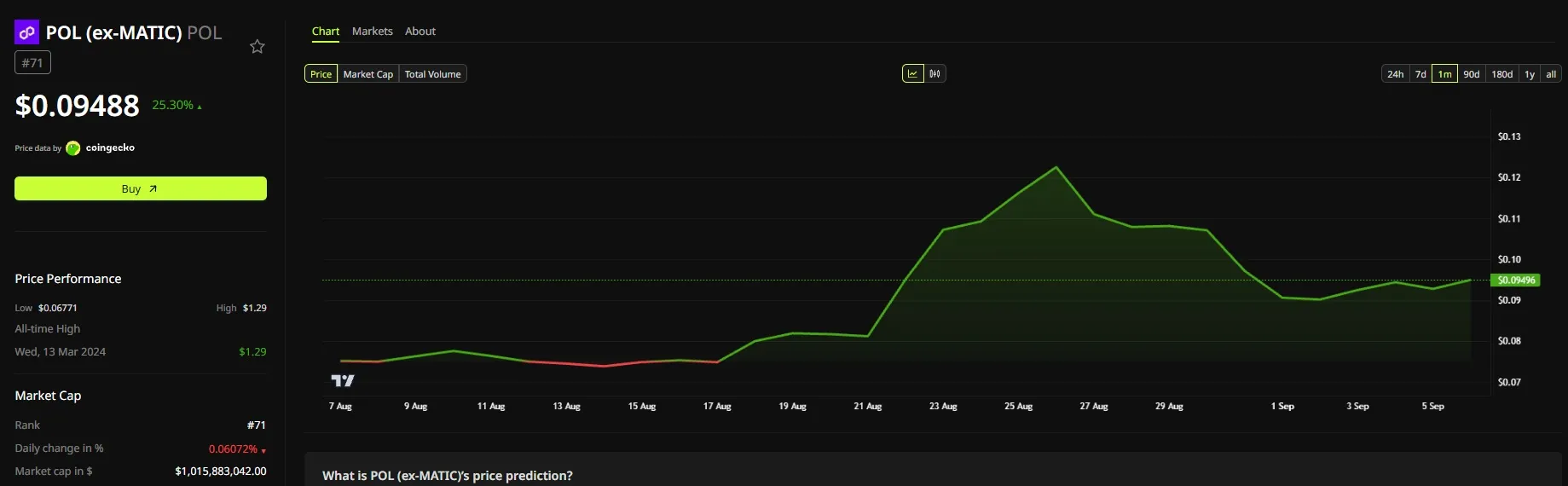
Polygon CEO Marc Boiron says staff time off pains him. His post on X split the crypto industry within hours.  The Polygon Labs boss admitted he prefers speed over rest. Critics called that a fiat mindset, so Boiron answered with a lesson about Bitcoin culture.  Polygon CEO Triggers a Fast Community Backlash  Boiron wrote that he feels torn whenever staff step away from work. He genuinely wants people to relax with their families. However, he cannot stomach the thought of a rival moving faster.  Im torn internally when people take time off. Is this normal?  On the one hand, I want people to relax, enjoy time with their families and take a break. I genuinely want it.  On the other hand, it pains me so much when I know we could move faster. I dont understand how you can…  He wrote that time off “pains me so much” and conceded that he struggles to admit the preference. In the end, he prefers the pace over the pause.  The timing sharpened the reaction. Polygon Labs cut nearly 30% of its workforce in January. Then the company trimmed staff again in July while it pivoted toward stablecoin payments.  Both cuts followed a wider industry pivot toward revenue. Many readers therefore judged
09-06Industry

Pineapple Tokenizes $1B Mortgage Records On Injective

Pineapple Financial (NYSE American: PAPL) has moved more than $1 billion in residential mortgage records onto the Injective blockchain, the network announced in a blog post on September 4, 2026. The milestone makes Injective one of the largest layer-1 chains by total value of tokenized real-world assets, and it turns what began as a proof of concept into a live, publicly trackable loan book.  A Working Loan Book, Not a Synthetic Security  Pineapple is migrating funded residential mortgage records onto Injective, with each loan represented by a metadata-rich onchain record tied to its underlying loan file rather than repackaged as a new mortgage-backed security. Each tokenized record carries more than 500 data points capturing loan-level data, provenance, and update history, Injective said. The original mortgage remains within its legal and servicing framework, while the onchain record acts as an auditable digital counterpart that gives authorized parties a consistent, verifiable view of the same information.  From $1 Billion Toward a $10 Billion Target  Pineapple‘s stated goal is to migrate its entire historical portfolio, more than 29,000 funded mortgages worth over $10 billion, onto the network over time. The migration is already measurable: the company’s dashboard shows 2,079 mortgage records onchain, up from 1,259 at the

09-06Industry

Poland Crypto Bill Blocked After President Nawrockis Third Veto

Market NewsThe Polish Sejm could not succeed in overriding President Karol Nawrockis third veto of the crypto bill, gaining only 241 votes.Now the framework for the domestic implementation of MiCA in Poland is unclear in light of ongoing political differences.  Poland‘s crypto regulation battle hit yet another milestone with the failure of the lawmakers to overcome President Karol Nawrocki’s third veto. The Sejm voted by 241 to 198 to reject the veto, while 3 representatives abstained from voting. Nevertheless, it takes at least 266 votes to override a veto, which means that at least three-fifths of the 442 deputies have to vote for this.  Third Override Effort Fails to Meet Criteria  The bill would have put Poland‘s cryptocurrency market under KNF jurisdiction. Additionally, it sought to help Poland’s adoption of the Markets in Crypto-Assets Regulation from the European Union. Nawrocki claims that the strategy pursued by the government imposes too much burden on cryptocurrency businesses. Nawrocki has also expressed concerns that stringent rules may drive companies offshore.  The President claimed that only one out of 16 amendments suggested by his office was taken into account in the latest legislative round. He is in favor of a different bill which aims at fraud and financial

09-06Industry

Binance P2P in India: Why Sellers Risk Bank Account Freezes

For an Indian crypto trader, selling USDT on Binance P2P can look like a routine transaction. When a seller matches with a buyer, they receive Indian rupees through UPI or a bank transfer. Once they confirm that the money has arrived, they release the USDT held in escrow.  But what happens if the rupees came from money connected to a cybercrime committed before the transaction?  That question has become a recurring concern on Reddits r/CryptoIndia community, where users have described bank liens, account freezes, and lengthy attempts to establish that they were simply counterparties in a legitimate crypto trade.  In an August 2026 post, a verified Binance P2P merchant said their bank placed a lien on their account weeks after they sold USDT and received payment through UPI.  The user said the buyer was allegedly connected to a cybercrime complaint and that they had retained the Binance order details, bank statement, UPI proof, and other records.  Similar concerns have appeared repeatedly. In another 2025 discussion, a user said their bank account had been frozen after two or three Binance P2P transactions, while another December post asked how long it takes before funds received from a P2P buyer can be considered “safe.”  How a Normal USDT Sale

09-06Industry

Strategy's Phong Le Explains Why They Sold Bitcoin at $60K, Bought at $80K

Key TakeawaysStrategy sold about 7,000 BTC near $60,000 in 2026, then paid $369.7 million for 4,603 BTC at $80,318.Phong Le says net debt fell from about $7 billion to zero, leaving $7 billion in cash and no forced selling.With bitcoin‘s price near $79,700, Strategy’s 845,050 BTC sit about $3.6 billion above cost basis.  Sell Low, Buy High? Le Says That Is the Wrong Question  This summer, Strategy sold about 7,000 BTC in the $60,000 to $65,000 range but then, between Aug. 24 and Aug. 30, paid $369.7 million for 4,603 bitcoin at an average of $80,318. On paper, it seemed like the absolute worst trade, but Phong Le does not see it that way.  Speaking on Bloomberg Crypto this week, Strategy‘s chief executive called the sale “the right trade at the time to sell bitcoin to fund some of our Stretch dividends,” referring to STRC, the company’s variable-rate preferred stock. He further noted:  “It‘s the right trade at this point in time to sell MSTR at a premium to buy bitcoin. We don’t really make decisions specifically on bitcoins price.”  The companys rule seems to be about cost of capital, i.e. sell equity when the stock trades at a premium to its coins, and touch

09-06Industry

Bitcoin Holders Just Cashed Out 110,000 BTC in Profits: Is a Bigger Price Drop Coming?

BTC‘s major rally allowed many investors to dispose of their assets. What’s next for its price?  CryptoQuant data shows that bitcoin investors started realizing major profits after the explosive August rally, disposing of roughly 110,000 BTC in just a few weeks.  Such highly concentrated profit-taking developments have historically been followed by substantial price correction for the underlying asset, the analysts warned. Moreover, several demand indicators have weakened, which could add to the selling pressure.  110K BTC Profit Taken  The major run that began on August 19 at prices of under $65,000 drove the leading cryptocurrency to almost $80,000 in just two days. According to CQs latest weekly report, holders realized net profits of 23,000 BTC on that day alone (August 21), which became the largest single-day profit realization this year.  The asset indeed dipped in the following days as it felt almost inevitable after such a gigantic jump, but went on the offensive once again in the following week or so. It rocketed past $82,000 on Friday before it was rejected following the US jobs report, and now sits below $80,000.  The report described the major profit-taking as a classic characteristic of a bullish cooldown, but warned that if they continue at such a rapid pace,

09-06Industry

Bitcoin Was $8 in 2011 After a 75% Crash — Today It Trades Near $80K

Fifteen years ago today, Bitcoin closed at $7.97.  At roughly $79,500 now, that means BTC has increased almost 10,000-fold, representing a gain of roughly 998,000% and an annualized return near 85% over 15 years. Historical pricing data show Bitcoin opened Sept. 5, 2011 at $8.36, briefly touched $9.96 and closed at $7.97.  But the more interesting part of the anniversary is where Bitcoin stood at the time.  Buying BTC at $8 in September 2011 did not feel like buying an obviously successful asset. Bitcoin had already experienced its first spectacular boom and collapse.  $8 Bitcoin Was Already Down About 75%  Bitcoin had surged to roughly $31.91 in June 2011, giving the network a market capitalization of about $206 million at its peak. Within days, the market suffered one of its earliest major crashes.  Mt. Gox was also compromised that summer, with an attacker accessing an administrator account and briefly forcing trades down to one cent on the exchange.  Discover more  FINANCE  Stocks  NEWS  By Sept. 5, Bitcoin at $7.97 was therefore roughly 75% below its June peak.  That gives the WatcherGuru anniversary a different meaning. The person buying Bitcoin for $8 was not buying an untouched technology at the beginning of an obvious uptrend. They were buying an asset that had already

09-06Industry

CASHCAT drops 16% – But THIS metric flashes hope for bulls

Cash Cat [CASHCAT] fell 16% in one day, marking one of the memecoins steepest declines.  However, trading Cash Cat could remain risky, especially for traders expecting further downside.  AMBCrypto examined why bearish pressure remained dominant and which signals could still support a rebound.  Why are CASHCAT longs suffering?  Pressure intensified on long traders as the CASHCAT perpetual market recorded a sharp Liquidation imbalance.  Liquidation data measures positions forcibly closed when traders lack sufficient margin to keep them open. Over 24 hours, long traders lost 14.8 times more than short traders. Long Liquidations reached $566,300, while Short Liquidations totaled only $38,210.  Source: CoinGlass  The imbalance showed that CASHCATs decline caught leveraged bulls on the wrong side. A similar pattern emerged on the 4th of September.  Long Liquidations reached approximately $480,000, compared with $28,000 in Short Liquidations. Repeated forced selling could deepen downside pressure, particularly if leveraged traders continue chasing a reversal.  Spot holders are fueling the decline  The spot traders have also contributed to the decline witnessed over the past day, as Spot Market Netflow remained positive.  Spot Market Netflow is the difference between inflows and outflows on exchanges. When inflows are higher than outflows, resulting in a positive reading, it means more of the asset is being moved onto exchanges, which

09-06Industry

Ancient Bitcoin Wallet That Turned $120 Into $3 Million Wakes Up

In briefFour more long-dormant Bitcoin wallets awakened between Aug. 29 and Sept. 4, moving a combined 202.84 BTC (~$15.73 million), per Galaxy Research—led by a 146.06 BTC stash ($11.31M) untouched since 2013.The 2011-era coins carried astronomical gains, including a 40 BTC wallet up over 2.5 million percent; one 6.78 BTC transfer was tagged with a Coinbase recipient attribution, typically signaling intent to sell.The moves extend a summer-long trend, following an earlier wave that shifted roughly $40 million in 10 days, with several wallets carrying “Noah Doe” lawsuit tags.  The parade of long-dormant Bitcoin wallets springing back to life is showing no signs of slowing, with at least four more ancient stashes stirring in recent days, one of them apparently headed for a sale.  According to Galaxy Researchs blockchain monitoring, the awakened wallets moved a combined 202.84 BTC, worth roughly $15.73 million, between Aug. 29 and Sept. 4.  Myriad: Bitcoins next price move? Click to make your prediction.  The largest, holding 146.06 BTC, or about $11.31 million, had sat untouched since November 2013, nearly 12.8 years, and delivered a gain of about 12,902% on a cost basis near $595. A 40 BTC wallet dormant since November 2011 followed, worth around $3.09 million and up a

09-06Industry

DAOs are forcing crypto protocols to choose between code and emergency brakes

Compound is a crypto lending protocol governed by holders who delegate their COMP tokens, a setup known as a decentralized autonomous organization, or DAO. It works like an online republic, with token holders debating proposals, voting, and letting software carry out the result.  Related Asset Compound #132 COMP · $20.03 24-hour change: up 1.73% Price history is not available. 24H Up 1.73% 7D Up 9.04% 30D Up 22.39%  In July 2024, that republic nearly sent a fortune to a small group of voters. Proposal 289 asked Compound to transfer 499,000 COMP, then worth about $24 million, into a yield-bearing vehicle they controlled. Two earlier versions had failed, and the third seemed headed the same way.  Then, during the final 34 minutes, supporting addresses cast 563,591 votes, equal to 82% of all support for the proposal. The last big block landed eight minutes before the deadline, and the measure passed by 682,191 votes to 633,636.  While this was extremely controversial and remains highly contested, there was no issue with the code, as it worked exactly as intended.  But that was the problem: the wallets had gathered enough COMP and delegated their voting power before the period closed, but Compound lacked an emergency authority that could pause

09-06Industry
1
...
294296
...
1000