






Tether‘s USDT, a $184 billion digital dollar, is coming back to Bitcoin this month, more than a decade after it first launched there. The new version promises private payments, with most details kept off Bitcoin’s public record.
USDT is the largest stablecoin, a crypto token pegged to the US dollar. It returns just as Washington asks whether Tether can police the coins it already has.
Sponsored

Sponsored
What Changes for USDT Holders When It Returns to Bitcoin?
For now, nothing. Tether billed the move as an expansion of its Bitcoin support in a 2025 announcement. Coins on Tron and Ethereum stay where they are.
“USDT on Bitcoin. Its coming home,” wrote Paolo Ardoino, CEO of Tether.
Ardoino set out the goal in 2025, promising exchanges and wallets private transfers, BTC-to-USDT swaps, and loans backed by Bitcoin.
“Bitcoin deserves a stablecoin that feels truly native, lightweight, private, and scalable,” Ardoino said at the time.
Is USDT Leaving Tron and Ethereum?
Theres no sign of that. Today, about $92 billion of USDT sits on Tron, roughly half of all coins in circulation, according to DefiLlama. Ethereum holds another $74 billion. Together, the two networks carry more than 90% of the supply.
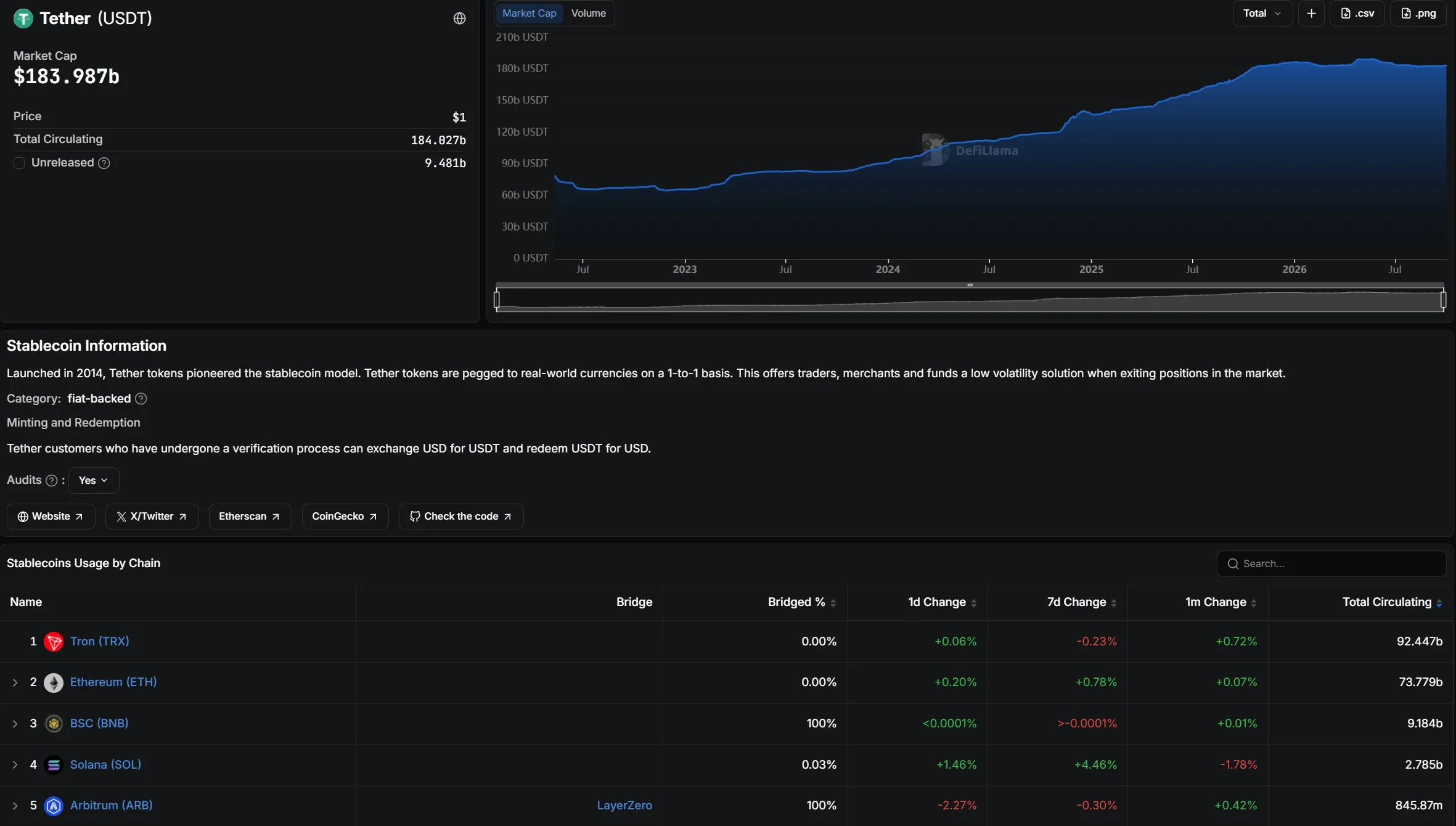
Stablecoin Usage by Chain. Source: DefiLlama
Sponsored
Sponsored
Tether‘s 2025 announcement says nothing about pulling USDT from those networks. Its title describes the move as expanding Tether’s Bitcoin support.
Still, Tether has dropped networks before. In September 2025, it ended support for five older networks, including Omni, the Bitcoin-based system where USDT first launched.
The rollout belongs to Utexo, a startup that raised $7.5 million in a round Tether led. Co-founder Viktor Ihnatiuk said this week that Utexo now holds a commercial license to issue the coin.
The technology underneath is RGB, a system for issuing tokens like USDT on Bitcoin. Payment details stay with the sender and receiver and only a small digital fingerprint is recorded on Bitcoin.
Instead of replacing Tron and Ethereum, the Bitcoin version draws on them. Utexos bridge, a tool for moving coins between networks, takes in USDT mainly from Ethereum and Tron, according to the RGB Protocol Association.
For users, the token is the same one, pegged to the dollar. The difference is which network it travels on.
Exchanges already ask users to pick a network, such as Tron or Ethereum, before they send USDT. Sending coins on the wrong network can mean losing them.
Can Tether Still Freeze a Private Dollar?
Freezing is Tether‘s main answer to critics. When US senators said Iran leans on Tether’s USDT to dodge sanctions, Tether pointed to $550 million it had frozen.
On Tron and Ethereum, every USDT transfer sits on a public record. Investigators can follow the money.
The RGB version hides most of that trail. Tethers announcement does not say how freezes would work.
Utexo has brought in Crystal Intelligence, a blockchain-tracking firm, for compliance, according to the RGB Protocol Association. Ihnatiuk himself plays down the privacy pitch.
“RGB…is mainly just a token standard, one that also brings you privacy, but thats more of a side feature,” RGB reported, citing Ihnatiuk.
The launch has also slipped past a mid-September window Utexo once called realistic.
Meanwhile, Utexo has met Morgan Stanley to discuss USDT on Bitcoin. Support for Lightning, a faster Bitcoin payment network, comes after launch. Until wallets and exchanges switch it on, Bitcoin USDT has nowhere to travel.