Cathie Wood's Ark Invest buys $21 million in Block as stock drops 6%

Quick TakeArk Invest bought $21 million worth of Block Inc. and $2.3 million worth of SpaceX shares on Thursday.Blocks stock fell 6.15% on Thursday as the company posted rising operating expenses in Q2, despite cutting 40% of its workforce in February.  Ark Invest bought additional shares in Block Inc. (XYZ) as the stock dipped 6% on Thursday.  The investment firms latest disclosure shows that it added 267,676 shares of the bitcoin-focused fintech company across Ark Innovation ETF (ARKK), Ark Next Generation Internet ETF (ARKW), and Ark Blockchain s stock fell 6.15% on Thursday to close at $79 — meaning that Arks latest purchase of the firms shares is valued at $21 million.  The companys investment strategy does not allow an individual holding to exceed 10% of a funds portfolio to maintain diversification within its ETFs. According to its fund disclosure, Block is the 10th-largest holding within ARKW, with a total value of $60 million and a 3.51% weight.  The Jack Dorsey-led fintech reported solid second-quarter financial results on Wednesday. Its revenue came in at $6.62 billion, up 9% year-over-year, exceeding expectations, while adjusted earnings per share came in at $1.02, up 65% year-over-year. The firms gross profit also grew 25% to $3.17 billion.  However, analysts

08-07Industry

Senate won't vote on crypto Clarity Act before its summer break

But many of the issues holding the bill up are now political, rather than strictly about the language in the legislation.  Lawmakers have come to agreements on the vast majority of their outstanding issues on the bill, which saw independent approvals from the Senate Banking Committee and Agriculture Committee. The biggest remaining issue was an agreement on a so-called ethics provision targeting Trump, who disclosed he made north of $1 billion from his various crypto businesses in 2025.  While Trump had agreed to an ethics provision brokered by Senator Cynthia Lummis, Senate Democrats — and some Republicans, including Thom Tillis — said they had concerns with the language. Tillis and Senator Ruben Gallego drafted a counter-proposal, which they said they sent to the White House at the end of July. The White House has not publicly responded as of press time.  Other outstanding issues include Agriculture Committee provisions and law enforcement concerns, a Senate aide told CoinDesk on Wednesday. Stablecoin yield and rewards are also still being discussed.  The next major procedural question is when Thune will file for cloture on the Clarity Act. If he files for cloture before the Senate leaves town this month, lawmakers can hold the first procedural vote on

08-07Industry

Tom Lee Sees S&P 500 at 8,000, Names Ethereum the Next Rally Leader

Fundstrats Tom Lee said on CNBC he expects the S&P 500 to reach 7,900 to 8,000 this month.  He also named Ethereum as an unexpected leader of the next leg higher, alongside the Magnificent Seven and software stocks.  Sponsored  Sponsored  Lees case for an August breakout  Lee said a deleveraging event a few weeks ago pushed cash to the sidelines. It also left investor sentiment too bearish, he said.  He added that strong earnings and cooling inflation fears are now driving a “chase” higher. AI spending also remains a strong theme, Lee said.  The anchor framed the recent pullback as froth clearing, not a fundamental shift. Lee agreed, then pointed to fresh earnings data.  This quarter‘s results are running more than $15 ahead of estimates set at the quarter’s start, Lee said. He added that 2027 earnings estimates have risen $8, nearing 410, with room to reach 425 by seasons end.  Sponsored  Sponsored  Lee is no stranger to bold S&P 500 calls. He made a similarly aggressive prediction last November, and other strategists have floated comparable 8,000 targets for this year.  Ethereums unusual role in the bull case  Lees Ethereum comment came with an important caveat. He was not saying Ethereum would push the S&P 500 higher, but rather play a role on

08-07Industry

Zeus Wallet taken offline after cyberattack, says no customer funds at risk

Zeus Wallet, a self-custodial Bitcoin Lightning Network wallet, took its infrastructure offline after a cybersecurity incident on Wednesday, and is auditing its systems before restoring services.  In an X post announcing the incident, Zeus said the attack did not put customer funds at risk and that it had no evidence the incident affected Lightning node software. “Based on our investigation so far, we believe this incident was limited to Zeus infrastructure,” Zeus founder Evan Kaloudis said in a company blog post.  According to Kaloudis, Zeus mitigated the attack within hours. He said that customers whose Lightning Service Provider (LSP) channels closed during the incident will receive replacement channels once services resume.  The company did not disclose the nature of the attack or provide a timeline for restoring operations. Zeus said the incident reinforces its work on trusted execution environments, also known as enclaves, and the Validating Lightning Signer (VLS) project to strengthen its infrastructure.  Zeus‘ move follows its Monday announcement that it would disable swaps following Boltz’s decision to halt operations. Boltz, a non-custodial Bitcoin swap service, said that its platform would remain disabled until further notice.  Cointelegraph requested Zeus provide additional details about the incident but had not received a response by publication.

08-07Industry

US Senate pushes CLARITY Act vote to September: Report

Senate Republican leaders are expected to leave for their August recess without voting on crypto market structure legislation, delaying consideration of the bill until at least September, according to a report from Politico.  Senate Majority Leader John Thune on Friday reportedly confirmed a Politico report that the chamber was “punting” the vote until the Senate is back from recess in September.  Citing two people with knowledge of the matter, Politico reported that the CLARITY Act lacks sufficient Democratic support to advance. Negotiations remain underway.  Thune may still file cloture before the recess. This procedural step could position the bill for a vote when senators return in mid-September, but it would not constitute a vote on the legislation, according to sources.  The sources said Democrats have declined to approve a time agreement that would expedite the Senates remaining pre-recess business and allow the crypto bill to reach the floor.  According to the report, Republican leaders would need unanimous consent from all 100 senators to complete the outstanding items without extending the session deep into next week.  Cointelegraph reached out to Thunes office to confirm the timetable and ask whether he plans to file cloture before the recess, but had not received a response by publication.

08-07Industry

Senate delays Clarity Act vote until after August recess, Thune confirms

Quick TakeSenate Majority Leader John Thune (R-S.D.) confirmed with The Block that the Senate is delaying a vote on the Clarity Act until lawmakers return from their August recess.“Were getting that queued up first thing when we come back,” said Thune.  The U.S. Senate is delaying a vote on the Clarity Act, a landmark crypto market structure bill, until lawmakers return from their August recess next month.  Senate Majority Leader John Thune (R-S.D.) confirmed with The Block late Thursday that the Senate is pushing back a procedural vote for the Clarity Act until September.  “Well, the Dems are insistent on no Clarity vote. Anyway, I worked with sponsors of the bill,” Thune said. “Senator [Cynthia Lummis] was great, and were getting that queued up first thing when we come back.”  The Senate is set to leave on a month-long recess starting on Friday and will be back in Washington in mid-September for a few weeks. Attention is likely to be focused on, and will increasingly shift, to elections in November — leaving the few weeks in September pivotal to passing crypto legislation.  A source familiar with the matter said Senate Democrats were reluctant to take the vote due to its potential political implications ahead of

08-07Industry

Sui to add post-quantum signature schemes for quantum-safe accounts

Quick TakeSui said it will integrate two post-quantum signature schemes approved by NIST.One scheme will serve Suis native accounts while the other will cover high-value vaults.Sui noted that users do not have to generate new phrases or move to another address to benefit from the quantum resistance updates.  Sui (SUI) is integrating two post-quantum signature schemes approved by the National Institute of Standards and Technology (NIST), enabling users to optionally adopt quantum-safe keys derived from existing recovery phrases.  According to its latest announcement, the blockchain network will add ML-DSA-65 as a native protocol signature scheme for everyday accounts and the hash-based SLH-DSA-SHA2-128s inside Move smart contracts for high-value vaults.  The effort comes amid the growing threat of quantum computing to the security of onchain keys.  “In most systems, an attacker needs a breach before they can start working on a key,” Sui said. “Onchain, the key is already published, exposed permanently the moment an account transacts.”  Sui argued that a sufficiently capable quantum computer running Shors algorithm could eventually break the elliptic-curve cryptography securing most onchain accounts, and that a “harvest-now-forge-later” attack does not require quantum hardware because attackers can collect exposed public keys today and exploit them once such machines become available.  “Sui was built

08-07Industry

Bitcoin miners‘ AI pivot loses Wall Street’s wow factor

Bitcoin miners pivot into artificial intelligence and high-performance computing (HPC) is reshaping their business models, but investors are no longer rewarding new infrastructure deals with the same enthusiasm they once did, suggesting the market has become more discerning as AI hosting strategies move into the mainstream.  According to new analysis by Blocksbridge Consulting published in TheEnergyMags Miner Weekly, the market reaction to AI infrastructure announcements has weakened significantly over the past two years. Reviewing 25 AI and HPC infrastructure deals announced between June 2024 and August 2026, the report found that the average announcement-day stock move fell from roughly 24% for the earliest deals to about 10% for the most recent ones. Median gains also dropped by roughly half over the same period, even as the size and value of the contracts increased.  The report found that annualized revenue per contracted megawatt has edged higher over time, indicating that AI hosting agreements are becoming more lucrative. However, as such deals become increasingly common, investors appear to be placing greater emphasis on execution, financing and long-term profitability than on headline contract values alone.  AI infrastructure deals are becoming more valuable, but less market-moving. Source: TheEnergyMag  That shift is evident in how the market has responded

08-07Industry

Bitcoin treasury trade ‘breaking’ and fund holdings drop 10%: Analysis

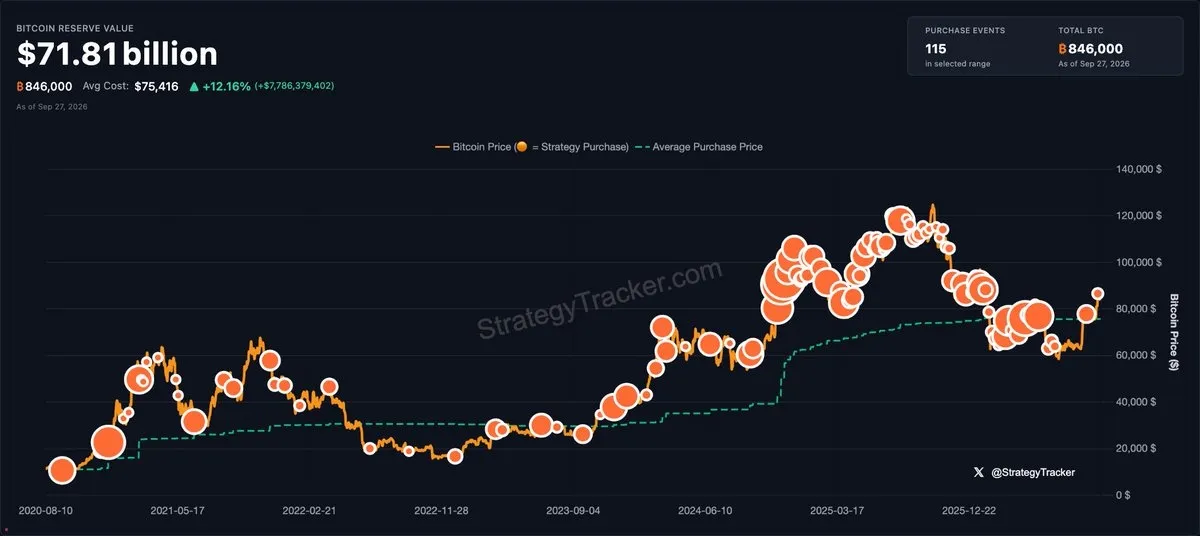
Bitcoin (BTC) institutional investment vehicles have shed 10% of their BTC holdings since May as analysis warns of a “breaking” sector.  Key points:Bitcoin institutional funds see a blanket 10% reduction in holdings over three months.Analysis says that the Bitcoin treasury model is “breaking” as company valuations fall below net asset value.Coinbase premium has been negative for a record 93 days.  Fund exposure drops as Bitcoin treasury companies face squeeze  Data from onchain analytics platform CryptoQuant shows that combined institutional BTC exposure, which includes trusts, exchange-traded funds (ETFs) and closed-end funds, has fallen from 1.33 million to 1.20 million BTC over three months.  Bitcoin fund holdings. Source: CryptoQuant  The drawdown comes as another major Bitcoin institutional investment vehicle, corporate treasuries, faces upheaval. Business intelligence software company Strategy, which holds the largest Bitcoin treasury of any public corporation, sold 1,638 BTC last week.  “Bitcoin treasury companies once amplified demand through a reflexive financing loop. Their shares traded above the value of their Bitcoin holdings, allowing them to issue equity or debt, buy more Bitcoin and reinforce the premium. That mechanism weakens when market capitalisations fall below net asset value, and financing becomes dilutive,” contributing analyst Novaque Research commented.  CryptoQuant highlights the plight of several Bitcoin treasury companies with stock

08-07Industry

JPYC raises $38 million Series B led by major Japanese logistics firm AZ-COM Maruwa

SummaryJPYC Inc. raised 6 billion yen ($38 million) in an extension of its Series B funding round to accelerate the expansion of its yen-pegged stablecoin.New investors in the latest round include AZ-COM Maruwa Holdings, a major Japanese logistics company.AZ-COM has plans to settle payments in JPYC with its clients, which included Amazon Japan.  JPYC Inc. raised 6 billion yen ($38 million) in an extension of its Series B funding round to accelerate the expansion of its yen-pegged stablecoin.  The investment brings the companys total raised to $106 million across seven funding rounds since November 2021, according to venture capital data site Tracxn.  New investors in the latest round include AZ-COM Maruwa Holdings (9090), a major Japanese logistics company.  AZ-COM plans to settle payments in JPYC with its clients, including Amazon Japan. Its network of around 2,300 partners is made up of subcontractors, drivers and so on. The move marked the first large-scale corporate use of a stablecoin for daily business operations in Japan.  JPYC is one of the most prominent stablecoins pegged to the Japanese yen with a market cap of $55.5 million, according to data tracked by CoinGecko.  Stablecoins are digital tokens pegged to the value of a traditional financial asset, usually a fiat currency.

08-07Industry
1
...
8486
...
1000