Bybit users hold more Bitcoin and Ethereum as USDT drops 11%

Bybit has reported $19.6 billion in mainstream assets in its 40th proof-of-reserves report, with user Bitcoin and Ether balances rising while USDT holdings fell sharply from the previous snapshot.  Bybit reported the figures using a snapshot taken at 03:00 UTC on Sept. 23. The exchange listed 56,131 BTC in user assets against 58,721 BTC held in wallets, giving Bitcoin a reserve ratio of 104%. The report was independently reviewed by Hacken.  Ethereum user holdings reached 551,868 ETH, while wallet assets stood at 570,018 ETH. The resulting reserve ratio increased to 103% from 102% in an earlier report. Bybit said every one of the 50 tokens covered by its current disclosure had reserves equal to or above user balances.  Bybit Bitcoin and Ethereum user holdings increased  Bitcoin balances held for users rose 0.24% from the Aug. 26 snapshot to roughly 56,100 BTC. Despite the increase in customer holdings, Bybits Bitcoin reserve ratio remained at 104%.  Ether recorded a larger change, with user holdings rising 2.96% to nearly 551,900 ETH. Bybit reported 570,018 ETH in wallets against those customer balances, lifting the reserve ratio by one percentage point to 103%.  The latest figures follow earlier changes in exchange balances during 2026. In June, Bybit and OKX users increased

10-01Industry

Dogecoin gets DeFi testnet as DogeOS bets miners will eventually secure its apps

DogeOS plans to back that trust with mathematical proofs — compact pieces of data showing the work was done by the rules without anyone having to redo it — and eventually have Dogecoins own network check them.  The first version depends on DogeOSs selected operators and hardware. A permissioned sequencer, an authorized operator, decides the order of transactions.  Validators, computers responsible for checking and approving updates, work alongside a trusted execution environment, a protected section of computer hardware that checks the proofs. A committee called the Security Council oversees the system, according to details shared by the team.  People using the planned applications would therefore rely on those operators and hardware to work correctly. Dogecoins miners do not yet verify the application proofs themselves.  DogeOS wants to give them that role through an upgrade to Dogecoin Core, the main software running the network. Its proposal, called OP_CHECKZKP, would add a rule allowing computers on Dogecoin to check proofs that calculations performed elsewhere were correct.  DogeOS checks its own work until Dogecoin can. (Shaurya Malwa/CoinDesk)  The proposal was published in July 2025. A separate implementation submitted in December remains a draft, with a placeholder proof checker and further development required before it could be activated.  DogeOS was founded

10-01Industry

Morgan Stanley Names 3 Biotech Breakthroughs That Offer Investment Opportunities

Morgan Stanley named three biotech breakthroughs that could reward investors, spanning Alzheimers drugs, gene editing, and artificial intelligence (AI).  Analysts Sean Laaman and Maxwell Skor published the research, and it coincided with the banks annual Global Healthcare Conference in New York.  Sponsored  Sponsored  Biotech Breakthroughs Carry Multibillion-Dollar Price Tags  Morgan Stanley‘s report sizes the Alzheimer’s drug market at $70 billion. The bank splits it between therapies that slow cognitive decline and treatments for symptoms such as psychosis and agitation.  The bank sees upside beyond drugmakers. Delaying nursing home entry by 12 to 18 months could deliver US healthcare value worth multiples of list price. Diagnostics, care delivery, retirement, and insurance firms could also benefit or need to adapt.  Early gene-editing therapies worked ex vivo, meaning clinicians removed cells, edited them in a lab, and returned them. In contrast, in-vivo versions edit DNA inside the body. That could open organs not easily removed, including the brain, heart, eyes, and liver.  Pharma and Biotech performance has been climbing since mid-2025. Image Source: Janus Henderson  Morgan Stanley forecasts a $10 billion in-vivo market by 2035 in near-term indications. Meanwhile, consensus sits at $6 billion. Data due over the next 18 months could set how investors value these platforms.  Sponsored  Sponsored  Morgan Stanley Favors AI Suppliers

10-01Industry

Is Oura's IPO Delay About Markets or Its $15 Billion Valuation?

Oura postponed its Nasdaq initial public offering (IPO), a listing that would have valued it near $15 billion. The Oura IPO delay came despite what the company called strong demand.  The smart ring maker blamed uncertainty in the IPO market. Treasury yields at 19-year highs and a September Federal Reserve (Fed) rate hike have weighed on growth stocks.  Sponsored  Sponsored  Why the Oura IPO Delay Reflects Rate Pressure  The 10-year Treasury yield, a benchmark for global borrowing costs, topped 5.2% last week and continued to rise to almost 5.3%. That was its highest level since 2007, and oil prices and the Feds first hike since 2023 added pressure.  Yield continues to hit new 52-week highs. Image Source: CNBC  Higher yields typically reduce what investors will pay for future earnings, which hurts growth names most.  “The recent spike in yields and resumed rate hikes have put some downward pressure on growth companies, and thats a majority of the companies in the IPO market.”  Avery Marquez, director of investment strategies at Renaissance Capital,  Demand was not the obstacle. Oura‘s oversubscribed IPO drew roughly four times more orders than shares ahead of Tuesday’s planned pricing.  Sponsored  Sponsored  Still, valuation looks like the sharper concern. Jay Ritter, director of the IPO Initiative at the University of Florida,

10-01Industry

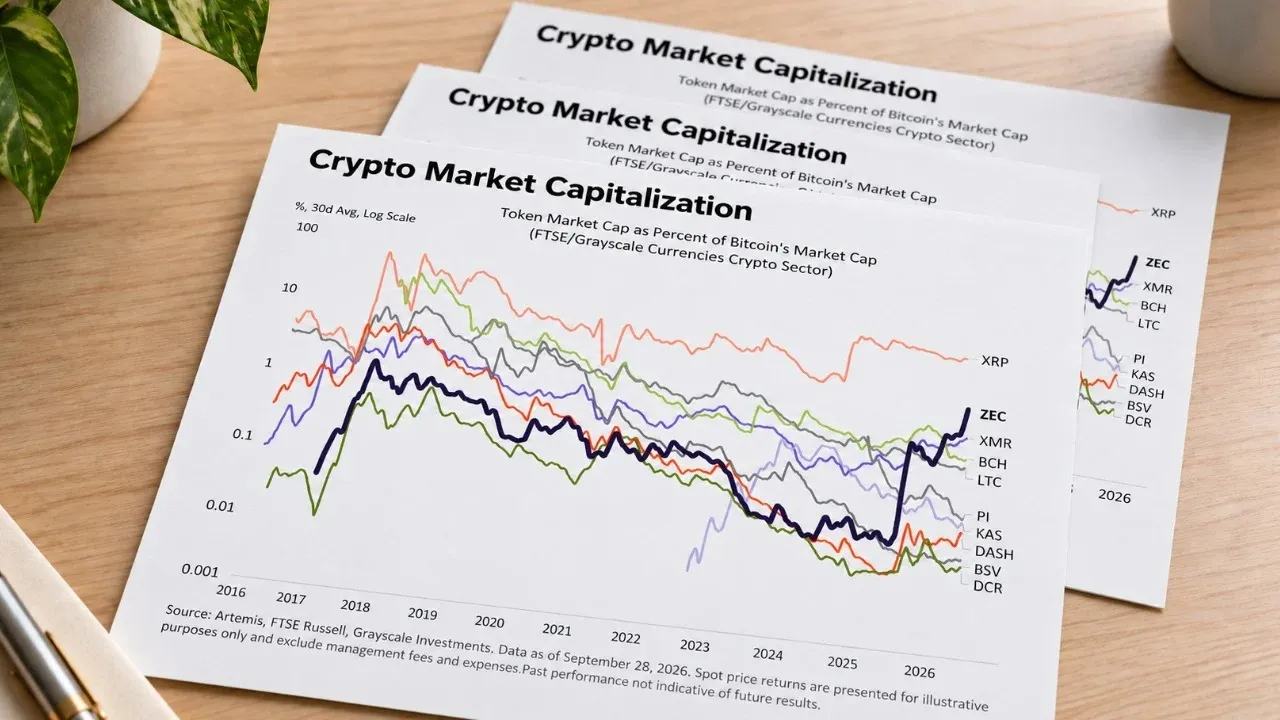
Grayscale: XRP's Near-6% Bitcoin Valuation Sets a Benchmark for Zcash

XRP is valued at nearly 6% of bitcoin‘s market capitalization, a level Grayscale cites as context for how far rival digital currencies can grow. Zcash rose from under 0.1% to about 1.5% of bitcoin’s value in a year, and the firm says it has not hit a valuation ceiling.  Key TakeawaysGrayscale counts 10 qualifying tokens alongside bitcoin in its sector.XRP‘s market value approaches 6% of bitcoin’s, versus Zcashs 1.5%.The firm argues that ZEC has not reached a valuation ceiling.  XRP, Zcash, and Litecoin Share Bitcoins Currency Category  Digital currency competition extends beyond bitcoin (BTC) to 10 other qualifying tokens, including XRP, Zcash (ZEC), and Litecoin (LTC), according to Grayscale. Zach Pandl, head of research at the crypto asset manager, outlined their shared classification in a Sept. 29 analysis. The firms Currencies Crypto Sector groups blockchains focused on the digital currency use case.  The category encompasses monetary functions such as transferring value, storing value, and expressing prices in a common unit. These digital currency functions span standard monetary protocols and cryptocurrencies with privacy features. FTSE Russell, an index provider, and Grayscale review the sectors and their constituents quarterly, allowing classifications to change as the market develops. Pandl wrote: “Bitcoin is the king of the category.”  Litecoin

10-01Industry

New Bitcoin upgrade catches hidden key leaks hiding the exact fix

Bitcoin improvement proposal BIP461 could make a hidden route for leaking wallet secrets easier to detect. The draft defines a common signing procedure for ECDSA, an existing Bitcoin signature scheme.  Related Asset Bitcoin #1 BTC · $83,531.58 24-hour change: up 0.15% Loading price history… 24H Up 0.15% 7D Down 0.76% 30D Up 6.39%  Independent compliant signers should produce identical signatures for the same secret key and message hash, creating a benchmark for detecting departures that could conceal key leakage.  Authored by Liam Gilligan, the proposal was merged into the BIPs repository on Sept. 16 and remains marked Draft. Its signatures work under existing Bitcoin consensus rules, so implementing this signing procedure requires no consensus change.  Comparing signatures for deviations  ECDSA allows a signer choices while creating a valid signature, including the nonce, a temporary value used in signing. Malicious firmware can exploit that freedom to hide key material in signatures that still pass verification, and BIP461 fixes those choices through a specified deterministic procedure.  Bitcoin‘s acceptance of a signature cannot establish that its creation kept the key safe. A common specification supplies an expected output against which the signer’s behavior can be checked.  The comparison requires identical inputs and the exact same standard, including access to the

10-01Industry

SlowMist traces Bitget hack activity to Aug. 31 zero-day exploit

SlowMist traced the earliest logged malicious activity linked to Bitgets $388 million theft to Aug. 31, when an attacker exploited a zero-day vulnerability affecting a third-party security product.  Attackers stole the funds from Bitget‘s hot wallets on Sept. 24 (UTC), transferring assets to addresses they controlled across several blockchains. SlowMist’s investigation identified malicious activity involving two third-party security products and a wallet application host.  According to a SlowMist progress report, the attacker used a hidden script to access the database of what SlowMist called “Product A,” after retrieving its password from an environment variable. Similar activity was later detected on two other nodes on Sept. 23 and Sept. 25. The dates and times in the report are in UTC+8.  On Sept. 25, the attacker also accessed the management platform of a second security product, which SlowMist called “Product B,” using an internal employees identity. SlowMist said the attacker then attempted to inject system commands, alter server configurations and upload malicious program files.  SlowMist said its investigation remains ongoing and that it is still examining how the attacker moved between the affected systems.  Attacker used custom withdrawal tool  The security company said it recovered a deleted, highly customized tool used to manipulate the wallet systems withdrawal process.

10-01Industry

Standard Chartered sees Ethenas USDe reaching $40B, ENA hitting $2

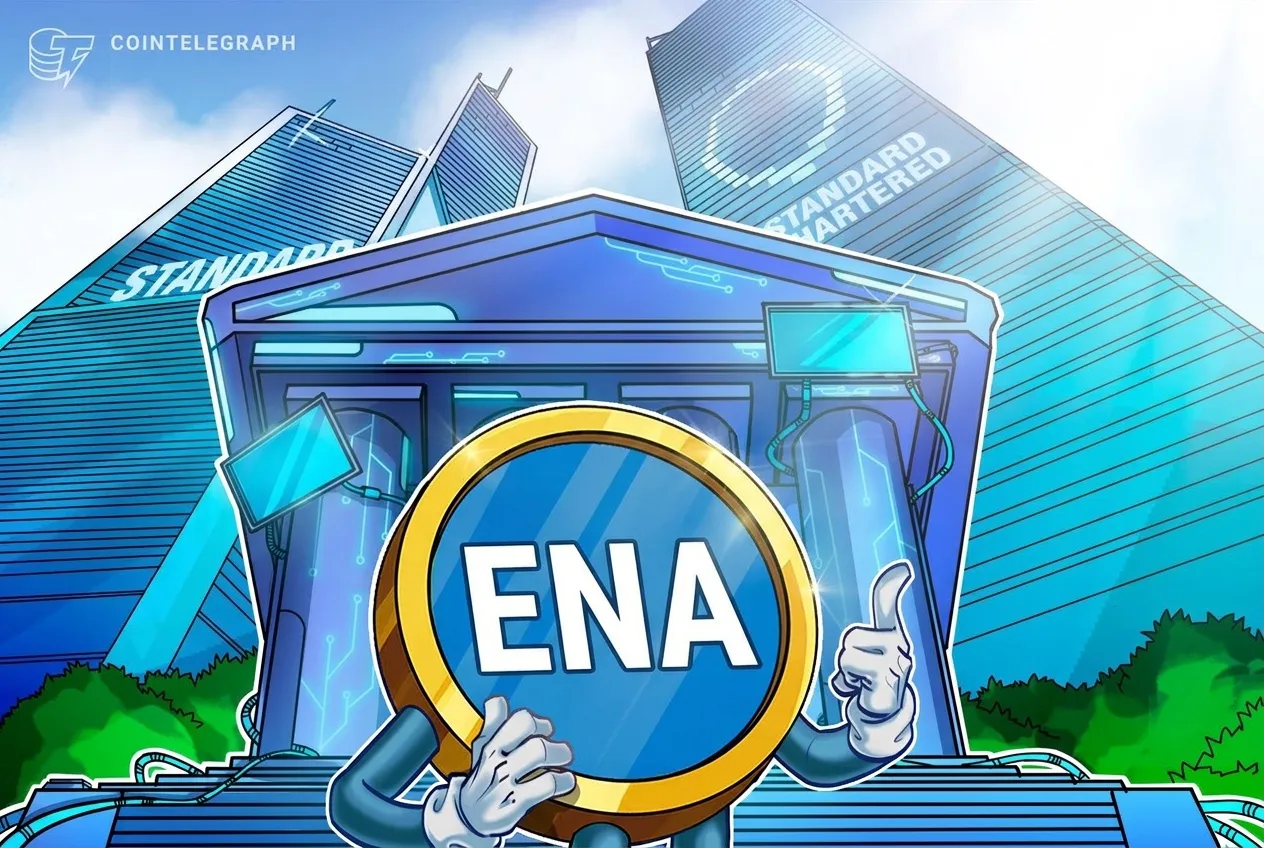
British multinational bank Standard Chartered expects Ethenas USDe stablecoin supply to grow eightfold to $40 billion by the end of 2028 as the protocol expands its sources of yield beyond crypto markets.  In a Wednesday research report shared with Cointelegraph, the bank initiated coverage of Ethenas ENA token with a year-end 2028 price target of $2, roughly seven times the $0.28 price cited in the report. Standard Chartered also expects USDe to slightly outpace overall stablecoin market growth over the period.  Its forecasts imply ENA would also outperform Bitcoin (BTC) and Ether (ETH) through 2028. Standard Chartered sees BTC reaching $300,000 and ETH $18,000 by the end of the period.  Standard Chartereds year-end digital asset price forecasts through 2028. Source: Standard Chartered Research  Standard Chartered said declining returns from USDes traditional crypto basis trade, which involves holding spot crypto while shorting perpetual futures, have pushed Ethena to expand into DeFi and institutional lending, real-world assets and basis trades tied to equities and commodities. Those sources currently generate a blended yield of 5.2%, giving USDe more room to scale.  The bank forecasts the broader market for tokenized assets will grow from about $350 billion today to $4 trillion by the end of 2028, expanding the pool

10-01Industry

Binance Pay lets visitors spend crypto at PayPay merchants in Japan

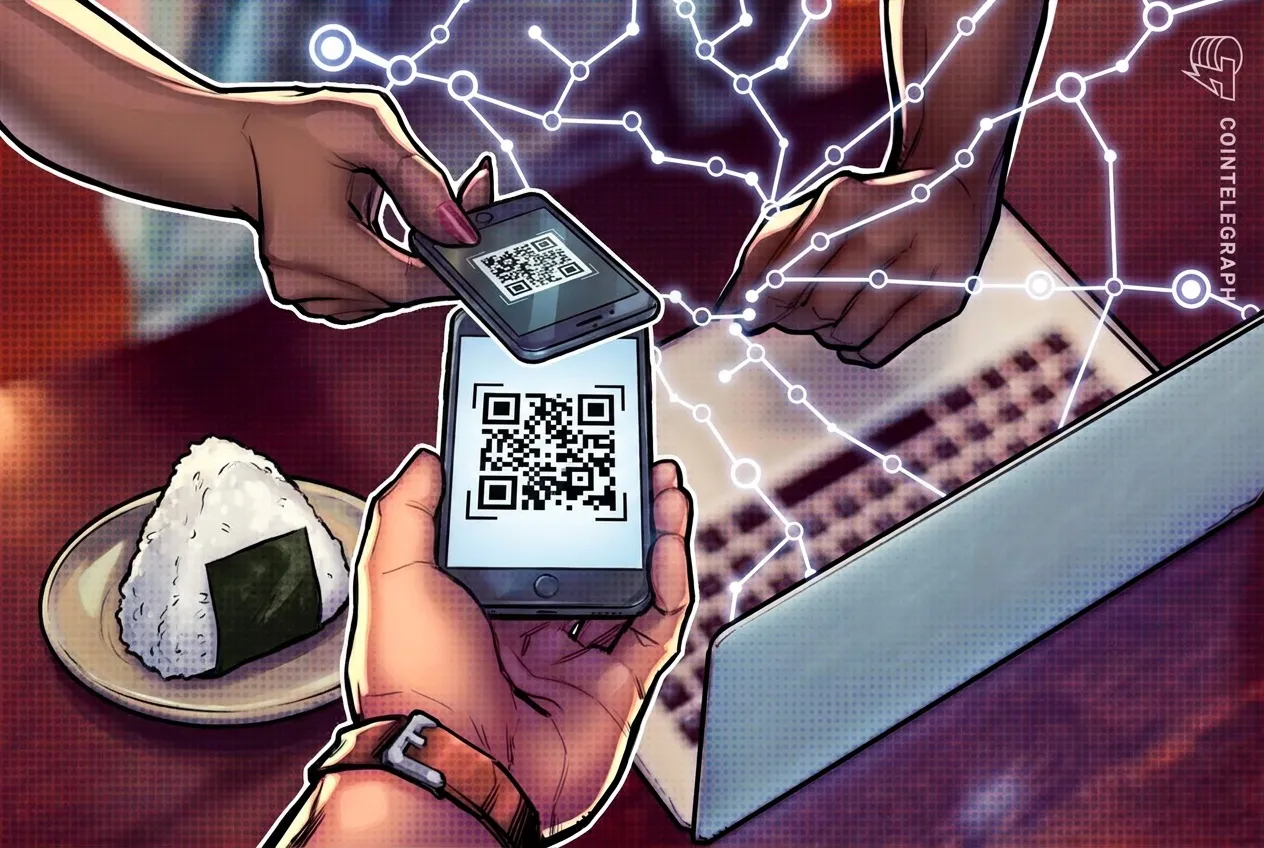
[Update, 07:00 UTC, Sept. 30: This article was updated after Binance clarified that users can pay with more than 100 supported cryptocurrencies, while USDT is used as the backend settlement layer.]  Binance Pay will allow eligible overseas users visiting Japan to spend more than 100 cryptocurrencies at the vast majority of PayPay-supported merchants starting Wednesday.  The service will run through HIVEX, a payment interoperability framework that connects overseas QR payment services to PayPay-supported merchants in Japan. Binance Pay uses Tether USDt (USDT) as its backend settlement layer, while HIVEX settles with PayPay and PayPay settles merchants in yen.  Binance told Cointelegraph it is the first crypto payment service to access PayPay-supported merchants through HIVEX. Merchants will not need to opt in separately, it said.  PayPay is a Japanese cashless payment service accepted at millions of locations nationwide, including major chains, smaller retailers, vending machines, taxis and public transportation. It lists nine other overseas payment services supported through HIVEX, mainly from China, Hong Kong and Taiwan.  Japan welcomed a record 42.7 million international visitors in 2025, according to the Japan Tourism Agency. In the latest comparable global ranking, based on 2024 data, it ranked ninth worldwide and first in Asia.  The country recorded 3.1 million visitor arrivals

10-01Industry

European stablecoin issuer AllUnity launches USD stablecoin USDAU

AllUnity is launching a new stablecoin pegged to the US dollar, expanding its digital asset lineup as dollar-pegged tokens continue to dominate the global stablecoin market.  The new token, USDAU, will maintain a 1:1 peg to the US dollar through segregated reserves and debut on Ethereum, Solana, Base, Tempo, Arc and Polygon, AllUnity said in a Wednesday announcement shared with Cointelegraph.  AllUnity, regulated under the European Union‘s Markets in Crypto-Assets (MiCA), already issues euro-backed EURAU, Swiss franc-backed CHFAU and Swedish krona-backed SEKAU stablecoins. CoinGecko measures EURAU’s market capitalization at roughly $400,000 and CHFAUs at about $45 million.  The launch comes as European policymakers debate the implications of dollar stablecoin dominance. US dollar-pegged tokens account for more than 99% of the roughly $291 billion global stablecoin market by capitalization, according to CoinGecko.  The European Central Bank warned in June that greater use in European tokenized finance could deepen dependence on the dollar and weaken the euros role.  AllUnity CEO Alexander Höptner pushed back on the idea that the dollar itself is the central concern.  “Europe‘s concern isn’t with the dollar, its with dollar liquidity flowing through offshore issuers with no European supervisor, no enforceable redemption rights and no visibility into their reserves,” Höptner told Cointelegraph.  He said USDAU

10-01Industry
1
...
5355
...
1000