CFTC Eases Registration Rules for Software Linking Users to

U.S. derivatives regulators moved to reduce a registration hurdle for software providers connecting users with regulated markets.  The CFTCs Market Participants Division issued a no-action position Thursday for passive software providers. The relief covers software used to connect users with registered futures commission merchants, introducing brokers and designated contract markets. Providers must meet specific conditions, including disclosure requirements and internal policies.  CFTC Broadens Software Relief  The position expands relief first granted to crypto wallet provider Phantom in March. The earlier relief covered Phantoms software for facilitating user trading with registered FCMs, IBs and DCMs.  The new position applies more broadly to qualifying passive software providers. The CFTC said staff would not recommend enforcement for failing to register as an introducing broker when providers meet the specified conditions.  Related: FCA Issues Cease-and-Desist Orders to Three London P2P Crypto Operators  The protection applies only to qualifying software activities. A footnote also indicates that the framework is not limited to crypto-related applications.  Solana Policy Institute General Counsel Patrick Wilson called the move a broader framework for developers. “That gives builders more clarity about how they can connect users to regulated derivatives markets without being treated as introducing brokers.”  Regulatory Push Continues  The CFTC action follows the SECs innovation exemption for onchain tokenized
09-18Industry

BitMEX Just Killed the Trade That Changed Crypto Forever

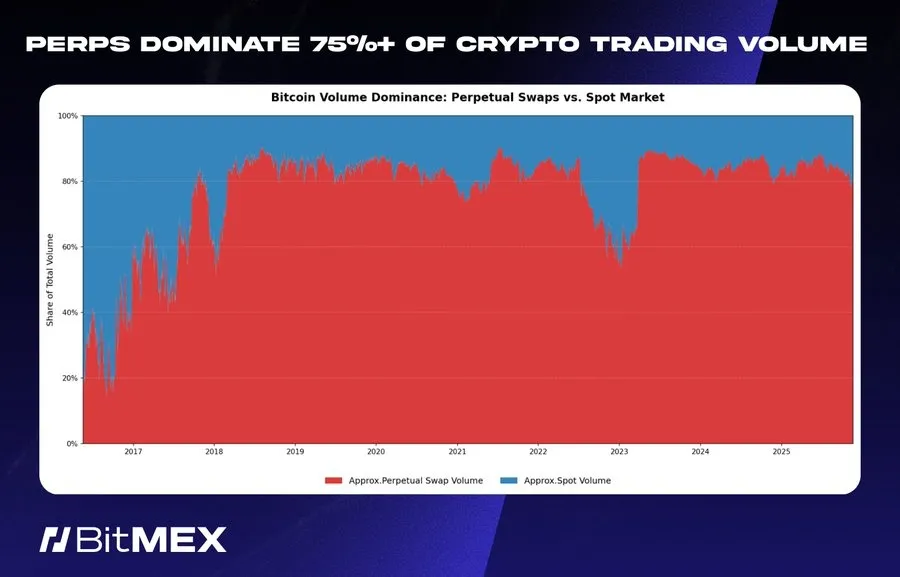
BitMEX has settled and delisted XBTUSD, ending one of the most influential trades in crypto history. The Bitcoin contract ran for more than 10 years and became the template for the perpetual futures market that dominates crypto trading today.  BitMEX itself will shut down on September 23. Yet the product it created is everywhere.  The Bitcoin Trade Every Major Exchange Copied  XBTUSD launched on May 13, 2016. It allowed traders to bet on Bitcoin without an expiry date.  Traditional futures expire on fixed dates. XBTUSD did not. That kept traders in one continuous market instead of splitting liquidity between different contracts.  BitMEX also introduced a funding system to keep the contract close to Bitcoins spot price. When too many traders crowded onto one side, they paid the other side.  Then came leverage. At launch, traders could control up to $100 of Bitcoin exposure for every $1 they put down. BitMEX later raised the ceiling to 250x for users who activated its Leverage Booster feature in April 2024.  The idea started as scribbles on a napkin in a Hong Kong bar.  Arthur Hayes, Ben Delo and Samuel Reed kept coming back to the same question: why should a market that trades 24/7 be forced onto futures that expire?  XBTUSD was

09-18Industry

Crypto.com Gets Green Light to Bring Single-Stock Futures to the US

Crypto.com is targeting US traders with single-stock futures through OG.com.  Crypto.com is moving closer to launching single-stock futures in the United States after the SEC acknowledged a Form 1-N filing from North American Derivatives Exchange (Nadex).  CEO Kris Marszalek revealed the company is now “authorized” to bring single-stock futures to the market through OG.com, which is its CFTC-regulated standalone prediction market platform launched in February.  US Single-Stock Futures  In a post on X, Marszalek also said the team is working with the SEC and CFTC for the offering in the US. Single-stock futures are contracts linked to the future price of individual stocks. They allow traders to take positions on stocks through futures contracts rather than buying the underlying shares directly.  The SEC document, dated September 16, confirms the filing was made under Section 6(g) of the Securities Exchange Act of 1934.  Crypto.com is not the only platform looking to bring single-stock perpetual futures to the US. According to The Wall Street Journal, Kalshi is also seeking regulatory approval for the products. The prediction market operator reportedly plans to offer around 60 perpetual contracts tied to major stocks and ETFs, including Tesla, Apple, and Nvidia. The planned stock contracts would target companies with market values of

09-18Industry

Bitcoins October rally meets 6% yield fears – Which side wins Q4?

Q4 is just around the corner, and the crypto market is already discussing whether it will be bullish or bearish.  Notably, the bears have quite a compelling case. The market has started reacting to the recent 25 bps hike by the Federal Reserve.  Goldman Sachs has already priced in another rate hike at the October FOMC, and there are reasons to believe that this hawkish scenario could play out.  Why is cryptos Q4 outlook turning bearish?  Following the Feds decision, the U.S. 2-year Treasury yield climbed to 4.734%, its highest level in 26 months.  Further increases could tighten financial conditions, especially with U.S. government debt exceeding $30 trillion.  Discover more  Merchant Services & Payment Systems  Business Operations  Finance  Source: X  The bigger signal, however, is coming from the 10-year Treasury yield.  Based on analysis from the Kobeissi Letter, a move above the 6% threshold next year can not be ruled out. The recent breakout above 5% is a crucial technical signal, suggesting that rising yields could continue to put pressure on liquidity and in turn on risk assets such as crypto.  Meanwhile, the U.S. Dollar Index crossed 100 for the first time in over four weeks. A stronger dollar could tighten global liquidity and reduce demand for risk assets, including crypto.  Combined with rate-hike

09-18Industry

Hong Kong Expands Stablecoin Settlement for Funds

Hong Kong plans regulated stablecoin settlement for tokenized money market funds.HKMA will test tokenization of over HK$1.3 trillion in Exchange Fund Bills.Hong Kong is expanding digital asset infrastructure across bonds and custody.  Hong Kong plans to expand regulated stablecoin settlement for tokenized funds while accelerating the broader use of digital assets across financial markets. The government also plans to test tokenization involving more than HK$1.3 trillion in Exchange Fund Bills by year-end.  Hong Kong Expands Stablecoin Settlement Framework  According to a public document cited by WuBlock Thursday, the 2026 Policy Address directs regulators to support regulated stablecoin trading on licensed virtual asset platforms. It also proposes using stablecoins to settle tokenized money market funds.  The Securities and Futures Commission will refine virtual asset licensing rules and establish clearer compliance requirements for service providers. Meanwhile, regulators will strengthen rules covering tokenized investment products and their issuance.  The framework could expand stablecoin settlement beyond trading into traditional investment products. It would connect regulated digital currencies with tokenized funds and other blockchain-based financial instruments.  Hong Kong has already developed regulated stablecoin infrastructure through its issuer licensing framework. Earlier this year, the city granted its first stablecoin issuer licenses, creating a regulatory foundation for broader institutional applications.  The policy direction also

09-18Industry

BoJ is set to hike rates and point to further monetary tightening in the near-term

The Bank of Japans (BoJ) monetary policy meeting will close a week packed with central bank decisions on Friday, with markets particularly interested in confirming expectations of a hawkish shift that has boosted a strong Japanese Yen (JPY) recovery in September.  Futures markets are practically fully pricing a quarter-point rate hike this time, which would push the BoJs benchmark interest rate to its highest level in about 31 years, amid higher inflation, rising wages, and pressure from US Treasury Secretary Scott Bessent.  The Japanese central bank will follow the Federal Reserve (Fed) and the European Central Bank (ECB) in tightening monetary policyas the war in the Middle East fuels global inflation. The Strait of Hormuz remains practically closed, and recent developments threaten the Red Sea alternative route, pushing Brent Oil prices above $100 and spurring serious concerns about supply disruptions.  What to expect from the BoJ interest rate decision?  Barring a highly unlikely surprise, the Bank of Japan will raise its benchmark interest rate from 1% to 1.25% on Friday, drawing monetary policy closer to levels the bank considers neutral for the Japanese economy. The decision is likely to obtain the support of the broad majority of the Policy Board, with recently appointed committee

09-18Industry

How To Watch Lions vs. Bills And All Of The Week 2 NFL Primetime Games

The NFL moves onto week two, with another interesting primetime slate.  First on the list, though, is one of the better Thursday Night Football matchups TV audiences will get all season. Heres how to watch all three primetime games this week.  What Is The NFLs Week 2 Primetime Schedule?  Thursday, Sept. 17: Detroit Lions (1-0) at Buffalo Bills (1-0), 8:15 p.m. ET on Amazon Prime Video  Thursday night marks the first regular season game for both the Amazon Prime Video team and Buffalo‘s newly-opened Highmark Stadium. And both couldn’t have asked for a better matchup between two high-flying teams sitting at 1-0.  Those victories were not necessarily created equal, however.  While the Lions withstood a pesky Saints team going for two in overtime to win, 31-30, Josh Allen and the Bills slashed through a Texans defense many projected as one of the leagues top units, en route to a 36-31 victory.  Needless to say, there will be plenty of scoring here, given both defenses limited resistance in week one. If either team can show some improvement on that side of the ball, it likely makes all the difference.  Sunday, Sept. 20: Indianapolis Colts (0-1) at Kansas City Chiefs (1-0), 8:20 p.m. ET on NBC/Peacock  The Chiefs are at home

09-18Industry

World Money Expands to 150+ Countries With Payments and

World has begun rolling out World Money in more than 150 countries. The service supports payments, stablecoins and investing, while allowing users to manage funds, transfer assets and track their portfolios.  World Money supports eight currencies and lets users send assets using a World username. Users can also track portfolios, transactions and set price alerts.  Payments and Investing  Users can access Mini Apps such as Kalshi, Credit and Morpho. They can also receive deposits and paychecks through virtual accounts powered by Bridge.  Related: UK Stablecoin Rules Split Payments From Lending Under 2027 Crypto Regime  Earn lets users deposit assets, including Worldcoin and stablecoins, into Morpho programs. Trade supports digital assets and real-world assets, including gold.  However, availability varies by market. World is adding Stripe as a funding option in the US. Users can fund accounts through Apple Pay and convert dollars into stablecoins within minutes.  World ID Integration  World Money uses World ID to verify that accounts belong to unique humans. Orb-verified users can receive boosted rewards on eligible programs.  Existing World App users can carry their credentials into World Money. The rollout extends Worlds services beyond identity verification and crypto payments.

09-18Industry

Solana price holds $100 as VIDAx volume on-chain hits 12.6x exchange levels

Things are getting interesting for Solana [SOL]. Tokenized stock trading on the network is heating up, and ETFs are also in the green. But does any of this actually matter for SOLs price?  Lets take a look.  VIDAs on-chain volume on Solana races ahead  Over the past seven days, VIDAx recorded on-chain trading volume equal to roughly 1,258% of its volume on traditional stock exchanges. Its on-chain volume was roughly 12.6x its traditional-market volume.  Its clear where traders are deliberately choosing to be.  Source: XStocks  While VIDAx is the standout example here, it is not the only tokenized equity with breakout activity.  Ultimately for Solana, this is another use-case beyond crypto trading itself.  ETFs in green pastures  SOL spot ETFs also finished the latest session in the green; there was almost $837Kin net inflows. It is not a huge number on its own, if compared with the stronger days it has seen and other tokens better inflows.  Source: SoSoValue  This matters because demand is coming in from two sides at once.  But this does not mean that SOL is ready for a breakout! What it does is make a case for the bulls.  Solana price keeps the story interesting  At the time of writing, Solana price was close to the $102mark. This is a

09-18Industry

Your Data Could Outlive the Startup You Gave It To. Elon Musk Wants to Buy What's Left

In briefSpaceXs AI unit held informal internal talks about buying customer and operational data from failed startups to train Grok.The approach echoes Googles $10 million bankruptcy-auction win for Spirit Airlines business records.SpaceXAI told staff in August it would train Grok on the entirety of SpaceXs own internal records, with Musk telling employees the model would effectively absorb who they are.  Elon Musks SpaceX has been talking, internally, about buying the leftover customer files of startups that already went under. Not licensing data from companies that are still operating and can say no. Buying the digital estate of companies that no longer exist to say anything at all.  The discussions are happening inside SpaceXAI, the artificial intelligence division born in February when SpaceX merged with xAI. People familiar with the talks told Bloomberg theyre informal and might go nowhere. But the idea makes sense from the perspective of an AI lab racing for the frontier.  Myriad: How much will Elon Musk be worth? Click to make your prediction.  The goal is basically cheap fuel for Grok. AI models learn from training data—the text, code, and records an algorithm studies to get better at predicting what comes next—and the good stuff, real business records instead of

09-18Industry
1
...
173175
...
1000