
NMLSRegulated
United States Crypto Asset Transfer License (MTL)





United States Crypto Asset Transfer License (MTL)

Ireland Crypto Asset Exchange License (CEX)
Ireland Crypto Asset Trading License (STP)

Argentina Virtual Asset Service Provider (VASP)
Bermuda Crypto Asset Exchange License (VASP)
Bermuda Crypto Asset Wallet License (WAL)
The Virgin Islands Crypto Asset Exchange License (CEX)
The Virgin Islands Crypto Asset Transfer License (MTL)
United Kingdom Virtual Asset Service Provider (VASP)
Australia Virtual Asset Service Provider (VASP)
Canada Crypto Asset Exchange Registration (MSB)
Exchanges with 24H trading volume exceeding 94.11%
| Currency/Name | Trade | Unit Price | Change | 24H Vol | +2%/-2% Market Depth | Liquidity |
|---|---|---|---|---|---|---|
| USDC/USDT | $0.99999535 | 0.00% | $24,492,387.88 | $2.73M/$2.53M | 718 |
| XBT/USDT | $79,036.82 | 2.18% | $7,323,899.74 | $1.90M/$2.89M | 724 |
| ETH/USDT | $2,481.05 | 1.42% | $4,077,387.82 | $1.80M/$2.24M | 741 |
| SOL/USDT | $96.03 | 0.84% | $3,180,338.98 | $1.15M/$877.91K | 658 |
| XRP/USDT | $1.48 | 1.91% | $2,729,243.16 | $1.37M/$1.30M | 682 |
| XMR/USDT | $436.51 | 2.50% | $1,285,976.13 | $221.39K/$475.96K | 576 |
| ADA/USDT | $0.22035254 | 2.15% | $1,197,788.63 | $400.06K/$336.15K | 626 |
| XDG/USDT | $0.08944064 | 4.03% | $737,555.04 | $699.69K/$765.36K | 616 |
| LINK/USDT | $11.55 | 0.58% | $388,503.57 | $172.98K/$256.43K | 579 |
| RLUSD/USDT | $1.00 | 0.01% | $379,583.29 | $446.36K/$296.14K | 670 |
What Is Kraken?
Kraken is a US-based cryptocurrency exchange where users can buy, sell and trade various assets with relatively low commissions. Clients can also earn rewards through coin staking. The exchange has a leading level euro volume and liquidity and allows users to trade over 100 crypto assets and 7 fiat currencies, including USD, CAD, EUR, GBP, JPY, CHF and AUD, on-the-go with a web platform and mobile apps.
Founded in 2011, it was one of the first few crypto exchanges offering spot trading, derivatives and index products. Today, the company offers numerous products and services, including but not limited to: spot trading, margin trading, futures, indices, stakings, OTC and an upcoming non-fungible token (NFT) marketplace. The exchange serves over 8 million traders and institutional clients, and is backed by Digital Currency Group, Blockchain Capital, Tribe Capital, Hummingbird Ventures and more.
Who Are the Kraken Founders?
The centralized exchange is owned by Payward Inc., founded by its CEO, crypto pioneer Jesse Powell.
Powell has been working with digital currencies since 2001. He graduated from California State University with a degree in Philosophy with a concentration in Ethics & Law, founded the Verge Gallery and Studio Project, created Internet Ventures & Holdings.
When Did Kraken Launch?
Kraken was founded in 2011 and launched in September 2013, offering Bitcoin, Litecoin and euro-denominated trades initially.
Where Is Kraken Located?
The company is based in San Francisco, California.
Kraken Restricted Countries
Kraken is available to all U.S. residents, except those living in New York and Washington. However, Kraken Futures are not available to all U.S. residents. Currently, the platform serves millions of customers in approximately 200 countries.
The company has several restrictions for the following countries: Afghanistan, Central African Republic, Congo-Brazzaville, Eritrea, Congo-Kinshasa, Guinea-Bissau, Cuba, Lebanon, Iran, Mali, Iraq, Namibia, Libya, Somalia, North Korea, South Sudan, Syria, Sudan, Tajikistan and Yemen.
What Coins Are Supported on Kraken?
More than 120 coins are supported on the platform, including BTC, ETH, LTC, XRP, ETC, ZEC, USDT and more.
How Much Are Kraken Fees?
Fees on the platform vary across different products, such as Instant Buy, Kraken Pro, Stablecoins, Margin, Futures and NFT. For the basic Instant Buy service, the company charges a fee of 0.9% for stablecoins and 1.5% for other crypto assets, on top of fees charged for different payment methods. For Kraken Pro, it uses a maker-taker fee model where maker fees range 0.00% to 0.16% and taker fees range from 0.10% to 0.26%, depending on how often a user trades each 30-day period.
Is It Possible To Use Leverage or Margin Trading on Kraken?
For advanced users, Kraken Pro offers margin and futures features. The platform offers up to 5X leverage. The maximum level of leverage depends on the currency pair.
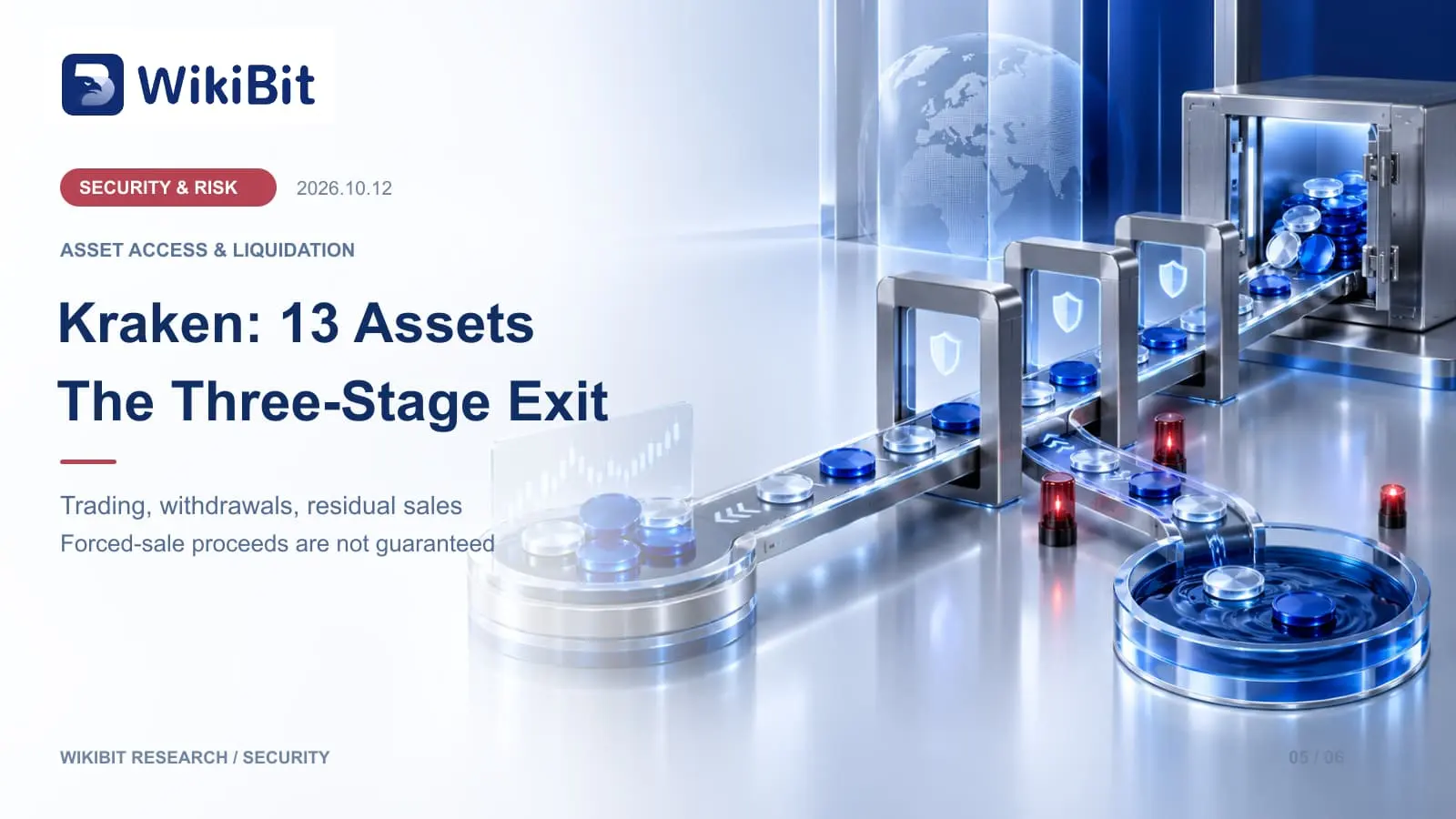
Krakens October 2026 delisting notice places 13 assets on a path toward forced liquidation in February 2027. Customers who leave their holdings on the venue after withdrawals close may receive far less than recent quoted prices, and Kraken expressly warns that some residual positions could produce minimal or no proceeds. The exchanges English notice, last updated October 8, gives three dates: trading and deposits end October 23, 2026 at 14:00 UTC; withdrawals end January 29, 2027 at 15:00 UTC; and remaining balances are subject to automatic liquidation February 1–12, 2027. These are different operational events. A coin can still appear as a custodial balance after trading stops, but that does not mean a holder can later choose a market exit or expect a guaranteed conversion price.Which assets are in the official batch? The current English notice names BMB, ELX, APU, BDXN, DUCK, BOS, U, OBOL, IDEX, FIS, UXLINK, ALTHEA and NOBODY. That is 13 assets. The current accessible Norwegian and Chinese language pages contain the same list. The matching language versions provide useful corroboration of the current batch. They do not establish what a future asset-specific notice might say, and they cannot replace checking account-specific venue restrictions. The confirmed October list should not
Recently, two prominent crypto figures on X, @blmario669 and @choc07_, highlighted the same issue: DEXE, once considered a potential 100x gem, plunged from $46.9 to $5.6 within a single day, an 88% drop. (It has since fallen to a low of $1.5, representing a 97% decline.) During the crash, a large investor reportedly suffered losses of nearly $1.7 million, equivalent to more than 10 million RMB. The sharp decline in DEXE has drawn attention toward market maker DWF Labs, which was accused of using the Ceffu MirrorX mechanism to bypass on-chain monitoring and execute a large-scale sell-off. For more detailed information, please refer to: @blmario669 and @choc07_. DEXE operates in the decentralized social trading and asset management sector. In October last year, it followed the broader market downturn and dropped to a low of $0.136. However, starting in February this year, it went against the market trend and entered a five-month consecutive rally, reaching $49.4 on July 13. The token recorded a peak gain of more than 360x, making it a true “100x coin.” Its market capitalization ranking also surged from outside the top 100 into the top 50. However, just seven days after reaching its all-time high, on July 21, DEXE suffered an

Kraken Institutional has announced a partnership with on-chain yield platform Upshift to launch a custom Vault service designed for institutional clients. The service will allow qualified investors to generate yield on custodied digital assets, including Bitcoin ($BTC), Ethereum ($ETH), and stablecoins, through tailored DeFi strategies. Partnership details and service structure According to a report from The Block, the collaboration involves building dedicated vaults that are customized to each clients investment strategy, risk tolerance, liquidity requirements, and asset composition. This approach moves beyond standard yield products by offering institutional-grade flexibility and control over DeFi exposure. The vaults will be managed through Upshift‘s on-chain yield infrastructure, which integrates with Kraken’s custody and trading services. This allows clients to maintain their assets under Krakens security framework while accessing decentralized finance opportunities. Market context and institutional demand The launch comes amid growing institutional appetite for yield-generating products in the crypto space. Traditional finance players have increasingly sought ways to deploy idle digital assets productively, particularly in a low-yield macroeconomic environment. However, many institutions have been cautious about DeFi due to concerns around smart contract risk, liquidity fragmentation, and regulatory uncertainty. By offering custom vaults with dedicated risk parameters, Kraken and Upshift aim to address these concerns while providing a compliant