GFSCRegulated
Gibraltar Virtual Asset Service Provider (VASP)





Gibraltar Virtual Asset Service Provider (VASP)


Bitten by Bitso! Pros: Secured transactions, diverse crypto-availablity. Issue: Deposit/withdraw speeds, dwell for ages!

Bitso trading fees are too high compared to other exchanges. Hoax community conference is not attractive, customer support is poor.

Bitso's user interface is very smooth and easy to use, and the trading experience is getting better and better. However, the customer service was a bit disappointing and the response time was not very fast.

not so good exchange i was having a hard time withdrawing my money.
Exchanges with 24H trading volume exceeding 71.98%
| Currency/Name | Trade | Unit Price | Change | 24H Vol | +2%/-2% Market Depth | Liquidity |
|---|---|---|---|---|---|---|
| XRP/USDT | $1.48 | 1.73% | $830,491.38 | $57.63K/$56.39K | 548 |
| USD/USDT | $0.99989536 | 0.01% | $724,041.11 | $84.94K/$92.11K | 584 |
| BTC/USDT | $78,999.15 | 2.18% | $664,571.06 | $143.25K/$120.21K | 596 |
| SOL/USDT | $96.01 | 0.83% | $165,145.25 | $28.35K/$41.39K | 524 |
| ETH/USDT | $2,475.84 | 1.24% | $152,363.52 | $106.67K/$57.22K | 560 |
Bitso is the leading financial services company powered by crypto in Latin America, with a community of over 9 million customers. Bitso offers a secure, regulated, and easy-to-use platform to buy, sell, store, and transact with more than 100 cryptocurrencies.
Bitso Business is the B2B segment of the company, serving more than 1,900 institutional clients. It provides infrastructure for cross-border payments and stablecoin-based solutions that enable global companies to pay and receive payments instantly in local currencies, efficiently and transparently.
Founded in 2014, with more than 500 employees in 35 countries, Bitso works to make crypto useful, unlocking the power of secure, borderless, and easy-to-use financial products. The company remains committed to empowering the region by providing universal access to the digital economy of the future and enabling a fairer monetary system. For more information, visit bitso.com.
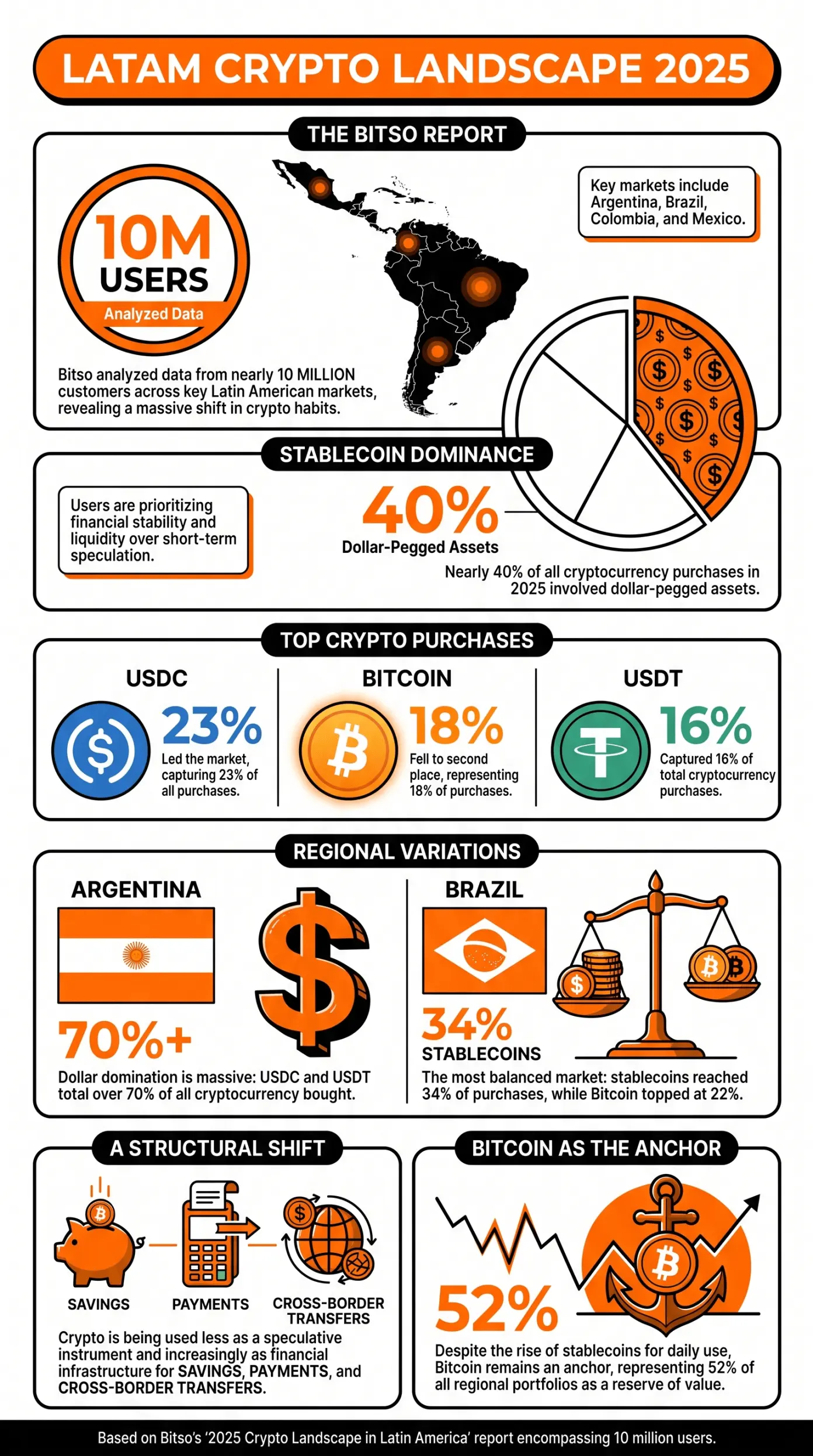
In its latest Crypto Landscape in Latin America 2025 report, Bitso found that 40% of all crypto purchases in the region involved dollar-linked assets, such as $USDT and $USDC. Even so, Bitcoin remains the most widely held asset, representing 52% of all portfolios. Key Takeaways:Bitsos 2025 report reveals that stablecoins like $USDC drove nearly 40% of crypto purchases across Latam.Highlighting a shift to stability, $USDC and $USDT now comprise over 70% of all crypto bought in Argentina.Moving forward, Latam users will keep using stablecoins for payments while holding 52% of funds in BTC. Bitso Report Reveals Latams Preference for Stablecoins Bitso, one of Latams largest cryptocurrency service providers, has unveiled its 2025 Crypto Landscape in Latin America report, underscoring the key role of stablecoins in the region. The report, which analyzed data from nearly 10 million customers across key markets including Argentina, Brazil, Colombia, and Mexico, found that nearly 40% of all purchases in 2025 involved dollar-pegged assets, such as $USDT and $USDC. $USDCs share of purchases (23%) overcame Bitcoin (18%) and $USDT (16%), which the exchange took as a sign that its customers are now prioritizing financial stability and liquidity over short-term strategies. This dynamic repeats across all nations, with variations. In Argentina, dollar domination
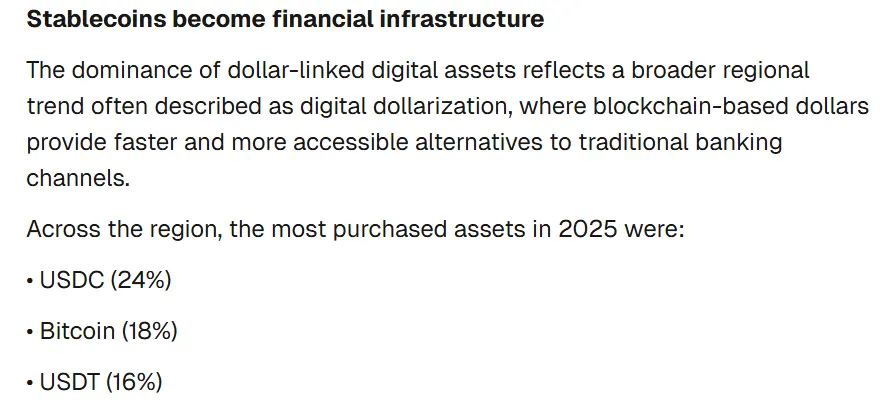
Digital asset adoption in Latin America is evolving, with more users now converting funds into stablecoins than into Bitcoin — a shift that reflects growing pressure from local economic conditions. According to Bitso‘s 2025 report on crypto adoption in Latin America, 40% of crypto purchases in 2025 were US dollar-linked stablecoins such as Tether’s USDt (USDT) and Circles $USDC ($USDC), while Bitcoin ($BTC) accounted for 18%. The report marks the first time stablecoin purchases have surpassed Bitcoin in the region. The findings are based on data from Bitsos nearly 10 million retail users across its exchange platform. The trend reflects a broader move toward what the Latin American crypto exchange described as “digital dollarization.” In countries facing persistent inflation, currency depreciation and limited access to traditional banking, stablecoins offer a relatively accessible way to store value and transact in US dollar equivalents. While the US dollar itself is not immune to inflation, it tends to depreciate more slowly than many local currencies and remains the worlds dominant medium of exchange, making it an attractive benchmark for users seeking stability. The most purchased assets in 2025 across Latin America. Source: Bitso The global stablecoin market has grown to roughly $320 billion, with adoption expanding across both developed
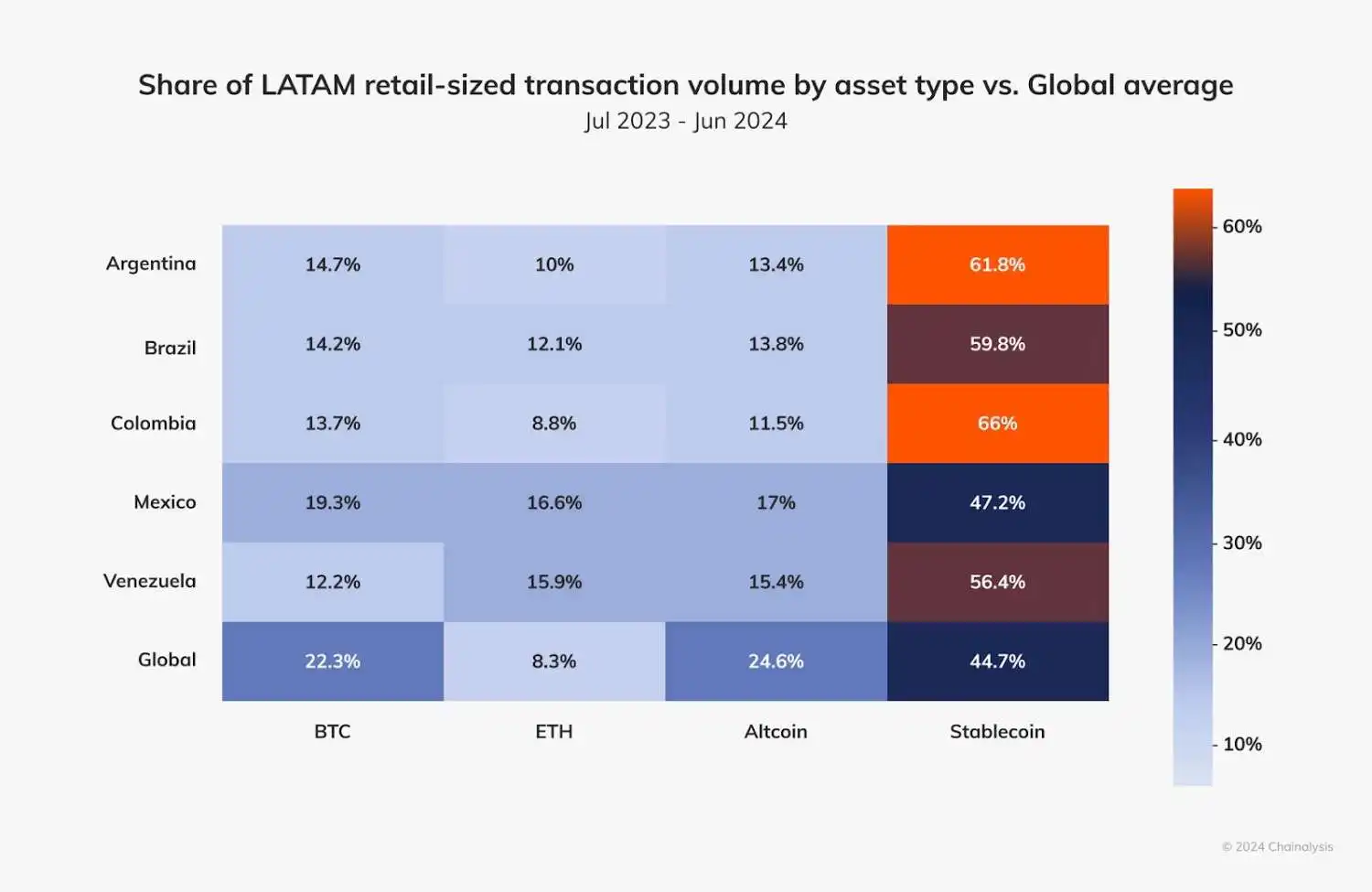
Bitso, the largest cryptocurrency exchange in Latin America, has announced plans for the launch of a multi-platform perpetuals aggregator and its own native token in 2026, according to the latest information shared with Finbold on Wednesday, November 26. The expansion initiative seeks to capitalize on the accelerating crypto adoption in the region seen in the past couple of years. Indeed, the Mexico-based exchanges retail user base grew more than 12% in 2024, reaching nine million customers. Stablecoins have seen the most notable surge in popularity, with Chainalysis data showing that Latin America is leading the world in stablecoin adoption, with traders in Argentina, Brazil, and Colombia recording stablecoin transaction shares of 61%, 59%, and 66% in 2024, respectively. Looking ahead, Bitso Business projects the regions remittances market to more than double from $600 billion today to $1.37 trillion by 2030. New trading features on Bitso Further, the Bitso user base is showing growing interest in more advanced trading features. This seems evident in the fact that the exchanges professional-grade (“Alpha”) and retail (“Classic”) segments generate nearly identical trading volumes despite the former serving fewer clients. The management interprets this as evidence that customers are increasingly “leaning towards sophisticated algorithmic trading.” This shift, propped by increased institutional