






Twelve Nasdaq 100 stocks have more than doubled in 2026, and none of them belong to the Magnificent Seven.
The Magnificent 7 stocks all have different primary focuses, even though they are grouped together as large, influential tech-adjacent powerhouses heavily tied to trends like artificial intelligence. But the biggest leaders was SanDisk, up 411% year to date, while Micron and Intel also more than doubled this year.
Sponsored

Sponsored
All 12 Nasdaq 100 Stocks That Doubled
The rest of the list skews heavily toward companies that build AI infrastructure hardware rather than software platforms.
- Sandisk (SNDK) +406%
- Micron (MU) +207%
- Intel (INTC) +175%
- Arm Holdings (ARM) +159%
- Marvell Technology (MRVL) +157%
- Western Digital (WDC) +152%
- Lumentum (LITE) +142%
- AMD (AMD) +126%
- Nebius (NBIS) +125%
- Applied Materials (AMAT) +110%
- Fortinet (FTNT) +101%
- Astera Labs (ALAB) +101%
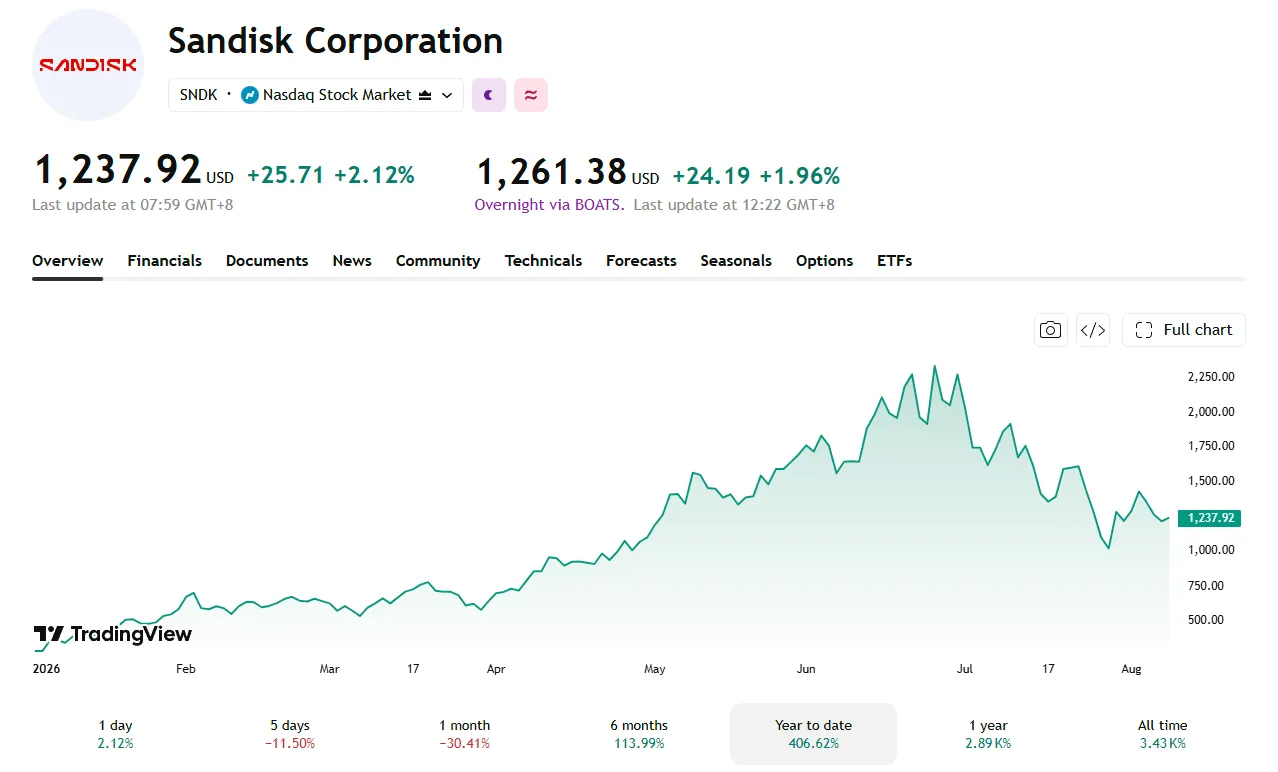
Even with a substantial drop, SanDisk is a top performer. Image Source: Trading ViewThe Magnificent Seven Are Sitting This Out
Returns vary widely inside the group. Amazon leads with a 20% gain this year, followed by Nvidia at 14%, Apple at 13%, and Alphabet at 12%.
Microsoft has managed just a 4% gain. Meta has fallen 10%, and Tesla is down 27%, the groups weakest performer. The S&P 500 has gained roughly 13% over the same period.
Sponsored
Sponsored
Ed Yardeni, founder of Yardeni Research, has tracked the reversal for months.
“The Impressive-493 has outperformed the Magnificent-7 since last November.”
Ed Yardeni,
Nvidia and Amazon are the only members keeping pace with the broader market this year with much expected from Nvidia as it continues to propel the AI chip market.
The gap leaves five of the seven trailing the broader index. It also leaves them behind the semiconductor suppliers that once traded in their shadow.
Why This Is Happening
Investors have rotated out of the Magnificent Seven and into companies building the physical AI infrastructure. Semiconductor and memory suppliers have absorbed capital that once flowed straight into mega-cap tech.
Wall Street‘s own strategists have pushed the trade further. Morgan Stanley, Goldman Sachs, and JPMorgan have all said in recent weeks that the group’s underperformance has gone too far.
Morgan Stanley Wealth Managements chief investment officer, Lisa Shalett, still called the semiconductor rally “meaningfully overbought.” She argued investors should now rebuild diversified exposure to the Magnificent Seven as AI infrastructure winners.
Why the AI Trade Moved Downstream
Most of these winners sell the physical building blocks of the AI boom. Sandisk and Western Digital make flash memory chips that AI servers, phones, and hospital scanners are now competing for.
That shortage has pulled in retail traders. Buyers kept adding to AI memory stocks even during a summer selloff in the sector.
Wall Street is split on how to trade the theme. JPMorgan and Morgan Stanley disagreed in July over the AI chip trade.
Jim Cramer took a side. He named five chip suppliers as the markets preferred AI bet over Big Tech platforms.
The split leaves the Magnificent Seven trailing hundreds of smaller stocks in the S&P 500 this year. Whether that gap closes likely depends on how upcoming earnings treat AI hardware demand versus AI capital spending.