SEC Grants Paxos Historic Approval to Clear and Settle US Equities on Blockchain

Charles Cascarilla, the chief executive officer and co-founder of Paxos, highlighted the arduous regulatory journey during the Thursday announcement, stating:  “Our clearing agency registration is the result of seven years of work with the SEC, beginning with our No-Action Letter in 2019 and the settlement pilot we operated with some of the worlds largest and most sophisticated financial institutions.”  He further emphasized that the approval allows the company to offer “the most complete infrastructure” for financial partners seeking to evolve alongside the blockchain-enabled tech realm.  The SECs decision validates a multi-year track record of live clearing and settlement operations because, as far back as February 2020, Paxos had operated under an SEC no-action relief letter, quietly clearing and settling U.S. equities daily for major global broker-dealers, including Credit Suisse, Instinet, and Société Générale.  With the latest registration secured, Paxos could drastically expand its footprint across global capital markets. The firm, which is already prudentially regulated by the New York Department of Financial Services (NYDFS) and serves as the infrastructure backbone for stablecoins utilized by Paypal and Mastercard, will now push to integrate its clearing network across major trading venues.  Lastly, while the SEC has frequently utilized regulation by enforcement against digital asset exchanges and decentralized


05-30

Coinbase Launches Crypto Derivatives Trading In US After CFTC Approval

Coinbase CEO Brian Armstrong shared a major feat for the exchange today. The exchanges derivatives business Coinbase Financial Markets has announced it is the first regulated futures commission merchant (FCM) in the United States. It can offer institutional users access to crypto perpetual futures and options markets worldwide.  Coinbase Introduces Derivatives Trading For US Traders  The company stated the move opens up a part of the digital asset market that has largely been inaccessible to US traders in regulated frameworks.  For context, crypto derivatives make up almost 80% of all global digital asset trading volume. Moreover, perpetual futures and options dominating the crypto trading volume on offshore exchanges, Coinbase noted.  The crypto exchange also spotlighted that the market is creating trillions of dollars in annual trading. However, the United States didnt have a compliant domestic access point, it added.  According to Coinbase, the guidance issued by the Commodity Futures Trading Commission (CFTC) is what made it possible. The recent decision allows Coinbase Financial Markets to provide access to international crypto derivatives liquidity to US clients. The offering provides access to one of the worlds largest crypto options exchanges.  Further, the company states that institutions can now start onboarding immediately on its crypto derivatives platform. Meanwhile, Bitcoin

05-30

Perps Lift Crypto Stocks—Robinhood, Coinbase End Week In The Green After CFTC Move

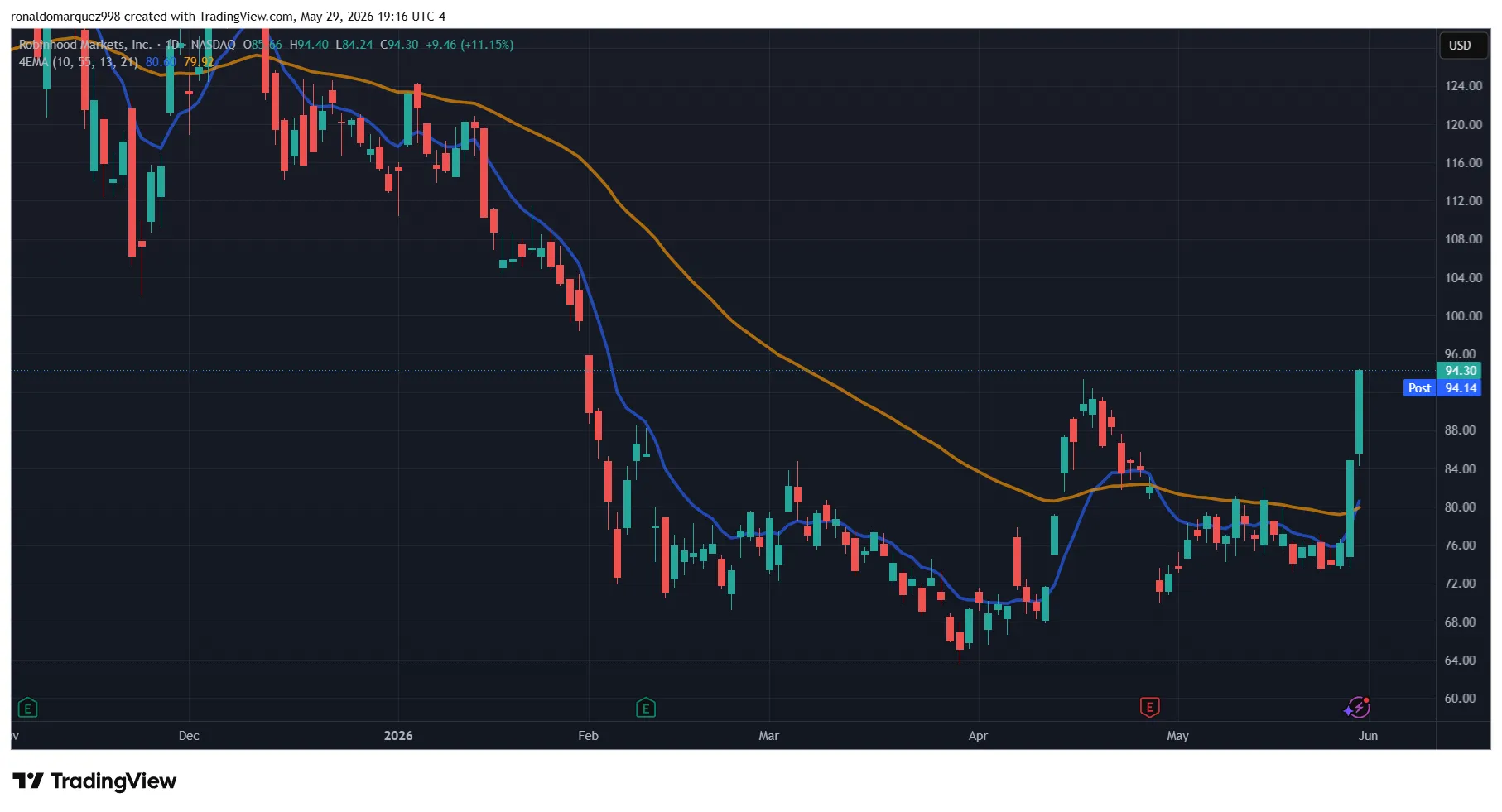
Robinhood (HOOD) and Coinbase (COIN) ended the week‘s final session in the green, with Robinhood’s stock leading the move as US regulators took steps that could expand the local market for crypto derivatives.  Shares of Robinhood rose sharply, jumping about 11% on the day to close around $94 per share, which also marked the highest level the stock has reached since February.  Coinbase (COIN) was not far behind, gaining close to 7% as the exchange‘s shares finished the session near $189. That level sits in the middle of the stock’s broader consolidation range of roughly $160 to $215, a band it has been trading within since late March.  CFTC Sparks HOOD And COIN Rally  The rally for both companies was widely attributed to action from the Commodity Futures Trading Commission (CFTC). Earlier on Friday, the agency announced it would allow US firms to offer perpetual (perps) futures trading, a potential catalyst for new product launches and expanded trading activity within the United States.  In addition to that policy shift, the CFTC also moved that same day to issue a no-action letter to Coinbase. Under the regulator‘s guidance, the letter permits Coinbase’s US customers to access the options and perpetuals the company already offers.  The impact of

05-30

JPMorgan CEO says banks will continue fighting against CLARITY bill

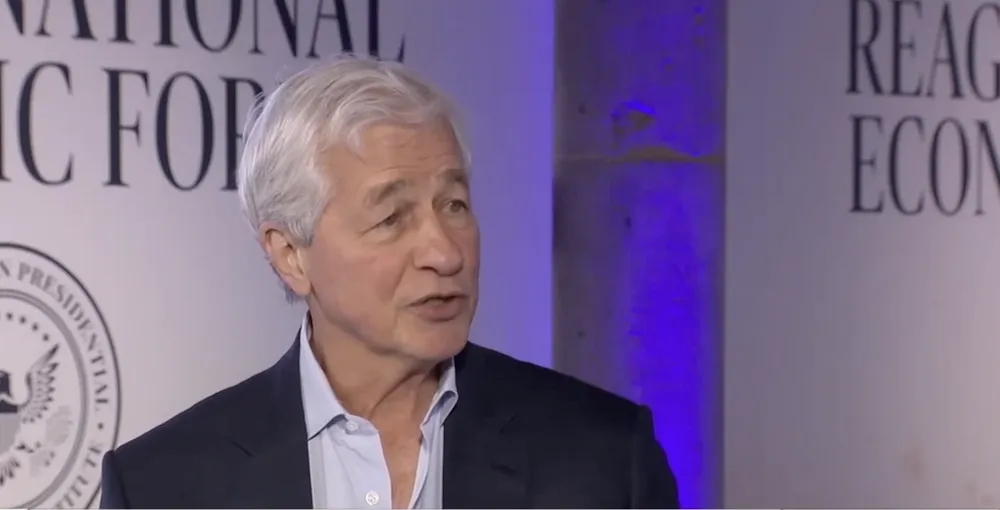
Jamie Dimon, the CEO of banking and financial services giant JPMorgan, said that the banking industry would continue to “fight” against the current version of the Digital Asset Market Clarity Act (CLARITY), a crypto market structure bill in the United States.  Dimon told Fox Business that the latest version of the bill “effectively” allows crypto companies to pay interest on user deposits and stablecoin balances.  The bill also fails to impose the same Anti-Money Laundering (AML) provisions, sanctions regulations outlined in the Bank Secrecy Act (BSA), and capital reserve requirements that banks must follow on crypto service providers, he said.  “The banks will not accept it that way,” Dimon continued, adding that if crypto companies want to offer yield-bearing products to customers, they should apply for banking charters.  Jamie Dimon says the banking industry will continue to oppose the CLARITY market-structure bill. Source: Fox Business  Dimon was critical of Coinbase and CEO Brian Armstrongs role in the ongoing negotiations between the crypto industry and the banking lobby. He said:  “We will fight it, if we lose, we lose, and we will live, okay? But it will be fought. No one is going to bow down to this guy or that company, and hes the only one,

05-30

SoFi stock warning: stablecoin faces major scaling headwinds

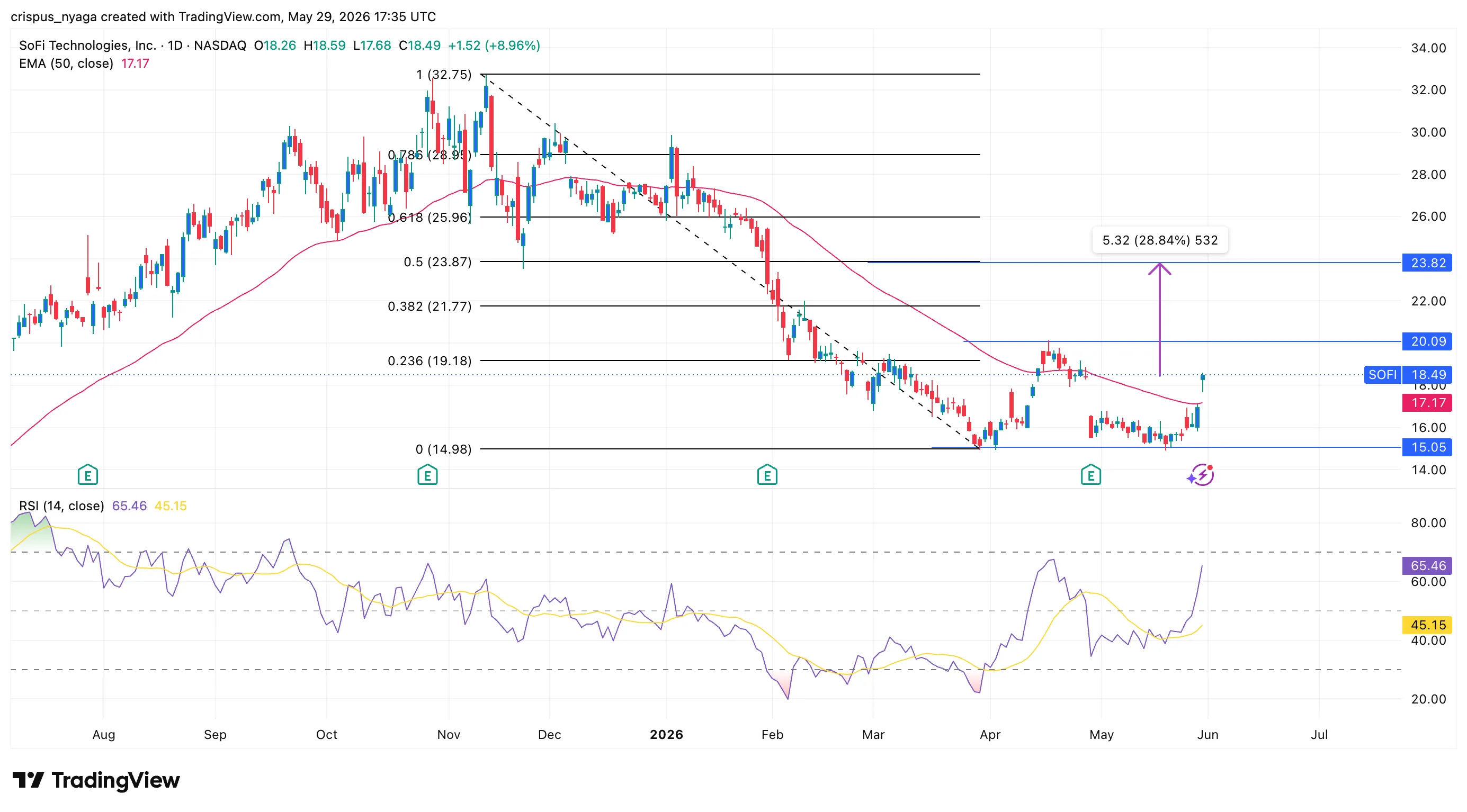
SoFi Technology (NASDAQ: SOFI) stock price popped on Friday after forming the highly bullish double-bottom pattern at $15. It soared to a high of $18.50, its highest point since April 28, up by 22% from its lowest point this year, as investors welcomed the new stablecoin.  SoFi Technology stock technicals point to more gains  The daily chart shows that the SoFi share price crashed and bottomed at $15, its lowest point in April and May this year. It formed a double-bottom pattern with a neckline at $20, its highest point on April 17. A double-bottom is one of the most common bullish reversal signs in technical analysis.  The stock has now jumped above the 50-day Exponential Moving Average (EMA), a sign that bulls have prevailed. Also, the Relative Strength Index (RSI) moved above its moving average and the neutral level of 50.  Therefore, the stock will likely continue rising as bulls target the key resistance level at $20. A move above that price will point to more gains, potentially to the 50% Fibonacci Retracement level at $23. This target is about 28% above the current level.  On the flip side, a drop below the double-bottom level at $15 will invalidate the bullish forecast and point

05-30

Nvidia’s Most Important Rental Chip Just Got 40% Cheaper: Why That’s Bad News for NVDA Stock

Nvidia (NVDA) H200 GPU rental prices fell roughly 40% in three weeks, sliding from $7 to about $4 per hour. The repricing is testing the AI scarcity story and tightening near-term risk around NVDA shares.  NVDA closed at $214.25 on May 28 ahead of the latest reading from the Ornn Compute Price Index. Spot softness on older Hopper chips is feeding fresh investor doubt about hyperscaler demand durability.  Nvidia (NVDA) Stock Performance. Source: Google FinanceOlder Silicon Weighs on the Nvidia Bull Case  The H200 drop tracks Nvidias generational handoff. Blackwell B200 and GB200 chips absorb premium pricing as Hopper supply normalizes across neoclouds, per Ornn.  Nvidia H200 Rental Prices. Source: Ornn Dashboard  Older GPU softening fuels narrative risk for shares priced on perpetual scarcity after Nvidias record earnings.  “The price to rent an Nvidia H200 just collapsed from $7/hr to $4/hr in three weeks. A -40% drop in the cost of the single most strategic asset in tech,” analyst Thierry Borgeat of Arvy highlighted.  Analysts Stay Constructive on NVDA  Wall Street has not flinched yet. Wedbushs Dan Ives kept his Outperform rating and $300 target, citing the AI capex boom. Consensus across 43 analysts sits near $304, implying 43% upside.  The bigger swing factor sits at the customer level.

05-29

Top Cryptos Struggle as Hyperliquid (HYPE) Only One Pushing Higher

With double-digit gains, Hyperliquids native token HYPE emerges as the clear winner among the largest assets in the cryptocurrency market, while Bitcoin, Ethereum, Solana, and XRP struggle to maintain their momentum. HYPE is the only asset in the top five cryptocurrencies by futures open interest to see significant growth, according to the most recent market data, which shows that it has increased by more than 11% in the past day.  Big players are out of it  While overall market activity remained relatively low during that time, Ethereum gained slightly more than 1%, and Bitcoin gained less than 1%.  HYPE/USDT Chart by TradingView  Even more notable is the fact that HYPEs performance took place despite a notable decline in the overall volume of derivatives in the cryptocurrency market. The trading volume for Bitcoin, Ethereum, Solana, and XRP dropped by 25% to 30% during the day. In contrast, Hyperliquid experienced a nearly 14% increase in volume and an incredible 15% increase in open interest.  Is Saylor Selling? Strategy Moves $30 Million in Bitcoin  Ripples Schwartz Mocks Audacious $286 Billion Bitcoin Lawsuit  The divergence shows that traders are continuing to rotate capital into the Hyperliquid ecosystem despite a decline in participation elsewhere.  You Might Also Like  From a technical perspective, HYPE remains

05-29

Micron Stock Analysis: 3 Key Levels as MU Stalls Below 950

MU — daily chart with candlesticks, EMA20/EMA50 and volume.Daily Technical Outlook for Micron StockTrend and Momentum  On the daily timeframe, MU closed at 923.52 after a 904.78–949.49 range. EMAs are stacked and rising: EMA20 735.53, EMA50 603.02, and EMA200 382.42. Therefore, the primary trend is decisively higher and extended above medium‑ and long‑term averages.  RSI14 sits at 75.68. Momentum is hot and overbought, which raises near‑term pullback risk without breaking the trend. Meanwhile, MACD prints 94.76 versus a 81.31 signal with a 13.45 histogram, keeping upside momentum positive and the bull case intact.  Bands, Volatility, and Pivots  Bollinger Bands show a mid at 728.77, an upper at 950.46, and a lower at 507.08, with price settling just beneath the upper band. However, the advance is stretched toward resistance, making follow‑through tougher without fresh fuel.  ATR14 is 67.98, indicating wide daily swings. Daily pivots sit at PP 925.93, R1 947.08, and S1 902.37, with price a touch below the pivot. Therefore, resistance is tight into 947 while first meaningful support tracks around 902.  Intraday Context: 1‑Hour Chart for MU  On the 1‑hour chart, the regime stays bullish but the thrust is fading. Price closed at 923.52, above EMA20 900.57, EMA50 838.18, and EMA200 682.02. Interpretation: the intraday trend

05-29

USDT & USDC Dominance: Benefits and Risks

Censorship, compliance, and address blacklists  Sanctions and law-enforcement requests shape how fiat-backed stablecoins operate. Both USDT and USDC have mechanisms to freeze balances at designated addresses. This is part of how issuers maintain banking relationships and comply with regulations.  For context on how sanctions regimes interact with crypto, review official sources such as the U.S. Treasurys announcement on sanctioning Tornado Cash-related entities (press release). Issuers publish policies and past actions; Circle, for example, communicates compliance decisions and blacklisting events through its site and blog, while Tether provides updates on law-enforcement collaborations and freezes on its transparency and news pages.  Operational takeawaysSegregate wallets by counterparty risk and business line to limit contagion from a freeze.Verify whether your custodian supports rapid address rotation if a wallet is flagged.For sensitive use cases, consider reducing reliance on assets with centralized freeze features—balancing that against liquidity needs.  Cross-chain realities: chains, bridges, and wrappers  USDT and USDC are native on multiple chains, but not everywhere. When a stablecoin isnt native, wrapped versions fill the gap. That convenience comes with added trust assumptions.  Bridge risk is additive  A wrapped stablecoin inherits issuer risk plus bridge risk. Exploits, validator failures, or governance issues at the bridge can cause a wrapper to diverge from parity with

05-29

No CBDC Under Trump: Treasury Secretary Scott Bessent

Treasury Secretary Scott Bessent said the Trump administration will not allow a US CBDC.The House-backed CBDC ban expires in Dec 2030, raising concerns among Republicans.Bessent also asked Congress to pass the CLARITY Act to establish clear crypto rules.  US Treasury Secretary Scott Bessent said the Trump administration will not allow a central bank digital currency in the United States, repeating the White House position during a press briefing on Thursday.  According to Journalist Eleanor Terrett, Bessent said a CBDC was “off the table” and framed it as a possible tool for financial tracking and surveillance.  Instead, he said the administration wants digital asset businesses, stablecoin issuers, and crypto trading activity operating inside the US regulatory system instead of offshore markets.  CBDC Ban Faces a 2030 Deadline  While the administration continues to oppose a Federal Reserve-issued digital dollar, the current legislative setup is not permanent.  The House-passed ROAD to Housing Act includes a temporary ban on a Fed-issued CBDC, but that restriction expires in December 2030. Some Republican lawmakers have warned that the expiration could reopen the door for the Federal Reserve to revisit a digital dollar program later in the decade.  Former Fed Governor and current Fed Chair Kevin Warsh has also stated he would block movement

05-29
1
...
672674
...
1000