Ethereum is splitting into three power centers and ETH treasury firms are paying for two
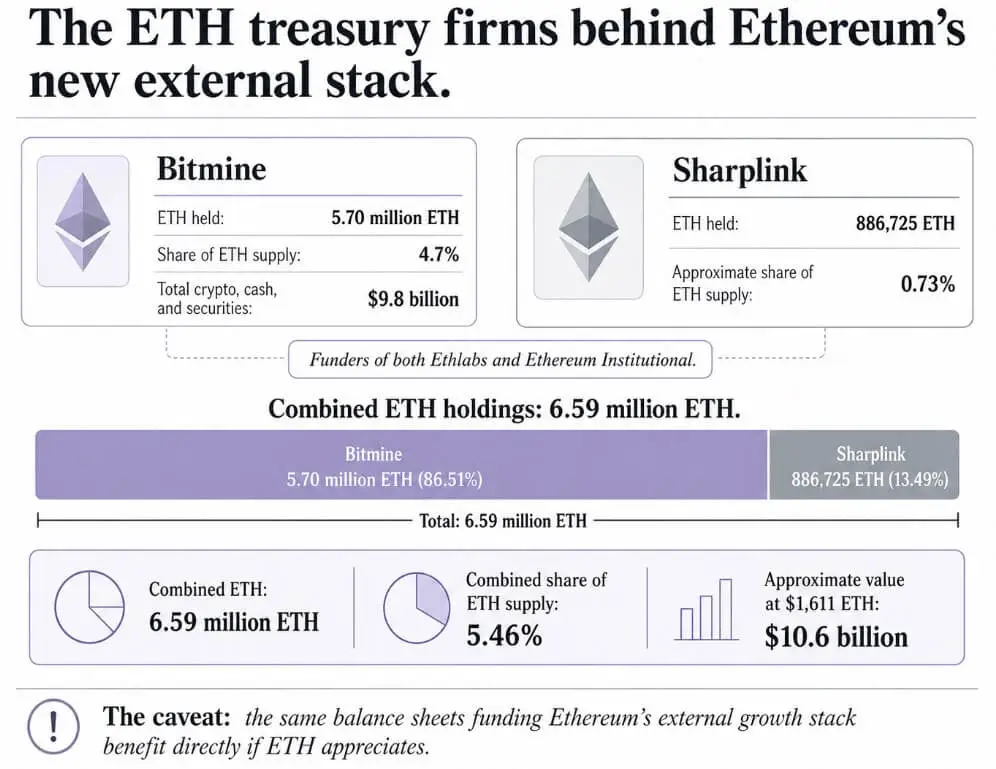
Ethereum Institutional announced its launch on July 1, folding a year of the Foundations go-to-market work into a group pitching Ethereum to banks and asset managers on tokenization and stablecoins. Ethlabs, built by five former senior Ethereum Foundation (EF) researchers, surfaced days earlier with the goal of faster settlement and $ETHs monetary case. Bitmine, Sharplink, and Joe Lubin fund both initiatives. The timing lines up with an organizational unraveling within the Foundation itself, as Hsiao-Wei Wang stepped down as EF co-executive director on June 18, joining Tomasz Stańczaks earlier resignation and at least eight senior departures over five months. The Foundations own March 2026 mandate already redefined its role: as a steward of self-sovereignty, censorship resistance, open-source code, privacy, and security, with no claim to being Ethereums parent or final authority. That leaves room, deliberately or not, for outside groups to take over the commercial half of the work. Ethlabs absorbed the technical and asset-value side, focused on infrastructure readiness, $ETH as a monetary instrument, and the arguments that make institutions comfortable holding and building on the chain. Ethereum Institutional absorbed the sales side through relationship-building, forums, and the pitch decks that turn interest into deployed capital. Both moved outside the EF because the Foundation was never