Bitcoin Price Clings to $75K After a Nasty $74,913 Shakeout

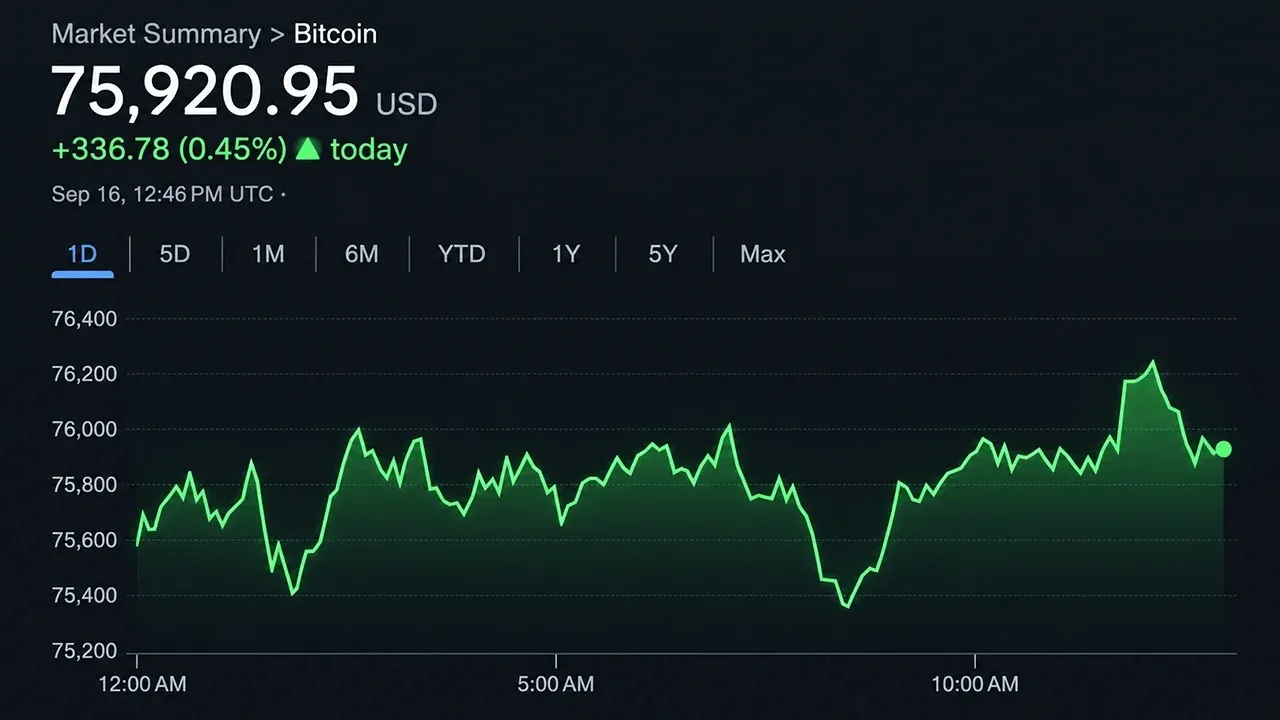
At 8:40 a.m., bitcoins price is hovering around $75,879 on Sept. 16, 2026, after a sharp intraday washout tested $74,913 and buyers managed to pull the price back into the mid-$75,000s. The bigger picture is far less tidy. Short-term momentum remains weak, longer-term moving averages still lean positive, and bitcoin is sitting between nearby support and a thick stack of resistance overhead.  Key TakeawaysBitcoins price held above its $74,913 wick low as buyers defended the $75,000 area.Bitcoins daily technicals stayed neutral, with 8 moving averages flashing negative.Bitcoins price needs to reclaim $76,000-$77,000 to target the $79,800-$82,300 zone.  One-Hour Chart: Buyers Defend $74,913, but the Bounce Needs Muscle  On the 1-hour chart, bitcoins price drama centers on a local high of $79,837 and a long lower wick that reached $74,913 before buyers stepped back in. Price subsequently recovered to roughly $75,859 at capture, while intraday volume picked up during both the selloff and ensuing bounce.  BTC/USD 1-hour chart via Bitstamp on Sept. 16, 2026.  That puts $74,913 squarely in the spotlight as nearby support. Holding roughly $75,000 to $74,900 keeps the post-wick recovery intact, while a break and hold below $74,900 would establish the first clear lower low of the current 1-hour swing. On the flip

09-16انڈسٹری

Bernstein expects ‘aggressive’ rulemaking from SEC, CFTC, following CLARITY Act failure

Bernstein analysts expect “aggressive and swift” rulemaking from the US Securities and Exchange Commission (SEC) and Commodity Futures Trading Commission (CFTC), after the Digital Asset Market Clarity (CLARITY) Act failed to pass a Senate cloture vote on Tuesday.  Bernstein analysts said the regulatory agencies will publish new regulations to “make up for the time lost negotiating the CLARITY Act,” in a Wednesday note shared with Cointelegraph.  The analysts said they expect agency regulations including token taxonomy for raising capital, developer protection measures concerning decentralized finance and self-custodial protocols, innovation exemptions for equity tokenization, faster approval times for real-world asset perpetual futures, and amendments to rules around federal sports even contracts and their classification as swaps.  Bernstein said that these federal agencies will bring more regulatory clarity for the industry, to compensate for the failure of the CLARITY Act, which would have “fool-proofed the industry against political regime shifts.”  On Tuesday, the US Senate failed to pass a cloture motion on the CLARITY Act, which would have established the country‘s first regulatory framework for digital assets. Bernstein’s analysts said that a re-vote of the act was unlikely, citing a limited time window and concerns over the bills ethics provisions.  On Aug. 19, the SEC proposed new

09-16انڈسٹری

Two Prime launches $10M-backed Bitcoin yield vault

Two Prime has launched an institutional Bitcoin lending vault on Pareto targeting annual returns of 1.5% to 2%, with roughly $10 million of the firms own capital committed to absorb initial credit losses.  CoinDesk reported on Sept. 16 that the Axiom WBTC Yield Vault accepts Wrapped Bitcoin and requires a minimum investment of 5 WBTC, putting the entry level near $380,000 with Bitcoin trading around $76,000 at publication. The quoted yield is a target tied to lending conditions and is not guaranteed.  The product takes Two Primes existing institutional credit business onto blockchain-based infrastructure, with Pareto handling the private-credit rails and ICE Digital Trust and Copper Technologies providing custody. Two Prime plans to lend deposited assets to institutional counterparties that can include public companies, credit-rated borrowers and diversified financial firms.  Two Prime puts $10 million behind the WBTC vault  Two Primes capital commitment gives the Axiom vault a first-loss layer before participating investors bear certain credit losses. CoinDesk placed the commitment at roughly $10 million, although the report did not disclose the precise size of the vault, its maximum capacity or how much of that capital had already been deployed when the product was announced.  The structure does not make the targeted return risk-free. Its

09-16انڈسٹری

KREMLIN malware uses Ethereum to update attack servers

Security researchers have traced more than 1,500 KREMLIN malware infections after uncovering a Brazilian banking campaign that uses Ethereum smart contracts to update attack infrastructure and malicious browser extensions to steal credentials and session data.  Elastic Security Labs disclosed the operation in a Sept. 14 technical report after tracking the activity under REF9334 since May 2025. Researchers followed seven campaigns over roughly 15 months and linked the latest versions to Chrome and Microsoft Edge extensions capable of collecting browser credentials, cookies, session tokens and other sensitive information.  SlowMist issued a threat-intelligence alert on Sept. 16 drawing attention to the blockchain component of the operation, including three Ethereum contracts linked to changing command-and-control infrastructure.  Despite the name KREMLIN, Elastic said it found no evidence connecting the campaign to Russia. The toolkit name comes from the malware authors handle, while the lures impersonate Brazilian banks, use Portuguese-language text and overwhelmingly reach systems located in Brazil.  ???? SlowMist TI Alert: KREMLIN Malware ????  Recently, a Brazilian banking malware operation, #REF9334, active since at least May 2025, was disclosed.  ???? The #KREMLIN malware ecosystem uses multi-stage loaders and malicious browser extensions to steal credentials, session tokens,… pic.twitter.com/8nYKgwgmfG  — SlowMist (@SlowMist_Team) September 16, 2026  KREMLIN uses Ethereum contracts as changing address books  Ethereum entered

09-16انڈسٹری

Bitcoin absorbs initial pre-Fed sell-off, leaving $70K as a critical test for Warshs Fed decision

Bitcoin fell to an intraday low below $75,000 on Sept. 15, extending a selloff already underway ahead of the Senate vote on the CLARITY Act.  Related Asset Bitcoin #1 BTC · $76,157.64 24-hour change: down 0.93% Loading price history… 24H Down 0.93% 7D Down 4.01% 30D Up 19.87%  The Senate failed 49-50 to invoke cloture on a motion to proceed to the bill, short of the 60 votes required, leading Bitcoin to its intraday low.  Coinbase fell about 10%, and Circle lost more than 11%, with the larger losses hitting crypto businesses directly exposed to US regulation.  On the macro side, the 10-year Treasury yield reached 5.041%, its highest level since 2007, while Brent crude traded above $105.  Related Company Coinbase A leading digital currency company  Polymarket showed odds for CLARITY passage falling from 31% to 19% before the vote, and Bitcoin had already slipped below $77,000 during that repricing.  The final vote landed in a market that had already priced in a much higher probability of failure. The decline combined political disappointment with 5% Treasury yields, $100-plus oil, and tighter rate expectations.ShockArticle figureWhy it mattered for BitcoinCLARITY Act vote failed49-50, short of 60-vote cloture thresholdRemoved near-term regulatory upsideBitcoin price actionIntraday low below $75,000Broke below the prior

09-16انڈسٹری

Zcash holders back 25-second blocks, vote to keep ZEC halving schedule

Zcash token holders backed cutting the networks target block time to 25 seconds from 75 seconds and preserving its existing halving schedule in a poll on the next major upgrade.  The faster-block proposal received 99.9% of the Zcash (ZEC)-weighted vote, while 98.9% supported keeping halvings, according to results published Monday. Voting power reflected eligible ZEC holdings, with both percentages including abstentions.  The shorter interval would reduce the expected wait for a transactions first confirmation, according to the proposal. The amount of new ZEC issued per block would fall to keep scheduled daily issuance unchanged.  The changes are proposed for NU7, a Zcash network upgrade whose activation date remains undetermined. Token holders also favored excluding features not implemented by Sept. 30.Results of the NU7 sentiment poll. Source: forum.zcashcommunity.com  The coinholder vote was separate from polls of ZecHub, the Zcash Community Advisory Panel and other community groups. Eligibility was limited to spendable ZEC in the Ironwood shielded pool at the voting snapshot. Developers plan to ship the final items for the upgrade by the Sept. 30 cut-off deadline, with testnet and mainnet activation not yet determined.  Halvings are scheduled cuts that reduce the issuance of new ZEC by half. The winning coinholder option would preserve that schedule

09-16انڈسٹری

Kraken parent plans regulated Hyperliquid perps

Payward has announced plans to bring on-chain perpetual futures to eligible U.S. clients through Hyperliquids HIP-3 infrastructure, using CFTC-regulated Bitnomial to deploy, clear and settle the proposed contracts.  Payward, the parent company of Kraken, said on Sept. 16 that Hyperliquid would be the first blockchain protocol used for the initiative. The planned markets remain subject to regulatory approval and are not yet available for U.S. trading.  The proposal expands on Paywards existing U.S. derivatives business. In its second-quarter 2026 financial update, the company said Bitnomial infrastructure already supports regulated U.S. perpetual futures and spot margin products. Payward reported 6.6 million funded accounts at the end of June, up 42% year over year.  NEW: Kraken‘s parent company Payward confirmed our scoop earlier that it is bringing Hyperliquid’s perps to the US, first starting with a permissioned HIP-3 market pic.twitter.com/vOA7sw3pmn  — Muyao (@MuyaoShen) September 16, 2026  Payward would put regulated markets directly on Hyperliquid  The planned structure differs from Payward‘s existing U.S. perpetual futures because trades would use Hyperliquid’s public blockchain infrastructure.  Under Payward‘s proposal, Bitnomial Exchange would act as the HIP-3 deployer. It would create, own and administer the perpetual markets while Bitnomial Clearinghouse handles clearing and settlement. Transactions would use Hyperliquid’s on-chain order book for matching and

09-16انڈسٹری

Ethiopia cuts power to Bitcoin miners as El Niño strains hydropower

Ethiopia has cut electricity supplied to Bitcoin miners to 23% of contracted levels after a 20% drop in reservoir inflows strained the countrys hydropower system.  Bloomberg reported on Tuesday that El Niño had intensified dry conditions across the East African country, forcing state-owned Ethiopian Electric Power to reduce electricity supplied to mining operations while prioritizing households and manufacturers.  EEP CEO Ashebir Balcha said the utility initially lowered electricity deliveries to miners to 75% of their contracted amounts before reducing them to 50% and eventually 23%.  The company plans to reassess reservoir and electricity conditions in October. Further cuts remain possible if water levels do not improve, while Ethiopia could restrict electricity exports to neighboring countries if domestic supply comes under more pressure.  Bitcoin miners lose access to most contracted power  Bitcoin miners have become a large source of demand for Ethiopias electricity system after low-cost hydropower attracted operators looking for cheaper energy.  Mining companies consumed almost one-third of the country‘s electricity output and generated 35% of EEP’s revenue during the previous fiscal year, according to Bloomberg. The latest restrictions therefore affect a customer group that has become financially important to the state power company.  Ethiopias mining expansion has been built largely around its hydroelectric resources. As crypto.news

09-16انڈسٹری

Malicious Uniswap v4 hooks are baiting DeFi traders with fake swap quotes

Liquidity aggregator 0x said on Sept. 14 that it had seen an alarming increase in malicious Uniswap v4 hooks over recent weeks, designed to quote one price and settle at another.  In the most extreme trades it observed, users received as much as 50% less at execution than the amount displayed in the quote.  An aggregator searches many pools, estimates their output, and typically favors the route promising the most tokens. A malicious pool can win the order by looking unusually attractive during that comparison.  Uniswap v4 hooks show when the best quote becomes the attack surface  In its analysis of Uniswap v4 hooks, 0x said it examined 84,163 hooks across six chains using static analysis, dynamic analysis, and settled-trade observations. In the dataset, labeled as of Sept. 11, 0x classified 19.4% as safe, 54.2% as malicious, and 26.4% as likely malicious.  The report separately said 0x had observed malicious routes deliver up to half less than quoted, a maximum shortfall rather than a typical outcome.  One Base hook trading the ETH/NVDAc showed 6,516 fills, including 3,946 charged fills. Fees ranged from 0% to 18%, with an 18% median when charged, and the hook collected $143,037 in total fees as of Sept. 11.  Related Asset Ethereum ETH

09-16انڈسٹری

Kakao sets 6 trillion won revenue target for KakaoAI by 2030

Kakao has set a 2030 revenue target of more than 6 trillion won ($4.3 billion) for its planned KakaoAI business as it prepares to bring AI agents directly into KakaoTalk and separate its investment operations into KakaoX.  SummaryKakao has targeted more than 6 trillion won in KakaoAI revenue by 2030, including roughly 1 trillion won from AI services.The company plans to demonstrate several KakaoTalk AI agents in October that can execute and complete services within the messaging app.Kakao wants its AI services to reach 20 million daily active users while increasing time spent on KakaoTalk by 50%.KakaoX is targeting 10 trillion won in 2030 revenue, with virtual assets, fintech, content, mobility and physical AI among its planned business areas.  Yonhap reported on Sept. 16 that Kakao Group Investment Strategy Office head Kim Do-young disclosed the target during an online meeting with minority shareholders, putting KakaoAIs planned revenue above the 2.7 trillion won recorded by the relevant businesses in 2025.  Revenue generated specifically from AI services is expected to reach roughly 1 trillion won by 2030. Kakao plans to build the business around its KakaoTalk messaging platform, connecting AI with advertising, commerce, maps and other existing services.  The company has set a target of more

09-16انڈسٹری
1
...
205207
...
1000