Bitget hack: Where did the stolen $387M go?

Bitget‘s attacker has moved much of the exchange’s $387.5 million theft toward Bitcoin through cross-chain services, while only around $840,000 had been publicly frozen five days after the Sept. 24 breach.  BlockSec reported that the stolen funds followed three main paths: quickly converting assets that issuers could freeze, consolidating value from several chains into Bitcoin and gradually sending BTC into CoinJoin transactions.  The security firm based its analysis on addresses published through Bitgets tracking dashboard and a Sept. 29 snapshot, meaning the balances and laundering totals can continue changing as funds move.  How did the Bitget hacker move the stolen money?  Bitget said the breach began at 18:31 UTC on Sept. 24 with unauthorized transfers from portions of its hot and warm wallet infrastructure.  BlockSec found that the first transactions involved tiny test transfers of 0.84 ETH and 93 TRX. Larger withdrawals started at 18:58 UTC, while Bitgets reconciliation system detected a discrepancy seven minutes later and blocked ordinary customer withdrawals.  The attackers were not relying on the normal customer withdrawal process, according to Bitget. The exchange said a vulnerability in a third-party security product gave the attackers high-level internal credentials, which were then used to submit forged withdrawal commands directly into its wallet system.  Private keys

1 ہفتوں کے اندرانڈسٹری

South Korea crypto exchange profits fall 78% in H1 amid trading slump

South Korean crypto exchanges saw operating profits fall 78% in the first half of 2026 as trading activity, market valuations and customer deposits declined, according to new government data.  On Thursday, the Korea Financial Intelligence Unit (KoFIU) said average daily trading volume at domestic virtual asset exchanges fell 44% from the previous six months, while market capitalization dropped 33% and won-denominated deposits fell 35%. Exchange sales declined 41% over the same period, even as the number of accounts eligible to trade rose slightly by 0.4%.  KoFIUs survey covered 26 registered virtual asset service providers, including 17 exchange operators and nine custody and wallet providers, and covered activity from Jan. 1 through June 30.  The figures come amid signs that South Korean retail investors have been shifting attention from crypto to the countrys stock market.  In May, the value of crypto held by South Korean investors fell 50.2% to 60.6 trillion won ($41.4 billion) over roughly a year. Korean outlet ChosunBiz linked the decline to capital moving toward stocks.  A Cointelegraph analysis in July also found that combined average daily volume across Upbit, Bithumb, Coinone, Korbit and Gopax had fallen about 89% year over year during comparable seven-day periods, while the KOSPI, South Koreas benchmark stock

1 ہفتوں کے اندرانڈسٹری

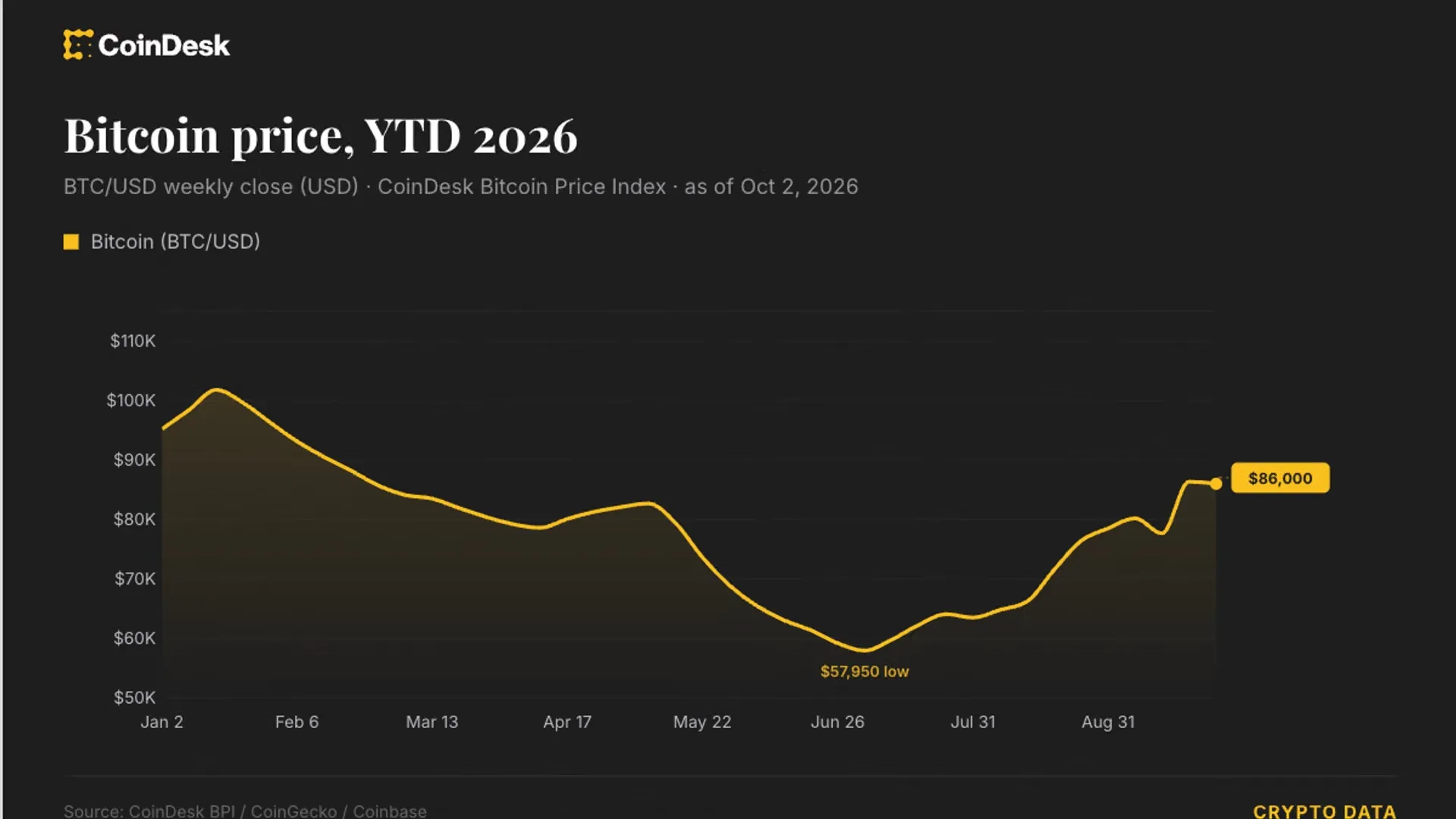
Bitcoin tops $86,000 ahead of U.S. jobs report

SummaryBitcoin briefly topped $86,885, with U.S. payrolls expected to rise by 90,000 and unemployment forecast to hold at 4.1%.The dollar reached an 18-month high as bond yields surged, while Frances borrowing premium over Germany widened to its largest in 14 years.  Bitcoin briefly topped $86,885 on Friday ahead of the latest U.S. jobs figures.  The largest cryptocurrency by market capitilization eased to around $86,000 but remains around 1.5% higher on the day and up roughly 3% in October.  The unemployment rate is expected to remain unchanged at 4.1%, while nonfarm payrolls are forecast to increase by 90,000 in September, down from 162,000 in August.  The surge in government bond yields, with U.S. 10-year Treasury yield having reached multi-decade highs of 5.34%, had kept bitcoin locked in the $82,000-$85,000 range throughout the week. Yields move inversely to bond prices, so the spike in yields means higher borrowing costs.  Meanwhile, the U.S. Dollar Index (DXY), which measures the dollar against a basket of major currencies, briefly rose above 102 on Thursday, reaching an 18-month high. A stronger dollar typically puts pressure on risk assets, although bitcoin has continued to advance. However, the euro has fallen to around $1.12, its lowest level since May 2025.

1 ہفتوں کے اندرانڈسٹری

Fed officials lean toward pausing rate hikes in October, could Bitcoin benefit?

Federal Reserve Vice Chair Philip Jefferson has signaled that policymakers may need more time before raising interest rates again, lowering expectations for an October hike as Bitcoin tries to recover while U.S. Treasury yields remain above 5%.  Federal Reserve Vice Chair Philip Jefferson said in an Oct. 1 speech at the University of Virginia that future policy changes should depend on incoming data, the economic outlook and the balance of risks after the central bank raised rates in September.  “My colleagues and I will need to come to our own judgment, which may take more time,” Jefferson said.  His comments followed a similar message from New York Fed President John Williams, who said another rate hike this year could be appropriate but saw no urgency to make the move. Both officials are voting members of the Federal Open Market Committee.  Markets have responded by cutting expectations for another increase at the Feds October meeting. The probability of an October hike dropped to around 25%, after traders earlier considered another move much more likely.  Attention has instead moved toward December as a possible window for another rate increase.  For Bitcoin, the change in expectations removes some of the immediate policy pressure that has weighed on the cryptocurrency

1 ہفتوں کے اندرانڈسٹری

Solana enters US banking with 90 North Dakota banks leading it

North Dakotas banks and credit unions are getting a dollar settlement route on Solana as banking technology provider Fiserv brings its digital asset platform into production.  Related Asset Solana #7 SOL · $119.95 24-hour change: up 2.46% Loading price history… 24H Up 2.46% 7D Up 0.06% 30D Up 20.88%  In its Oct. 1 announcement, the company identified Roughrider Coin, an interbank payment token overseen by the Bank of North Dakota (BND), as the platforms first live use case.  Participating institutions will access it through Commercial Center, Fiservs online banking system already used for traditional interbank transfers. BND says initiation, approval, and settlement will run through the same operational channels banks use for ACH and wires, allowing staff to work through familiar banking systems.  Fiserv says more than 90 North Dakota banks and credit unions are participating. That figure describes participation in the rollout, leaving how much money actually moves through Roughrider undisclosed.  The production milestone follows Bank of North Dakota and Fiservs October 2025 announcement, which planned availability in 2026.  Public network, controlled access  BND‘s deployment documentation describes Roughrider as a permissioned asset on Solana’s public blockchain. Participation is voluntary and restricted to financial institutions, and token transfers run on Solana under those institutional access controls.  US bank

1 ہفتوں کے اندرانڈسٹری

South Korea advances tokenized securities rules ahead of 2027 rollout

South Korea‘s Financial Services Commission has proposed detailed regulations for issuing and trading tokenized securities as the country’s regulatory framework is set to take effect in February 2027.  The changes would allow stocks, bonds, funds and certain fractional investment securities to be issued and circulated in tokenized form.  The proposal also introduces requirements for companies issuing and managing tokenized securities. Under the proposed changes, companies issuing tokenized securities while directly managing customer accounts would need at least 4 billion Korean won ($2.8 million) in equity capital and dedicated compliance and technology staff.  Separately, revisions to capital markets regulations would create an additional over-the-counter exchange license for debt securities and cap retail investors at 100 million won ($70,000) in annual net purchases on each OTC exchange.  The proposal builds on a three-phase roadmap unveiled on Sept. 4 for bringing securities issuance and trading onto distributed-ledger infrastructure.  The rules will undergo public consultation from Friday to Nov. 11 before an approval process begins. The proposed regulations are scheduled to take effect on Feb. 4, 2027, alongside amendments recognizing distributed ledgers as infrastructure for issuing and circulating securities.

1 ہفتوں کے اندرانڈسٹری

Upbit adds AI powered tools to explain why crypto prices are moving

Upbit has expanded its AI powered market analytics platform with new tools that summarize daily crypto market conditions and identify news and events linked to price moves in individual digital assets.  SummaryUpbit has expanded Data Lab with AI Market Report and Uptrace, giving users AI generated market summaries and analysis of factors linked to individual crypto price moves.AI Market Report uses major asset prices, gainers and losers, sentiment indicators and the Upbit composite index to produce weekday videos lasting no more than 90 seconds.Uptrace connects price data with related news, allowing users to select markers on asset charts and view AI analysis of events linked to price movements.Dunamu has reorganized AI News Briefing into Real time Issues and Topic NOW, separating ranked market news from summaries that track how individual stories develop.Upbit Data Lab has added several tools since its April 2025 launch, including technical indicators, U.S. spot Bitcoin and Ether ETF flow tracking and an asset screener.  Dunamu, the operator of South Koreas largest cryptocurrency exchange Upbit, said Friday that the additions were introduced through Upbit Data Lab, its analytics service launched in April 2025.  The latest update introduces AI Market Report and Uptrace, while an existing AI news service has been

1 ہفتوں کے اندرانڈسٹری

SBI wants stablecoin QR payments for Japan-Korea travel

SBI DigiTrust has started testing stablecoin-based remittances and QR payments between Japan and South Korea with NICE Information & Telecommunication and DSRV, with the three companies targeting completion by the end of December 2026.  SBI Group said on Oct. 1 that the partners are testing a scenario in which Japanese travelers pay at NICE-affiliated merchants in South Korea by scanning QR codes. The work covers how money moves from the Japanese customer to the Korean merchant, what payment instructions are needed and how the companies systems would connect.  SBI DigiTrust Partners with South Korean Firms to Test Cross-Border Stablecoin Payments  SBI DigiTrust, a blockchain infrastructure provider under the SBI Group, has entered into an agreement with South Korean payment processor NICE Information & Telecommunication and blockchain… pic.twitter.com/BQO6qEicw1  — Norbert Gehrke (@norbertgehrke) October 2, 2026  SBI stablecoin test focuses on tourist QR payments  The official announcement says the companies are studying a practical checkout flow instead of limiting the project to blockchain transfers between test wallets. NICE contributes its existing payment infrastructure and merchant operations, while DSRV examines the blockchain architecture needed to support the settlement process.  SBI DigiTrust handles the Japanese regulatory, financial and digital-asset side of the project. The SBI Group company said its role includes

1 ہفتوں کے اندرانڈسٹری

Bitcoin Lightning security alert issued as attackers target older Core Lightning nodes

Core Lightning has warned Bitcoin Lightning Network node operators to upgrade immediately after receiving reports that attackers are targeting systems still running version 26.06.7 or earlier.  According to the Core Lightning team, operators using affected older releases should move to the latest version as soon as possible, weeks after developers released another round of security fixes for the open source Lightning node software.  “Urgent security update: If youre running version 26.06.7 or earlier, please upgrade to the latest release as soon as possible,” the team said.  Core Lightning has not disclosed which vulnerabilities are being targeted in the reported attacks or what an attacker could potentially achieve against an unpatched node. The warning therefore does not establish whether the attacks involve one of the flaws fixed in September or a separate issue affecting older versions.  The alert follows a series of security updates that Core Lightning developers have released since August. As crypto.news previously reported, the project confirmed multiple vulnerabilities in August after reviewing a large number of AI generated Common Vulnerabilities and Exposures reports.  At the time, operators waiting for the security release were given the option of running Core Lightning with its offline setting. The configuration disconnected a node from Lightning peers and

1 ہفتوں کے اندرانڈسٹری

South Korea clears token rules for stocks, bonds and funds

South Korea has proposed detailed rules for bringing tokenized securities into its regulated capital markets from Feb. 4, 2027, including a KRW100 million annual retail purchase cap on each licensed over-the-counter exchange.  SummarySouth Korea will let stocks, bonds and funds enter its tokenized securities framework in 2027.Retail investors face a KRW100 million annual net purchase limit on each licensed OTC exchange.Issuers managing customer accounts need KRW4 billion capital plus dedicated compliance and technology staff members.Distributed ledgers must involve two account managers plus Korea Securities Depository under proposed rules framework.Public comments run through November 11 before approvals and the February 4, 2027 launch date.  The Financial Services Commission said its proposed subordinate regulations entered public consultation on Oct. 2 and will remain open for comments through Nov. 11. The measures cover which securities can be tokenized, how distributed ledgers must operate, requirements for issuers managing customer accounts and a new OTC licensing structure.  You might also like:  South Korea to let stocks, bonds and funds go onchain  South Korea opens token rules to regular securities  The FSC proposal allows conventional securities such as stocks, bonds and investment funds to be issued and circulated in tokenized form. Fractional investment products, including non-monetary trust beneficiary certificates and investment contract

1 ہفتوں کے اندرانڈسٹری
1
...
4648
...
1000