OpenPayd gains 43 U.S. licenses ahead of Nasdaq deal

OpenPayd said on Sept. 2 that it had completed the regulatory alignment needed to bring MSB USA and 43 state money transmitter licenses under the financial infrastructure providers corporate umbrella.  SummaryOpenPayd integrated MSB USA, bringing 43 state money transmitter licenses under its corporate group umbrella.MSB USA remains a nonbank money services business and will continue operating during platform integration.OpenPayd reported annual recurring revenue exceeding $96 million and annualized volume above $300 billion globally.Proposed Titan merger values OpenPayd at up to $1.145 billion and currently targets fourth-quarter completion.Nasdaq listing remains subject to shareholder approval, closing conditions, minimum proceeds and exchange acceptance requirements.  The integration gives London based OpenPayd a regulated route into much of the U.S. payments market. The company plans to use the licenses to support global business clients seeking to send or receive payments in the country.  MSB USA will continue operating under its existing leadership while preparing for full integration with the OpenPayd platform. OpenPayd did not disclose the acquisition price, payment structure or expected integration cost.  You might also like:  Decta taps USDC for international treasury settlements via OpenPayd  The announcement comes three months before the intended completion of OpenPayds proposed combination with Titan Acquisition Corp. The transaction could lead to OpenPayd shares


09-02انڈسٹری

Wall Street is now racing to control the $1.9T stablecoin shift to avoid losing its customer base

Standard Chartered estimated in January that stablecoins could pull about $500 billion from US bank deposits by the end of 2028.  Regional banks looked especially exposed given how much they depend on the spread between what they pay depositors and what they earn on loans.  Now, 21 major financial institutions, including Bank of America, Citi, Goldman Sachs and Wells Fargo, committed Sept. 1 to build one.  The group announced plans to establish a company in the second half of 2026, launch a US dollar-denominated stablecoin in the first half of 2027, and comply with both the GENIUS Act and MiCA.  The venture started as a 10-bank exploration into reserve-backed digital money in October 2025 and has since grown to 21 institutions spanning North America, Europe, Asia, Africa, and the Middle East.  Its stated use cases include wholesale and institutional activity, cross-border payments, digital-asset settlement, and retail markets where client benefits can be achieved.Earlier bank concernSept. 1 bank responseStablecoins could pull deposits out of banks21 institutions committed to launch a bank-backed stablecoinRegional banks could be exposed to funding pressureLarge banks are positioning to capture stablecoin flowsCrypto platforms could compete for customer cashBanks are creating their own digital-dollar productStablecoins could redirect reserves into TreasuriesBanks may seek a

09-02انڈسٹری

Ethereum Whale Moves 109,806 ETH to Exchanges in Three Days, Raising Sell-Off Concerns

A prominent Ethereum whale has transferred a total of 109,806 $ETH to major exchanges over the past three days, according to blockchain analytics firm EmberCN. This follows an initial deposit of 154,300 $ETH to exchanges on Aug. 31, signaling a potential large-scale sell-off that could impact the market.  Whales Transaction History and Current Holdings  The wallet in question currently holds 58,048 $ETH, bringing the estimated total sell volume to 167,864 $ETH, valued at approximately $406 million. The whales activity has drawn attention due to the sheer size of the transfers, which have been distributed across multiple exchanges over a short period.  Data from EmberCN indicates that the whale initially acquired the $ETH at an average price of $1,700 about two years ago. If the entire amount is sold at current prices, the whale could realize a profit of around $122 million. This substantial gain highlights the whales strategic entry point and the potential for significant market movement.  Market Impact and Investor Sentiment  Large transfers to exchanges are often interpreted as a precursor to selling, which can create downward pressure on prices. The Ethereum market has been sensitive to whale activity, and this latest move has sparked discussions among traders about possible short-term volatility.  However, it‘s important

09-02

Binance deepens TradFi push with physically settled options on over 1,000 US equities

Binance is putting options on more than 1,000 selected US stocks and exchange-traded funds inside the same account that already offers crypto and several forms of equity exposure.  Related Company Binance Global crypto exchange  The product is limited to eligible users outside the US, and the securities machinery behind the offer does not belong to Binance.  The company said on Sept. 1 that Nest Trading Limited will introduce the orders and route them to Alpaca Securities LLC. Alpaca will execute, clear, and settle the trades, then custody any shares delivered when an option is exercised.  Eligible customers can move among more products without leaving Binance, while Nest and Alpaca carry distinct responsibilities behind the scenes.  Who does what behind Binance  Binance is the customer-facing access point, Nest Trading is the introducing broker, and Alpaca provides execution and post-trade infrastructure.  An options customer places an order through Binance, but Nest introduces it to Alpaca. If physical settlement produces shares, Binance says Alpaca holds them on the users behalf.  Graphic shows Binance stock-option orders flowing through Nest Trading and Alpaca Securities before delivered shares reach customers after exercise.  Nests Abu Dhabi Global Market register lists the firm as active under financial services permission 260000. Its permitted activities include arranging deals, dealing

09-02انڈسٹری

Cryptoquant: Bitcoin Price Rally Hid a 60,000 BTC Whale Buying Spree

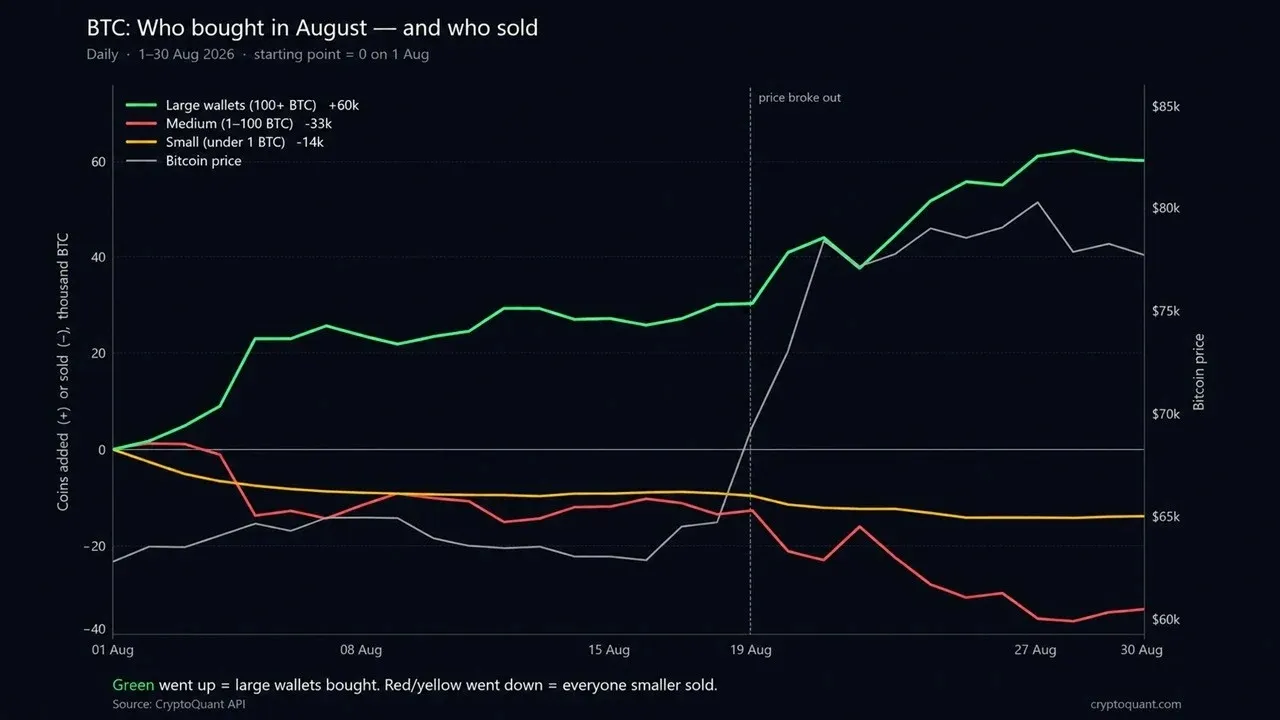
Wallets holding more than 100 bitcoin added roughly 60,000 BTC in August, according to Cryptoquant data, while smaller holders sold into the months rally.  Key TakeawaysWallets with 100+ BTC added about 60,000 BTC between Aug. 1 and Aug. 30, Cryptoquant says.Mid-size wallets (1-100 BTC) sold roughly 33,000 BTC over the same stretch.Whale buying accelerated after bitcoins price broke $62,000-$65,000 on Aug. 19.  The Chart Behind the Bitcoin Price Rally  Cryptoquant analyst Woo Minkyu laid out the month gone by in a single chart, exposing a stark slip. Between August 1 and August 30, wallets holding 100 or more bitcoin added approximately 60,000 BTC to their combined balances, a figure worth roughly $4.7 billion at prices near $78,000.  Over that same window, wallets holding between 1 and 100 BTC reduced their holdings by about 33,000 BTC, and the smallest wallets, those under 1 BTC, sold off close to 14,000 BTC.  Image source: Cryptoquant report called “August in one chart.”  By lining up those three cohorts, the picture becomes even more unambiguous because while bitcoins price climbed toward its best August since 2017, the buying was concentrated almost entirely among the largest holders, and the selling came disproportionately from everyone else.  Who Sold Into Strength  Thats not necessarily bearish on

09-02انڈسٹری

Crypto industry urges SEC to avoid blanket novel ETF restrictions

Crypto industry participants urged the US Securities and Exchange Commission (SEC) to avoid a blanket restriction on “novel” exchange-traded funds (ETFs) and instead evaluate products based on their individual risk parameters.  Venture capital firm a16z asked the SEC to evaluate novel products according to their underlying characteristics, coordinate fund-registration and exchange-listing reviews and adopt more predictable timelines. Digital asset investment manager Grayscale and the Crypto Council for Innovation (CCI) supported optional confidential pre-filing processes.  All three opposed changing existing investment-company classifications in ways that could automatically sweep products holding non-securities into the Investment Company Act framework.  The letters were dated Aug. 31 and posted by the SEC around the close of a 60-day public-comment period on its request for feedback concerning novel ETFs.  The SEC opened the consultation window on the next generation of ETFs on June 30, seeking feedback on whether existing regulations are adequate, how such funds should be regulated and whether changes to the registration process are needed.  Related: California Senate passes bill to ban memecoin issuance by public officials  Crypto industry stakeholders urge SEC for more regulatory clarity on novel ETFs  A16z argued that crypto-based ETPs now benefit from more developed market infrastructure, including exchange-approved listing standards and established disclosure requirements, and therefore

09-02انڈسٹری

Cardano clears key voting thresholds for constitutional committee renewal by 0.18% margin

Cardano‘s 2026 Constitutional Committee renewal had crossed both voting thresholds in a pre-boundary snapshot on Sept. 1, but formal ratification still waited for the epoch change. The narrow margin on the stake pool side exposed how non-participation can become an effective veto in the network’s on-chain governance.  Related Asset Cardano #15 ADA · $0.19 24-hour change: down 1.09% 24H Down 1.09% 7D Down 6.63% 30D Up 5.67%  Cardano divides governance authority among delegated representatives, stake pool operators, and the Constitutional Committee.  DReps vote with ADA delegated to them, SPOs represent block-producing stake pools, and the committee reviews the constitutionality of actions that require its approval. For an update to the committees own membership, DReps and SPOs vote while the committee does not.  A synchronized Koios voting snapshot retrieved at about 09:59 UTC showed DRep support at 69.36% against a 67% threshold. SPO support stood at 51.18% against a 51% requirement, leaving a margin of 0.18 percentage points at that observed moment.  The proposals on-chain record still showed no ratification, enactment, or expiration, and the Koios chain tip remained in epoch 652. The decision was due at the boundary into epoch 653 at about 21:44 UTC on Sept. 1.MeasurePre-boundary snapshotRequirement or timingDRep approval69.36%67% threshold metSPO approval51.18%51%

09-02انڈسٹری

Kalshi Suspends House Candidate Laurie Buckhout for Betting on Herself

In briefKalshi suspended North Carolina Republican Laurie Buckhout for three years on Friday after finding she traded contracts on her own congressional race.She bought less than $1,000 of contracts and must pay a $2,589.96 penalty, having cooperated with the exchanges inquiry.Kalshi banned former Rep. George Santos for life in the same batch of notices, fining him $71,356 after he failed to cooperate.  Prediction market Kalshi has suspended North Carolina Republican House candidate Laurie Buckhout for three years after finding she bet on her own election, according to a settlement notice published Monday.  Buckhout launched her campaign in North Carolinas 1st Congressional District in December 2025 and bought less than $1,000 of contracts on her race against Democratic Rep. Don Davis, the notice states. As a candidate she qualified as a direct decision maker over the outcome, which bars trading under Rule 5.17(z) of the exchanges rulebook.  The settlement took effect Friday. It bars the retired Army colonel from Kalshi for three years and imposes a penalty of $2,589.96, more than double what she wagered. Kalshis compliance department found she cooperated with the inquiry.  Buckhout acknowledged the wager to The Hill. “I bet on myself. Literally. It was a dumb mistake,” she said, adding that

09-02انڈسٹری

HashKey joins DTCC digital assets working group

HashKey Group said on Sept. 2 that it had joined the Depository Trust & Clearing Corporations Digital Assets Advisory Services Industry Working Group, becoming its first Asian digital asset service provider.  SummaryHashKey joined DTCCs digital assets working group as its first Asian digital asset service provider.DTCCs May announcement identified more than 50 participants, while HashKey now cites over 100 institutions.HashKey plans to contribute Asia Pacific regulatory experience toward institutional token issuance, settlement and custody standards.DTCC targets an October launch for tokenization services after conducting production transactions with custodied securities.HashKey already participates in Hong Kong initiatives covering tokenized bonds, funds, notes and settlement infrastructure.  The Hong Kong based company will participate in discussions about how tokenized securities can be issued, transferred, settled and safeguarded through institutional market infrastructure.  HashKey said the working group now includes more than 100 financial institutions, asset managers and digital asset companies. Participants named in its announcement include JPMorgan Chase, Goldman Sachs, Nasdaq and the New York Stock Exchange.  You might also like:  HashKey, YF Life test HKDAP stablecoin for insurance payments  DTCCs own May announcement named more than 50 participating organizations. The larger figure provided by HashKey appears to reflect additions made since the group was publicly introduced, although DTCC has not

09-02انڈسٹری

WikiBit Exchange Exit Scam Risk Ranking #14 — Echobit: MSB Stickers + Czech VASP Registration, Can a “Compliance Puzzle” Really Guarantee Safety?

Introduction: A “Schrödinger‘s Compliance” Exchange  In the first 13 editions, we investigated HashKey (the compliance top student), HTX (a sanctions hotspot), UZX (a DAO penny stock), Phemex (the Morgan Stanley elite), Tapbit (the MSB sticker king), Coincheck (Japan’s survivor exchange), Deepcoin (El Salvador‘s new regulatory outfit), Upbit (South Korea’s national exchange), Azbit (officially exposed by Seychelles FSA), FameEX (the multi-country registration collector), Bitvavo (Europe‘s compliance king), CoinUp (publicly criticized by Yi He), and BiFinance (officially condemned by Hong Kong’s Securities and Futures Commission).  Along the way, we have seen all kinds of regulatory issues.  For the 14th edition, we examine a new type of player — the “compliance puzzle” exchange: Echobit.  On paper, Echobits resume looks impressive:“US + Canada MSB registrations”“Czech VASP registration”“Korea CODE alliance member”“Strategic partnership with Coinone”“200x leverage futures trading”“More than $300 million in daily trading volume”“$20 million venture capital fund”  Sounds like a rising compliance-focused crypto exchange, right?  But on the other side of the story:  Echobit itself admits that there are widespread fake websites, fake apps, and fake Telegram groups impersonating the platform.  A third-party security platform classified echobit.global as a “high-risk phishing/scam website” with a trust score of only 1/100.  FXVerify users rated the platform only 1/5, with complaints including:  “Funds were frozen after making

09-02گہرا غوطہ
1
...
346348
...
1000