Tokenization Value Accrual Explained: Who Earns Fees When Assets Move Onchain?

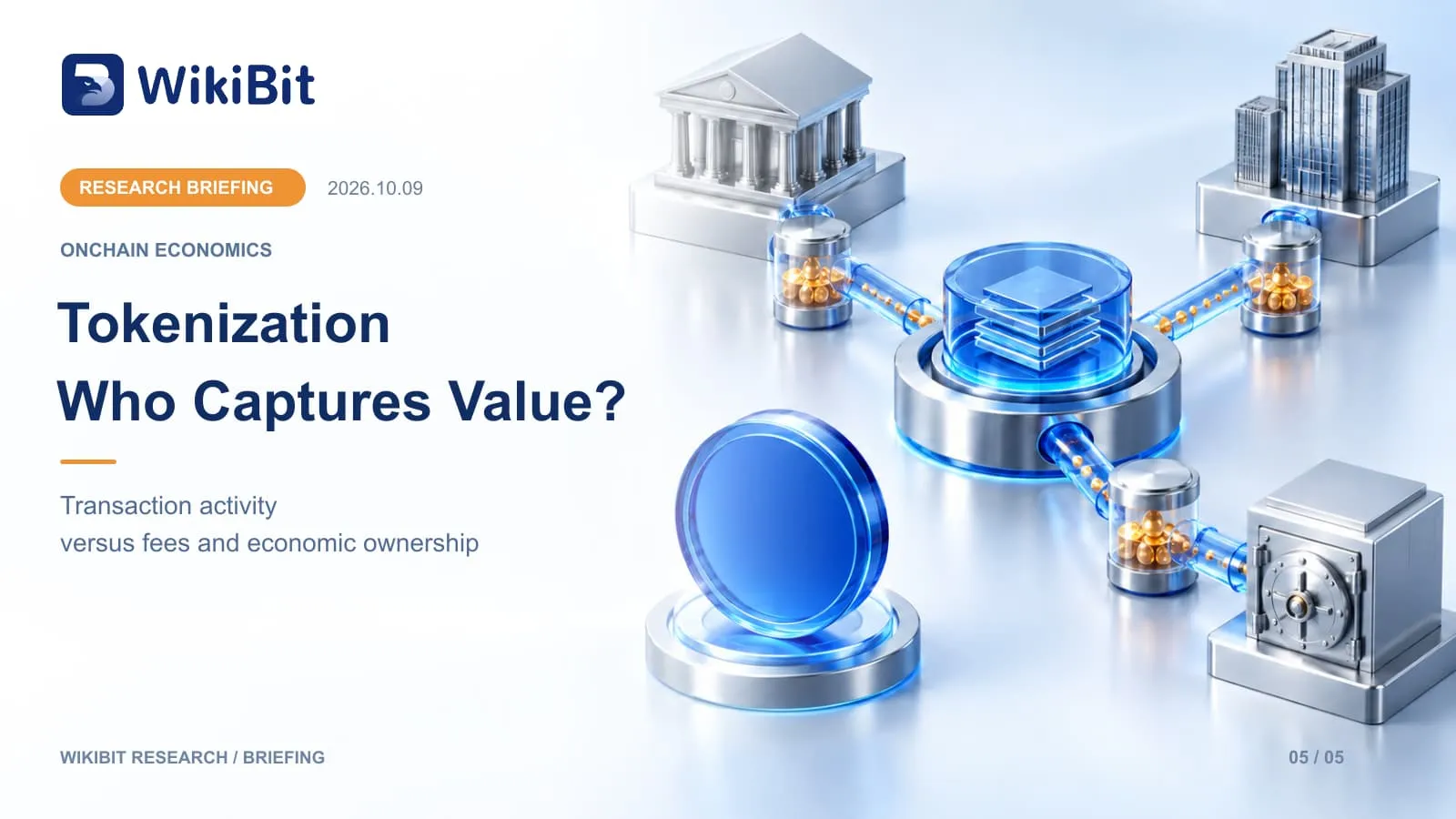
The most important question about tokenization has changed.  For years it was: Can financial assets be represented on a blockchain?  Now the more useful question is: Who earns money when those assets move, trade, borrow, settle and generate yield onchain?  That is the central argument of Breaking the Wall, a new long-form report published on October 8, 2026 by Citrini Research. The firm sees a potential convergence between traditional finance, programmable assets and AI-operated financial workflows. But it cautions against a shortcut that has dominated crypto market narratives: assuming that broader blockchain adoption automatically makes Bitcoin, Ether or every token associated with tokenization more valuable.  The reports framing is a thesis, not a proven forecast. Tokenized stocks and bonds can grow while some blockchain tokens underperform. Conversely, a service provider can build a valuable business from onchain activity without issuing a token at all.  This distinction is not academic. It determines how investors should evaluate the rapidly expanding set of companies, protocols and governance tokens marketed as “RWA winners.”Asset Growth, Network Usage and Value Capture Are Three Different Things  Imagine $10 billion of tokenized government securities issued on a blockchain.  That is a large headline issuance figure. But what happens economically depends on how the tokens are
10-09انڈسٹری ریسرچ

Why the Bitwise Dogecoin ETF Failed: Crypto Popularity Is Not the Same as ETF Demand

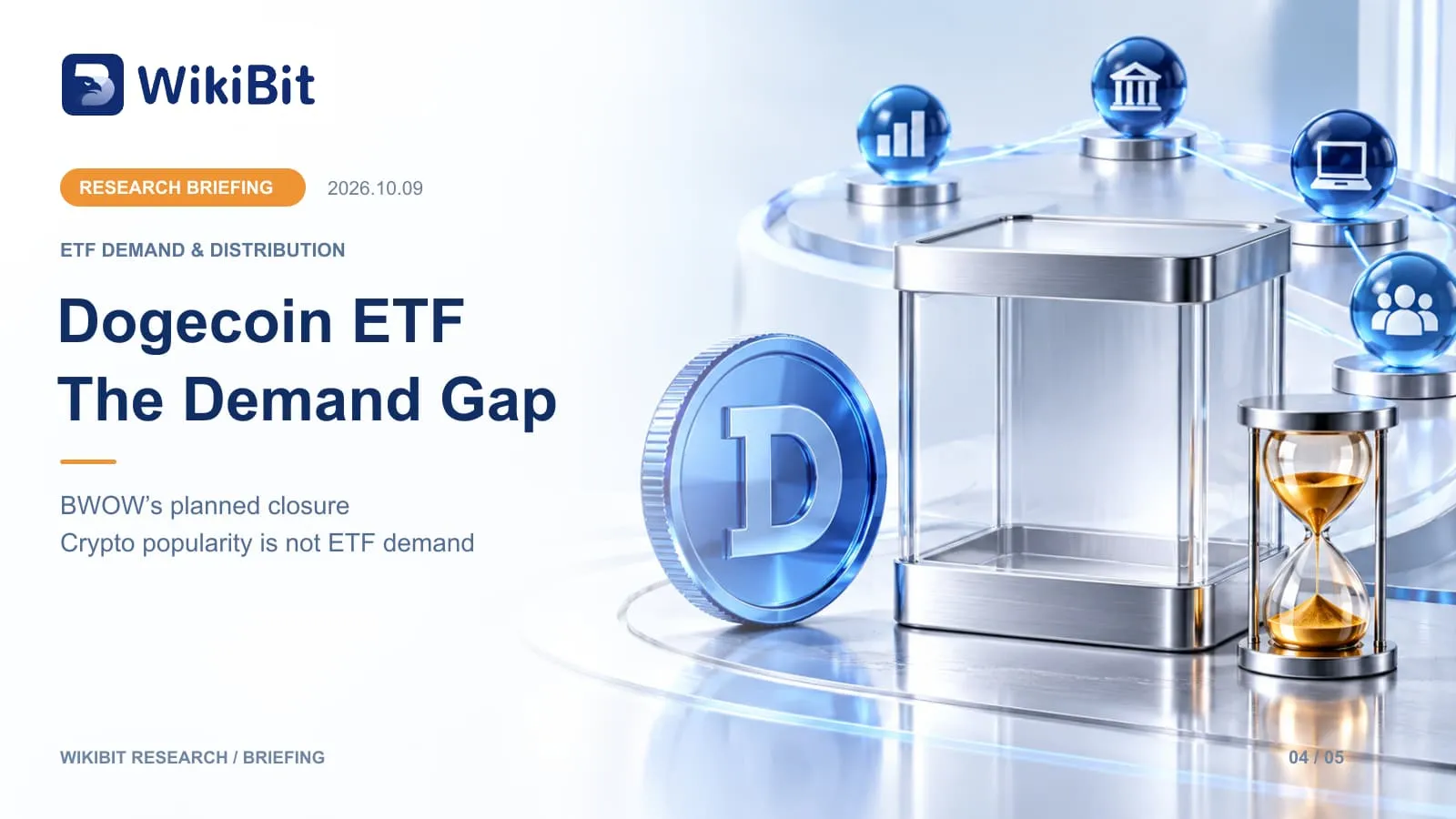
Dogecoin can be culturally important, actively traded and widely recognized—and still fail as an exchange-traded investment product.  On October 8, Bitwise CEO Hunter Horsley described the poor reception of his firms Dogecoin ETF as evidence of a meaningful divide between investors who use traditional brokerage ETFs and traders who use crypto-native applications. The Bitwise Dogecoin ETF, ticker BWOW, is scheduled to trade for the final time on October 14, 2026, with liquidation and cash distributions expected around October 22.  This is not a new closure announcement. Bitwise disclosed its decision on September 10. What changed on October 8 was the CEOs candid interpretation of why the product failed to attract a durable audience.  BWOW had approximately $725,870 in net assets as of October 7, according to SoSoValue data reported by The Block, and only about $51,480 in September trading volume. Those numbers are extremely small for a listed product that needs a viable base of assets, market-making and operating economics.  The more important conclusion is not that DOGE has no audience. It is that an assets audience and an ETFs audience are different markets.A Popular Token Does Not Automatically Have Institutional Buyers  Dogecoins economic and cultural appeal has largely grown through internet communities, online trading

10-09انڈسٹری ریسرچ

Samsung Wallet and USDC: Why Stablecoin Adoption May Start Without a Crypto App

The most important part of Samsungs latest stablecoin announcement is what the user will not need to do.  They will not need to install a separate crypto application or learn how to safeguard a seed phrase. Samsung says eligible U.S. Galaxy users will be able to make cross-border USDC transfers directly inside Samsung Wallet beginning in the last week of October 2026. The feature will support transfers to compatible crypto wallets and eligible bank accounts in more than 60 countries, with local-currency delivery possible for bank-account recipients.  Samsung estimates the service will be available across 82 million U.S. Galaxy devices. That is a device distribution figure, not 82 million new crypto wallets, customers or transactions. Availability will still depend on device compatibility, identity and geographic eligibility.  The product is significant because stablecoin adoption may increasingly arrive as a feature of software people already use, rather than as a decision to enter a new asset class.A Payment Feature, Not a New Layer 1  Samsungs October 7 announcement identifies USDC as the initial stablecoin. It says Bastion will provide the cross-border payment infrastructure and Coinbase will act as Bastions sub-custodian through Coinbase Prime Vault. User access requires biometric authentication on compatible registered devices.  Infrastructure and network support

10-09انڈسٹری ریسرچ

Securitize Stocks on Solana: Why Shareholder Rights Matter More Than the Token Wrapper

The most consequential detail in Securitizes October 8 tokenized-stock launch is not that Apple or Nvidia can trade through a blockchain interface. It is the legal claim represented by the token.  Securitize launched Securitize Stocks with an initial collection of 12 U.S.-listed equities on Solana through its regulated broker-dealer infrastructure. The initial tickers are AAPL, MSFT, NVDA, GOOG, TSLA, META, AMZN, NFLX, CRCL, SPCX, MSTR and PLTR. The tokens are backed one-for-one by underlying shares. They are designed to convey security entitlements and associated economic rights such as dividends and, where applicable, voting benefits.  Yet an important qualification appears in Securitizes own disclosures: a token holder is not automatically a registered shareholder of the underlying company. The initial product is a security entitlement held through Securitize Markets, not a direct issuer-register entry. A convertible entitlement-token structure is intended to support conversion to direct recorded ownership in supported circumstances.  That may sound like a legal footnote. It is central to whether tokenized equities can become a serious capital-markets asset class.A Token That Tracks a Stock Is Not Necessarily a Share  Crypto markets have offered many different products under the label tokenized stock. Some are debt obligations whose value tracks a stock. Others are synthetic derivatives.

10-09انڈسٹری ریسرچ

EU MiCA Stablecoin Rules: What ESMA's January 2027 Deadline Actually Changes

Europes latest stablecoin policy is not simply another exchange delisting notice. It challenges a more fundamental assumption: that an exchange can stop trading a non-compliant stablecoin while continuing to provide other services involving it indefinitely.  On October 8, 2026, the European Securities and Markets Authority (ESMA) published an opinion on crypto-asset services involving asset-referenced tokens (ARTs) and e-money tokens (EMTs) that do not meet the Markets in Crypto-Assets Regulation (MiCA). The opinion asks national regulators to ensure MiCA-authorised crypto-asset service providers stop making affected tokens available to EU clients across the regulated service chain—not only on order books. The services specifically identified include exchanges, execution, advice, reception and transmission of orders, transfers, custody, administration and portfolio management.  Remaining pre-existing exposures should be resolved as soon as possible and no later than three months after publication, making January 8, 2027 the outer date in the opinions timetable. That is a supervisory remediation limit, not a three-month permission slip to keep selling the affected assets. ESMA says any residual service during wind-down must be limited to what is necessary for liquidation, conversion, withdrawal, transfer or safekeeping, under close supervision.  This distinction matters for exchange operations, stablecoin distribution and the practical rights of existing holders.From Trading

10-09انڈسٹری ریسرچ

Blast L2 Shutdown Update: KuCoin BLAST Deposits Suspended as Bridge Withdrawal Reopening Remains Unverified

Blast‘s announced Ethereum Layer 2 shutdown remains one of the most consequential asset-access risks being monitored by WikiBit. The project’s published plan begins by unwinding ETH/staking-related assets held through Lido. The project estimated this could take about a week, and said normal withdrawals would be unavailable while the unwind was under way.  As of this report‘s October 9 cutoff, WikiBit has not independently found an authoritative notice confirming that Blast’s normal withdrawal interface has reopened. That is not proof every withdrawal is failing; it means the all-clear milestone cannot yet be asserted.New development: KuCoin suspends BLAST deposits  KuCoin published a separate announcement on October 8 temporarily suspending deposits of BLAST for what the exchange describes as essential maintenance. This adds another venue-specific access constraint while the underlying chain is winding down.  The announcement does not itself state that KuCoin suspended deposits because of the Blast shutdown, nor does it mean KuCoin froze every customer withdrawal. The exact product and direction matter: KuCoin BLAST deposits, not a confirmed universal BLAST asset freeze.Original shutdown mechanism: unwind Lido-held ETH  Blasts native-yield structure used exposure to yield-generating assets rather than treating every bridge asset as idle, immediately withdrawable collateral. The wind-down first needs to unwind assets associated with

10-09انڈسٹری ریسرچ

Samsung Wallet USDC Rollout: Custody, External Transfers and Compliance for 82 Million Compatible Devices

Samsung Electronics America announced that USDC stablecoin functionality will launch inside Samsung Wallet in the last week of October 2026 for eligible U.S. Galaxy users. The service integrates custody, transfers and fiat off-ramps into a mainstream device interface. Its importance to risk monitoring is the multi-party custody and compliance chain, not a reported security loss.The number 82 million is device compatibility, not live users  Samsung says the feature can be available across approximately 82 million U.S. Galaxy devices. Its footnote defines that count as devices compatible with Samsung Wallet. It does not mean 82 million users have been KYC-verified, funded a wallet or executed a USDC transfer. The launch is planned for the final week of October, not already fully deployed on October 8.Eligibility and identity controls  Samsungs stated conditions include being an eligible U.S. resident aged 18 or older, having a Samsung account, a compatible device using Android 13 or later, completing registration and identity verification, and enabling biometric authentication. The registered device and biometric step become part of transaction initiation, creating security convenience but also account-recovery/device-control dependencies.Who holds the money?  Samsung states explicitly that Samsung is not a bank, money transmitter or digital-asset custodian and does not hold customer funds. Bastion

10-09انڈسٹری ریسرچ

NFL v. Kalshi at the Supreme Court: Sports Event Contracts, Swaps and State Gambling Law

The National Football League filed an amicus curiae brief on October 8, 2026 in Flaherty and Davenport v. KalshiEX, LLC, No. 26-299, asking the U.S. Supreme Court to grant review of the dispute between New Jersey officials and the prediction-market venue. The document does not mean the Court has already agreed to hear the case or ruled that Kalshis sports contracts are unlawful.What the NFL is asking the Court to decide  The question is whether federally listed sports event contracts count as swaps under the Commodity Exchange Act, potentially invoking exclusive CFTC jurisdiction and displacing state gambling oversight. The NFL sides with state regulators: it argues that contracts on game outcomes and individual events are essentially sports gambling, not ordinary derivatives used to hedge economic exposure or discover a financial price.  The brief is an outside-party legal submission, not a court decision or CFTC regulation. It supports the state officials petition for certiorari following litigation in the Third Circuit.Why this case matters to crypto and event-market platforms  Event contracts now appear next to crypto, equities and derivatives within major trading apps. A platforms ability to offer sports markets across U.S. states depends heavily on whether the product is characterized as federally regulated swaps

10-09انڈسٹری ریسرچ

KuCoin’s Older 25-Token Delisting: Withdrawal Window Has Closed—Do Not Confuse It With the October 30-Token Batch

KuCoin users face two different delisting batches whose withdrawal dates must not be confused. The older batch covered 25 tokens, with trading already removed on September 7, 2026. KuCoins original September 3 announcement set the final normal withdrawal cutoff at October 7 at 08:00 UTC. That deadline has passed at the October 9 reporting cutoff.  This is a distinct event from KuCoins newer 30-token batch, which left spot markets on October 8 and has a November 9 scheduled withdrawal deadline. A user holding AUDIO, ACX, WAXP or REEF should not assume the newer November window applies.The 25 affected tokens  The official older batch includes ACX (Across), HYDRA, KARRAT, PORTALS, GAFI, SCOR, AUDIO (Audius), BLUM, HONEY, SN3, NOBODY, TSTBSC, HPOS10I, LVVA, MTRG (Meter Governance), EMYC, DUCK, J (Jambo), MOVA, BFC, WEN, FWOG, GAIN, WAXP and REEF.  A substantial part of this list consists of thin-liquidity tokens, but recognizable projects such as Across, Audius, WAX and Reef are also present. Being delisted from KuCoin is not proof that each underlying network or protocol has stopped operating.The three official dates  September 4 at 08:00 UTC: deposits were disabled. September 7 at 08:00 UTC: spot trading ceased and related orders were cancelled. October 7 at 08:00 UTC: the

10-09انڈسٹری ریسرچ

U.S. Government Moves $1 Billion in Bitfinex-Linked BTC: Transfer, Custody and Sale Are Different

On October 8, 2026, blockchain monitoring attributed an unusually large Bitcoin transfer to wallets associated with U.S. government seizures from the 2016 Bitfinex hack. Arkham-based reporting counted roughly 12,267 BTC, worth about $1.01 billion at the contemporaneous market price, sent to new, unlabeled Bitcoin addresses. The size makes the movement market-sensitive; the destination makes interpretation critical. A transfer is not proof that the government sold Bitcoin.What was observed on October 8  CoinDesk and Decrypt both reported the 12,267 BTC transfer and emphasized that the destination addresses were not identified as exchange deposit wallets. A government-associated source label is an analytics inference about wallet attribution; a new unlabeled destination provides no public confirmation of its ultimate owner or purpose. Neither the Justice Department nor the U.S. Marshals Service had supplied an explanation in the reporting reviewed for this briefing.Coinbase Prime movements are a separate observation  Galaxy Research and Cointelegraph described approximately 9,261 BTC, then worth about $770 million, moving to Coinbase Prime over the preceding two days. Part originated from known seizures, including some Bitfinex-related funds, while an additional 2,456 BTC was described as coming from previously unidentified holdings. This is an analyst classification and cannot be rewritten as the government officially announced

10-09انڈسٹری ریسرچ
1
...
7678
...
1000