Cardano Foundation spins out digital identity firm Veridian

The Cardano Foundation has spun out Veridian as an independent digital identity company after three years of development, with its shares tokenized on Cardano and plans to seek investors in 2027.  SummaryVeridian‘s shares have been tokenized under Switzerland’s DLT Act using Cardanos CIP-0113 programmable token standard.CEO Thomas A. Mayfield will lead the companys government, enterprise, and AI agent identity business.Veridian plans to seek strategic partners and investors in 2027 to support expansion, including in the United States.The company says it has mapped all 142 requirements in Utahs state-endorsed digital identity implementation guide.  The Cardano Foundation, in an announcement dated Oct. 8, said Veridian will operate as an independent commercial business led by Thomas A. Mayfield. According to the release, the company will provide tools for governments, organizations and individuals to verify the identity and authority of participants in digital interactions without relying on a central identity database.  Alongside the corporate separation, the Foundation said Veridian‘s shares have been issued as ledger-based securities under Switzerland’s DLT Act. The release describes them as the first asset deployed on Cardano using the new CIP-0113 programmable token standard, developed by the Foundation and the Cardano community.  Cardano tokenizes Veridians shares under its new standard  The share issuance uses a

2 دن پہلےانڈسٹری

OKXICE Tokenized Stocks 2026: SEC Notice for 24/7 U.S. Equities

OKX and Intercontinental Exchange, the owner of the New York Stock Exchange, have advanced a proposal for around-the-clock trading in tokenized U.S. equities through their reported OKXICE joint venture.  Reuters reported on October 5 that the venture had filed a notice with the U.S. Securities and Exchange Commission concerning a proposed venue operating 24 hours a day, seven days a week. The contemplated universe includes shares or share-linked instruments referencing more than 60 U.S. companies.  This is a material market-structure development. It is not evidence that the market has already begun accepting orders, that the SEC has approved every instrument or that holders of a token automatically hold the same legal rights as registered shareholders.The reported venture  Public reporting describes OKXICE as a 50–50 venture between crypto exchange OKX and Intercontinental Exchange. The proposed model brings together an established securities-market operator and crypto-native trading infrastructure.  The underlying question is whether an equity-linked product can remain continuously tradeable after traditional U.S. stock-market hours without losing essential protections around ownership, custody, disclosure, settlement and corporate actions.Why the filing matters  Most U.S. listed equities trade within regulated exchange sessions, with extended-hours trading subject to separate market conditions and liquidity. Crypto markets operate continuously.  A tokenized-equities venue could allow 24/7

2 دن پہلےانڈسٹری ریسرچ

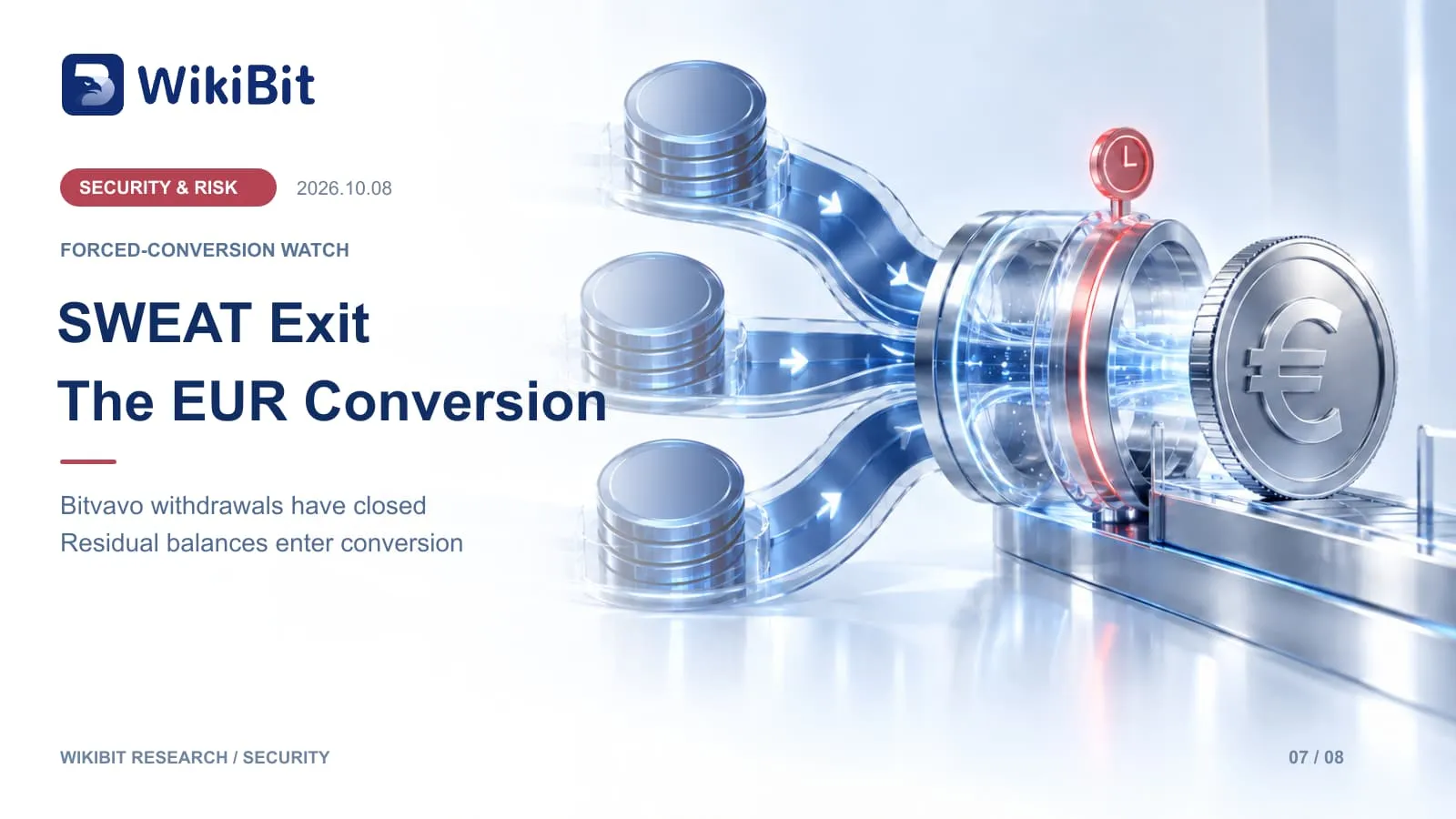
SWEAT Bitvavo Oct. 8 Update: Withdrawals Closed, EUR Conversion Due Oct. 15

The most urgent near-term SWEAT risk has moved from a future withdrawal deadline into the platform-controlled conversion stage. Bitvavos published October 7 timetable ended deposits at 13:00 CEST, trading at 14:00 CEST and SWEAT withdrawals at 15:00 CEST. Those times have now elapsed. The exchange has not promised a guaranteed conversion rate for any residual holdings.What happens to SWEAT left on Bitvavo?  Bitvavo says it will sell remaining SWEAT and credit EUR by October 15 or earlier. The operator will attempt an orderly sale, but spread, slippage and execution price are not guaranteed. This is a forced change in asset form: a customer may end up owning a euro account balance rather than the original SWEAT token.  The platform warns that the displayed EUR value can temporarily show zero after the trading halt while the sale and crediting are processed. That processing state alone is not proof of confiscation; the economic questions are whether the eventual EUR credit arrives and what execution terms are applied.Project shutdown is a separate, later event  The Sweat Foundations official wind-down guidance states that Sweat Wallet and SWEAT in their current form end December 30, 2026. Until then the app and current contract services are expected to run.

2 دن پہلےانڈسٹری ریسرچ

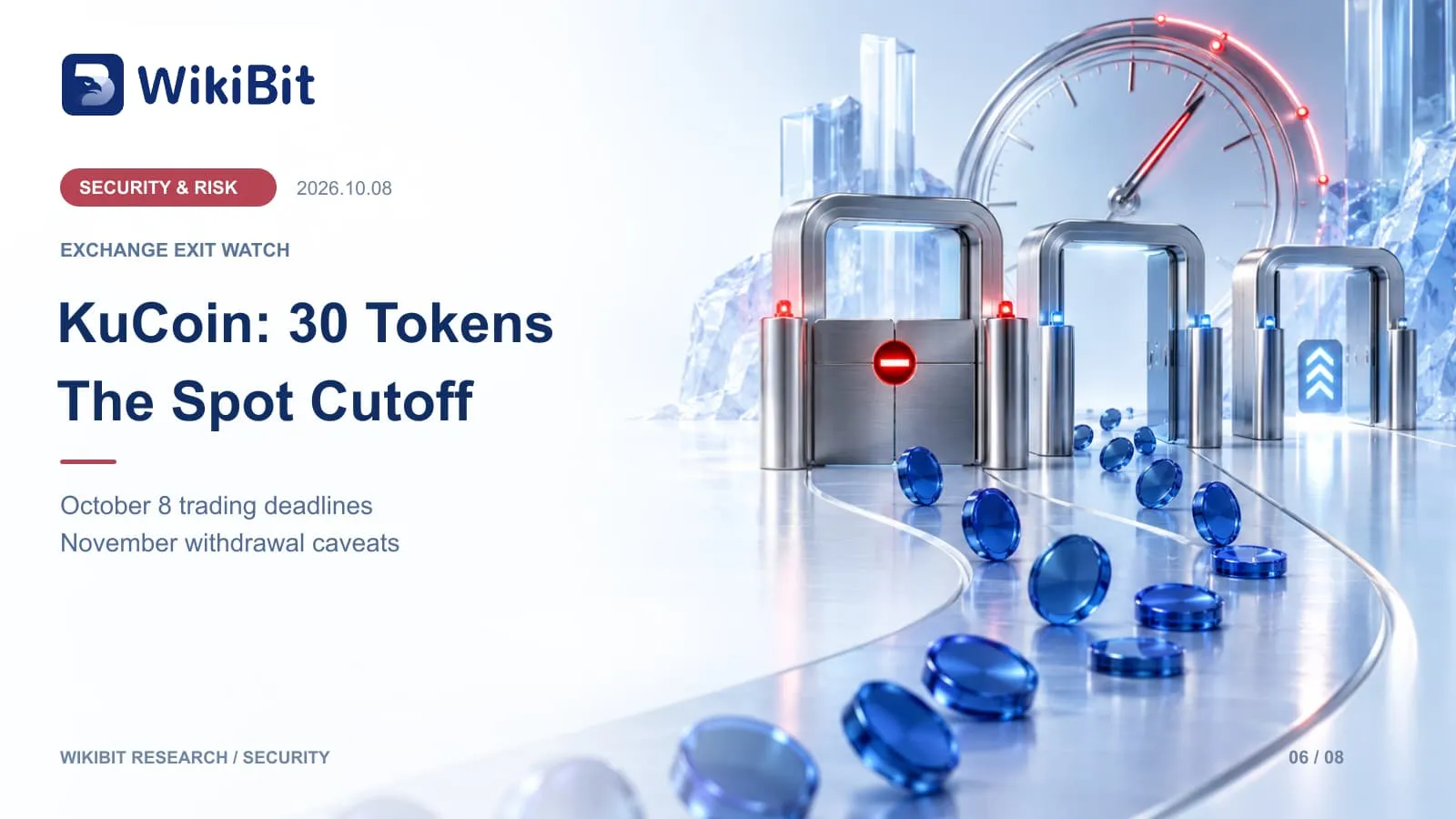
KuCoin 30-Token Delisting: October 8 Spot Cutoff and November Withdrawal Caveat

KuCoins 30-token delisting has entered its most consequential trading-access day. At the 00:20 UTC October 8 reporting cutoff, the global announcements next milestones were still in the future: 06:00 UTC for affected Trading Bots, followed by 08:00 UTC for spot delisting. The announcements earlier October 6, 08:00 UTC deposit cutoff has passed.Full affected-token list  The global KuCoin notice names A47, FORTH, RVV, B3, BAL, BOBA, B, CHEEMS, XLAB, ETHW, GMRX, ICX, KLINK, L3, MAN, USDP, PIX, PVT, PUSH, QKC, RVN, RMV, ROUTE, SFP, SCA, SCRT, UNA, VAI, WSDM and WL.  A regional KuCoin Australia notice lists a 14-token subset, illustrating that readers must verify the actual jurisdictional trading entity and matching announcement. The 30-token global list is not a statement that every regional KuCoin product follows identical support rules.Trading Bot cutoff: 06:00 UTC  Affected Spot Grid, AI Spot Trend, Martingale, Infinity Grid, DCA and Smart Rebalance automation will be retired. KuCoin says unclosed bots can be terminated by its system. A bot stop can unwind or cancel strategy orders at a time the user did not independently select.Spot cutoff: 08:00 UTC  The affected spot markets are scheduled to stop trading and remaining open orders will be cancelled. Traders lose KuCoin price discovery and the

2 دن پہلےانڈسٹری ریسرچ

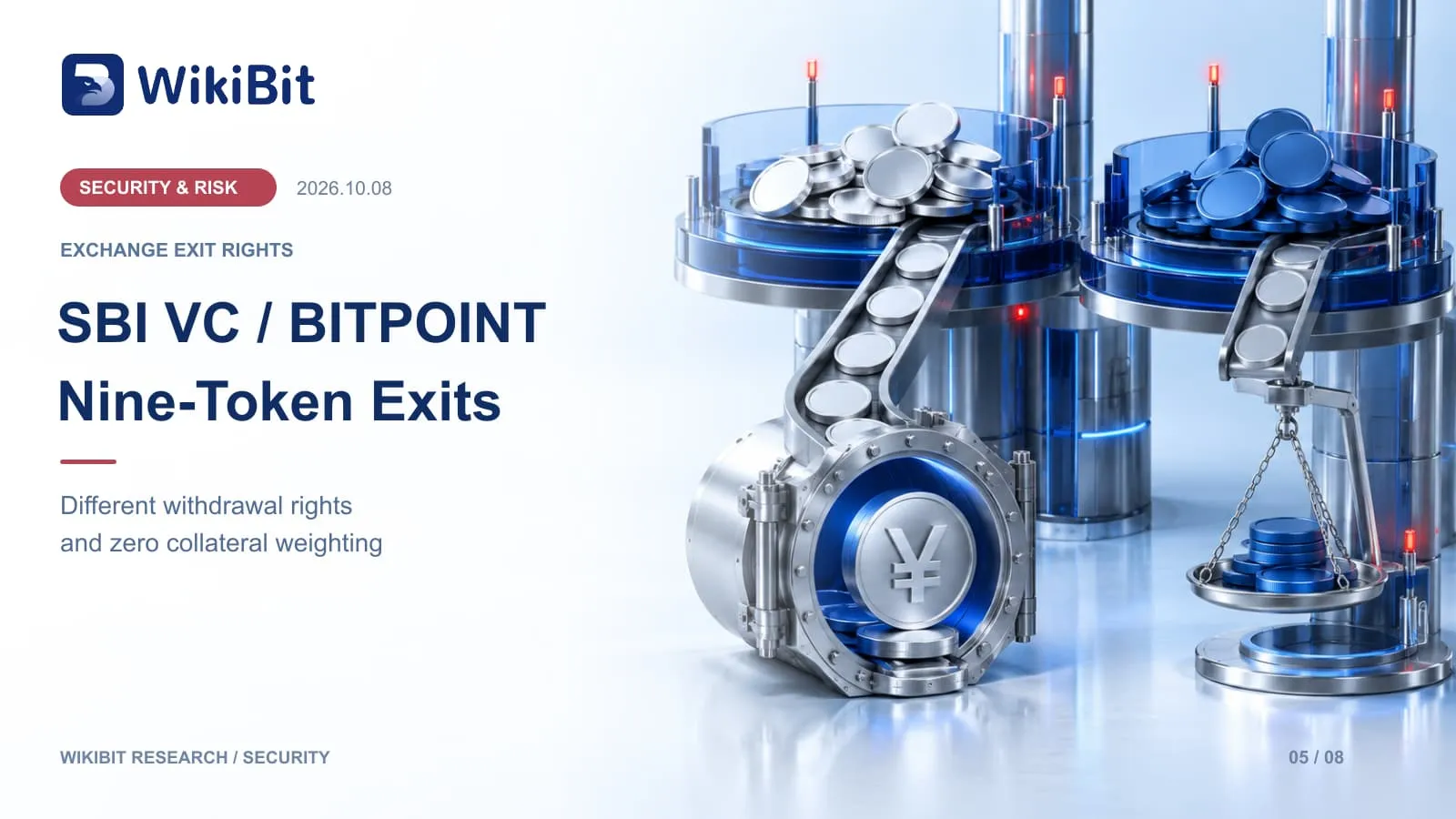
SBI VC Trade and BITPOINT: Nine-Token Retirement Creates Different Withdrawal and Margin Risks

Nine cryptocurrencies lost some purchasing, order-book or deposit functionality across two Japanese retail crypto brands on October 7, 2026. The affected assets are not one unified market event: they belong to two distinct product notices issued by businesses now operating under SBI VC Trade after corporate consolidation.  VCTRADE is retiring APT, ETC and OAS. BITPOINT is retiring BNB, DEP, JMY/JASMY, OSHI, PEPE and TRUMP. Both set major final service dates for October 28 at 13:00 JST, but asset-level withdrawal availability, collateral handling and trading mechanisms differ.VCTRADE: APT, ETC and OAS  SBI VC Trade says purchases of Aptos, Ethereum Classic and Oasys ended October 7 at 13:00 JST. Sales are scheduled to continue until October 28 at 13:00 JST. Its funding notice also ends OAS inbound transfers at the first cutoff and OAS outbound transfers at the final cutoff.  The critical distinction: VCTRADE does not provide crypto withdrawal services for APT or ETC under this product. Therefore the option to withdraw the original token before delisting is not available there for those two assets. OAS holders can apply to withdraw before the final cutoff, subject to the exchanges acceptance and processing controls.Margin-collateral haircut: 50% to zero  SBI VC Trade also states that APT, ETC and

2 دن پہلےانڈسٹری ریسرچ

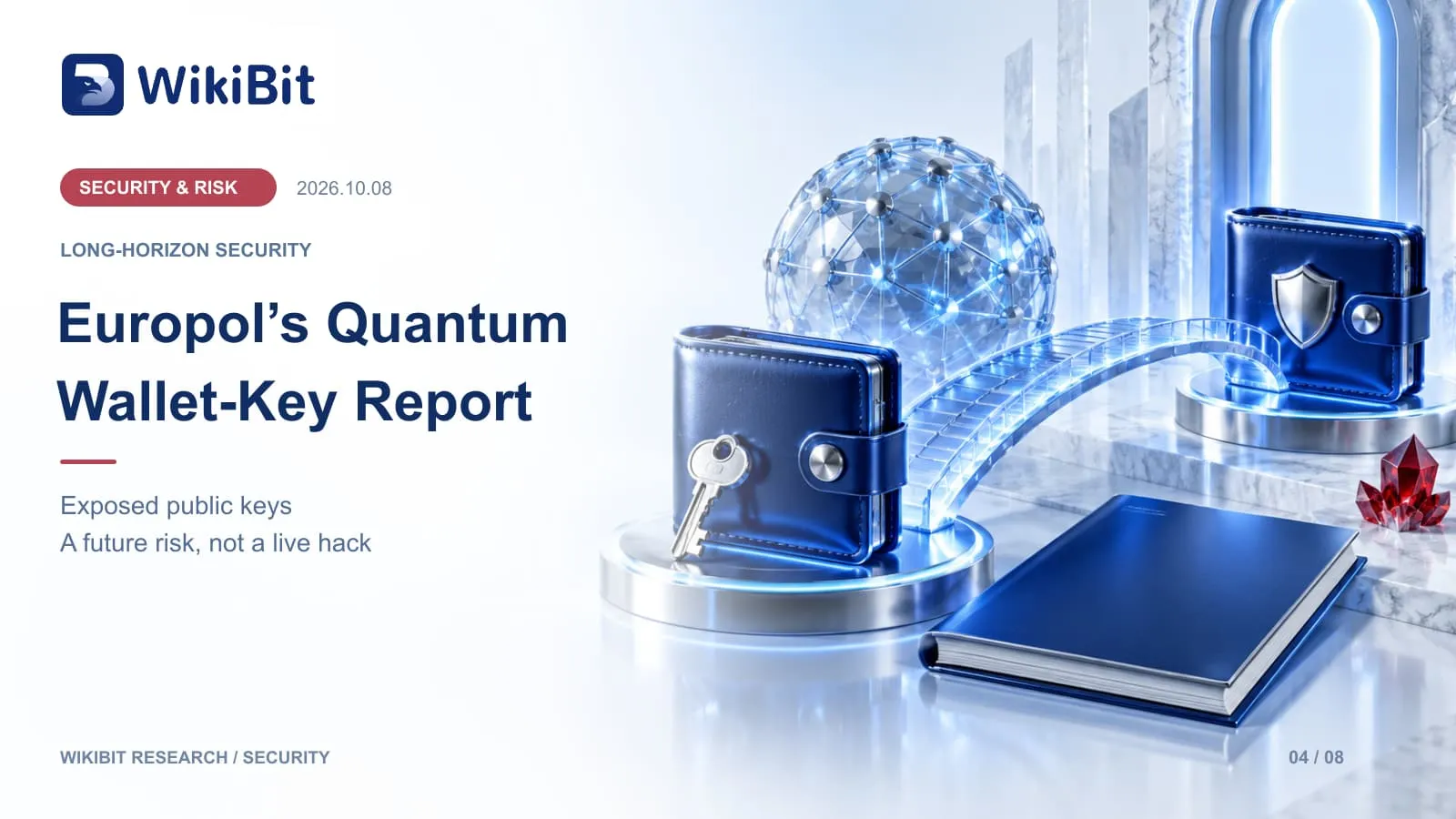
Europol Quantum Crypto Security Report: Exposed Wallet Keys, Not a Live Hack

Europols European Cybercrime Centre published Quantum Computing and Cryptocurrencies — Bridging Technical Expertise and Decision-Making on October 7, 2026. The report separates a genuine future cryptographic weakness from exaggerated claims that a quantum computer can already empty ordinary wallets or rewrite a blockchain.  The main threat concerns public-key signatures that prove ownership of cryptocurrency, not an instantaneous failure of every hash function used by Bitcoin or Ethereum. Europol says machines capable of carrying out the relevant attacks do not yet exist, and it gives no reliable arrival date. Nevertheless, it urges exchanges, wallet developers, custodians and blockchain communities to begin coordinated migration planning before that capability exists.What quantum computing could eventually break  Much of todays cryptocurrency custody uses public-key cryptography. A holder proves the right to spend by signing with a private key corresponding to a public key. A sufficiently capable error-corrected quantum computer could, in theory, run algorithms that recover certain classical private keys from exposed public keys. The economic result would be unauthorized signing and transfer, not necessarily a failure of the chains block-production history.Why hashing is broken is the wrong headline  Hash functions and public-key signatures have different properties under known quantum algorithms. Hashes may suffer security-margin reductions in some

2 دن پہلےانڈسٹری ریسرچ

Cardano CIP-0113 Makes Issuer-Level Freeze and Transfer Restrictions Possibl

The Cardano Foundation announced on October 7, 2026 that its CIP-0113 programmable token standard is live on mainnet after development with community contributors and multiple independent security audits. The standard allows issuers of selected regulated tokens—such as stablecoins, tokenized funds, bonds or shares—to bind compliance logic to the asset and have that logic checked when the asset is transferred, minted or burned.  This is a major market-structure and custody-control change. It is not a hack, and it is not an announcement that all Cardano funds can now be confiscated.What the standard introduces  Cardano has long supported native assets. CIP-0113 adds configurable compliance behavior for a token whose issuer opts into the programmable architecture. Rule modules may express KYC eligibility, allowlists, denylists, sanctions screening, freeze functions, seize/reassignment powers and restrictions on who can receive or hold tokens. The issuer chooses the modules and may update them as laws or product requirements change.  The Foundation says compliance checks are enforced by Cardanos ledger rather than by a proprietary custodial wrapper. This means an issuer can issue a native Cardano token with programmable behavior while still using normal network infrastructure. The release required no hard fork.What happens on an attempted transfer?  The relevant policy is evaluated when

2 دن پہلےانڈسٹری ریسرچ

Abstract L2 Shutdown: December 15 Deadline Creates Asset-Access Risk

Abstract, the consumer-focused Ethereum layer 2 built by Pudgy Penguins parent Igloo, has announced that it will cease operations on December 15, 2026. The announcement was made on October 6, and users are being directed to move assets out while the network and its normal exit infrastructure still operate. Abstract warns that assets left on the chain after the shutdown deadline could become inaccessible. This is a network lifecycle and asset-access event, not a reported exploit.What happened and why the network is closing  Igloo says maintaining an L2 focused almost exclusively on consumer-facing crypto applications has not produced a financially viable standalone business. Management points to stalled growth, thin liquidity, a limited DeFi market, low institutional uptake and continuing operating costs. CEO Luca Netz says the parent spent tens of millions of dollars sustaining the chain and chose not to finance the network indefinitely at the expense of its Pudgy Penguins business or launch an additional token as an emergency funding mechanism.  Abstract launched in January 2025. Its operating story illustrates how adoption metrics and blockchain revenue differ. The team reports more than 325 million transactions, approximately $6 billion of decentralized-exchange volume, millions of Abstract Global Wallets and extensive consumer brand participation.

2 دن پہلےانڈسٹری ریسرچ

MetaMask Staking Update: Validator Exits Push Ethereum’s Exit Queue to a 2026 High

MetaMask Staking‘s infrastructure security incident is now producing a measurable network-level effect on Ethereum’s validator queues.  Ethereums exit queue rose from roughly:  166,000 ETH on September 29  to a 2026 peak around:  850,000–851,000 ETH on October 2  after MetaMask began precautionary validator exits.  By October 5, public queue readings still showed roughly:  767,000–786,000 ETH  waiting to exit, with an estimated delay of around:  13–14 daysThe queue is falling, but remains historically high  The exit backlog has started to decline from the October 2 peak.  That is consistent with validators gradually passing through Ethereums churn limits.  It does not mean the MetaMask incident is fully resolved.Entry queue is even larger  At the same time, roughly:  1.44–1.5 million ETH  was waiting to enter staking on October 5.  Estimated entry wait:  about 25 days  This matters because exited MetaMask-operated ETH is expected to be re-entered/reallocated over time, and the large entry queue lengthens the full round trip.Lidos official timeline  Lido says the final affected MetaMask-operated validators are expected to:  exit, but not necessarily be fully withdrawn, by the end of October 7.  The complete:  exit → withdrawal → re-entry  cycle can take up to approximately:  45 days  because of the extended entry queue.No action required for stETH holders  Lido continues to say:  no action is required from stETH holders.  The protocol expects exited ETH to return gradually.  The event can reduce reward

2 دن پہلےانڈسٹری ریسرچ

Binance STG to ZRO Merger: Global Users Convert at 0.08634, UK Users Get Different Treatment

Binance reaches the main execution phase of the Stargate Finance token merger into LayerZero on October 6.  For Binances global platform:  STG/USDT trading ends at 03:00 UTC  and:  STG deposits and withdrawals suspend at 03:30 UTC.  Binance says affected STG balances will be converted to ZRO at:  1 STG = 0.08634 ZROWhy STG is being merged into ZRO  Stargate became part of the LayerZero ecosystem through acquisition/consolidation.  The token structure is being consolidated so ZRO becomes the surviving token for Binances supported merger process.  This is a token-structure migration, not a security exploit.Global Binance spot timeline  At:  03:00 UTC on October 6  Binance removes:STG/USDT;  and cancels pending STG spot orders.  Existing ZRO spot trading remains unaffected.Deposit and withdrawal cutoff  At:  03:30 UTC  Binance suspends STG deposits and withdrawals.  The global notice says that after the merger is completed:  old STG deposits and withdrawals will no longer be supported.  Users should not send old STG after the cutoff expecting it to be credited.Conversion ratio  Binances stated conversion ratio is:  1 STG = 0.08634 ZRO  This is platform conversion under the event terms.  It is not a floating market execution chosen by the user.Trading Bots and copy trading  Spot Copy Trading support was removed earlier, on October 5.  Trading Bot support for the affected STG pair is also removed with spot trading.  Users relying on automation should not assume

2 دن پہلےانڈسٹری ریسرچ
1
...
911
...
1000