Arbitrum gets $10 ARB target from Standard Chartered

Standard Chartered has initiated coverage of Arbitrum‘s ARB token with a $10 end-2030 price target, arguing that revenue from enterprise chains such as Robinhood Chain could strengthen Arbitrum’s economics as financial firms move activity onchain.  SummaryStandard Chartered initiated ARB coverage with a $10 end-2030 target, implying roughly seventyfold upside today.The bank forecasts ARB at $0.50 in 2026, $1.50 in 2027, and $3.50 in 2028.Robinhood Chain returns 10% of net protocol revenue to Arbitrum under its expansion program license.Arbitrum Foundation said expansion-program fees represented 35% of DAO income during July after Robinhood launched.Standard Chartered forecasts tokenized assets reaching $4 trillion by 2028 and equities reaching $750 billion.  The Block reported on Sept. 15 that Geoff Kendrick, Standard Chartereds global head of digital assets research, set interim ARB targets of $0.50 by the end of 2026, $1.50 for 2027, $3.50 for 2028 and $6.50 for 2029 before reaching $10 in 2030. ARB traded around $0.13 when the note was published, making the final forecast roughly 70 times that level.  The $0.50 figure circulating in some summaries is therefore not ARB‘s current market price. Market data on Sept. 15 put the token close to $0.13, with a market capitalization below $1 billion. Standard Chartered’s projections are

09-15Industry

7,000% Growth by 2030: Standard Chartered Predicts Arbitrum (ARB) to Hit $10

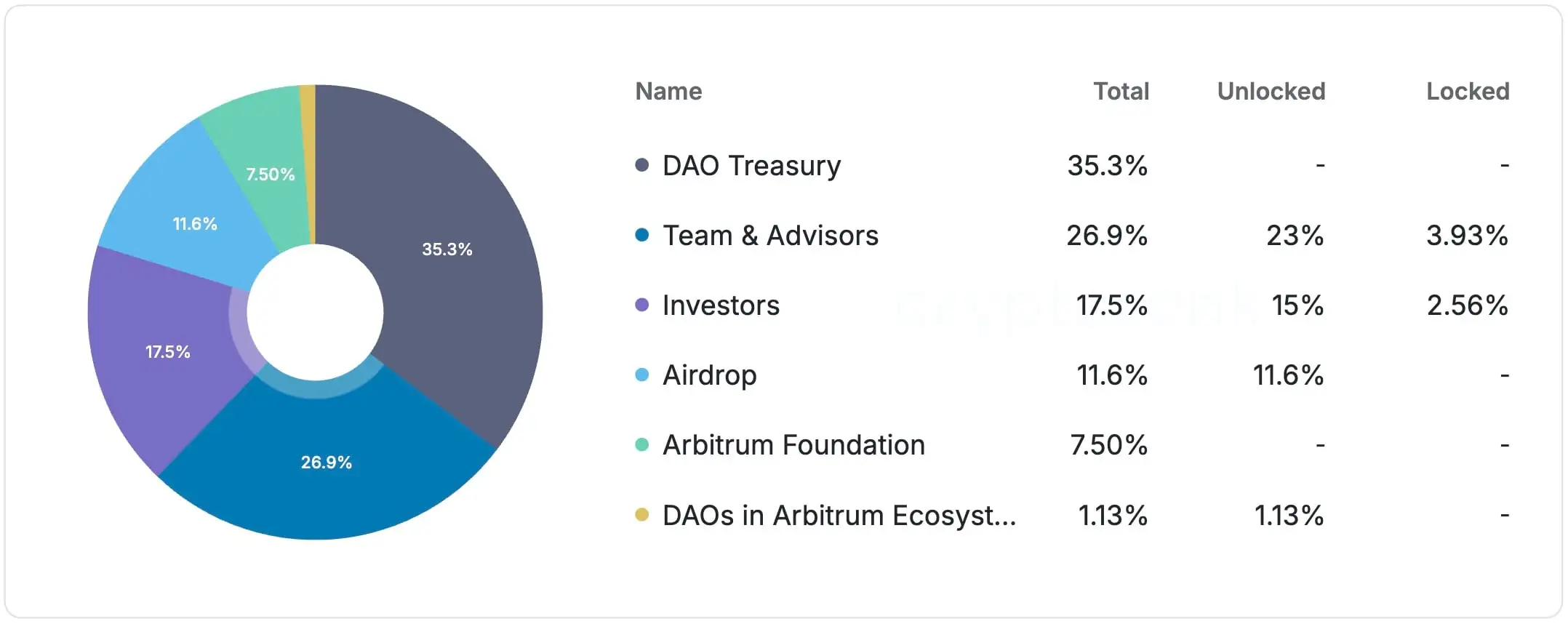
Banking giant Standard Chartered has unexpectedly shifted its attention away from the markets traditional heavyweights — Bitcoin and Ethereum — toward Arbitrums native utility token, $ARB, issuing a report with a long-term forecast for the asset.  The banks analysts built a detailed mathematical model for the asset and forecast a 7,000% rise by the end of 2030 — from the current $0.14 to $10.  The research shows that $ARBs fundamental valuation is changing dramatically as the market moves past the peak of major unlocks and traditional finance (TradFi) pours into the asset-tokenization sector.  Arbitrum ($ARB) token allocation and vesting breakdown, Source: Cryptorank  Over the past two years, tokenomics inflation has driven $ARBs price down by 90%. Its supply has grown to 5.8 billion tokens (58.45% of the total issuance), while selling pressure is still being felt today as a linear unlock of 14.4 million $ARB ($2.0 million) enters the market.  However, the unlock schedule is entering a flatter phase: the period of large, price-destructive cliff unlocks is over.  Arbitrum fell for two years due to inflation, but a contract with Robinhood changed everything  The main driver of the blockchains new economy has been its integration with Robinhood Chain. In September 2026, Arbitrums monthly revenue soared to $5

09-15Exchange

Bitcoin needs to reach $82,900 to outrun a looming miner margin squeeze

Bitcoins August price recovery coincided with a sharp improvement in mining revenue, but the network is preparing to reclaim part of that gain.  Related Asset Bitcoin #1 BTC · $77,013.06 24-hour change: down 0.92% Loading price history… 24H Down 0.92% 7D Down 1.65% 30D Up 22.37%  A mempool.space difficulty reading preserved at 20:24:22 UTC on Sept. 14 projected a 4.6976% increase at the next adjustment, with 661 blocks remaining and the retarget expected around 05:42 UTC on Sept. 19. Against the current difficulty of 127.4508 trillion, that would imply a new level near 133.44 trillion if the estimate holds.  The immediate hurdle is simple. With Bitcoin at $79,158 in the same mempool.space reading, fees and other inputs held flat, BTC would need to reach approximately $82,877, or roughly $82,900, to offset a 4.6976% difficulty increase in dollar hashprice. That is a breakeven threshold, not a price forecast.  The projection is not settled. Hashrate Indexs Sept. 14 mining roundup showed a 5.26% increase for the same expected Sept. 19 retarget earlier in the day. Each new block changes the pace calculation, and estimators can use different windows. The eventual protocol adjustment, rather than either projection, will determine the squeeze.  A price-led recovery meets returning hashpower  August shows

09-15Industry

Fin.com raises $20M to expand stablecoin payments

Fin.com has raised $20 million in seed funding as the New York payments startup expands infrastructure for moving stablecoins into local bank accounts and digital wallets.  Fortune reported on Sept. 15 that the financing closed in August and was led by Expa and Uber cofounder Garrett Camp, with Coinbase Ventures, Tenet Fund, founders of Figure, Mesh founder Bam Azizi, Second Sight Ventures and investors linked to sovereign and royal family offices in the Gulf and Africa participating. Fin.com did not disclose its valuation.  Founded by Nabeel Alamgir and Mustafa Dar, the company is building white-label payment infrastructure that lets businesses collect, convert and distribute money using a mixture of stablecoins and local banking rails. Its focus includes South Asia, Africa and the Middle East, regions the founders identified as central to the companys expansion strategy.  Fin.com funding targets the stablecoin-to-fiat gap  Fin.com‘s product focuses on a point in cross-border payments where blockchain settlement still depends on conventional financial systems: delivering digital dollars as spendable local currency. Alamgir described the company’s objective as solving the “last mile delivery problem,”referring to the process of moving funds from stablecoin rails into bank accounts and wallets.  Through one API, Fin.com says businesses can accept bank transfers, international wires and

09-15Industry

Proposed stablecoin rules might guarantee your dollar while making you wait a week to spend it

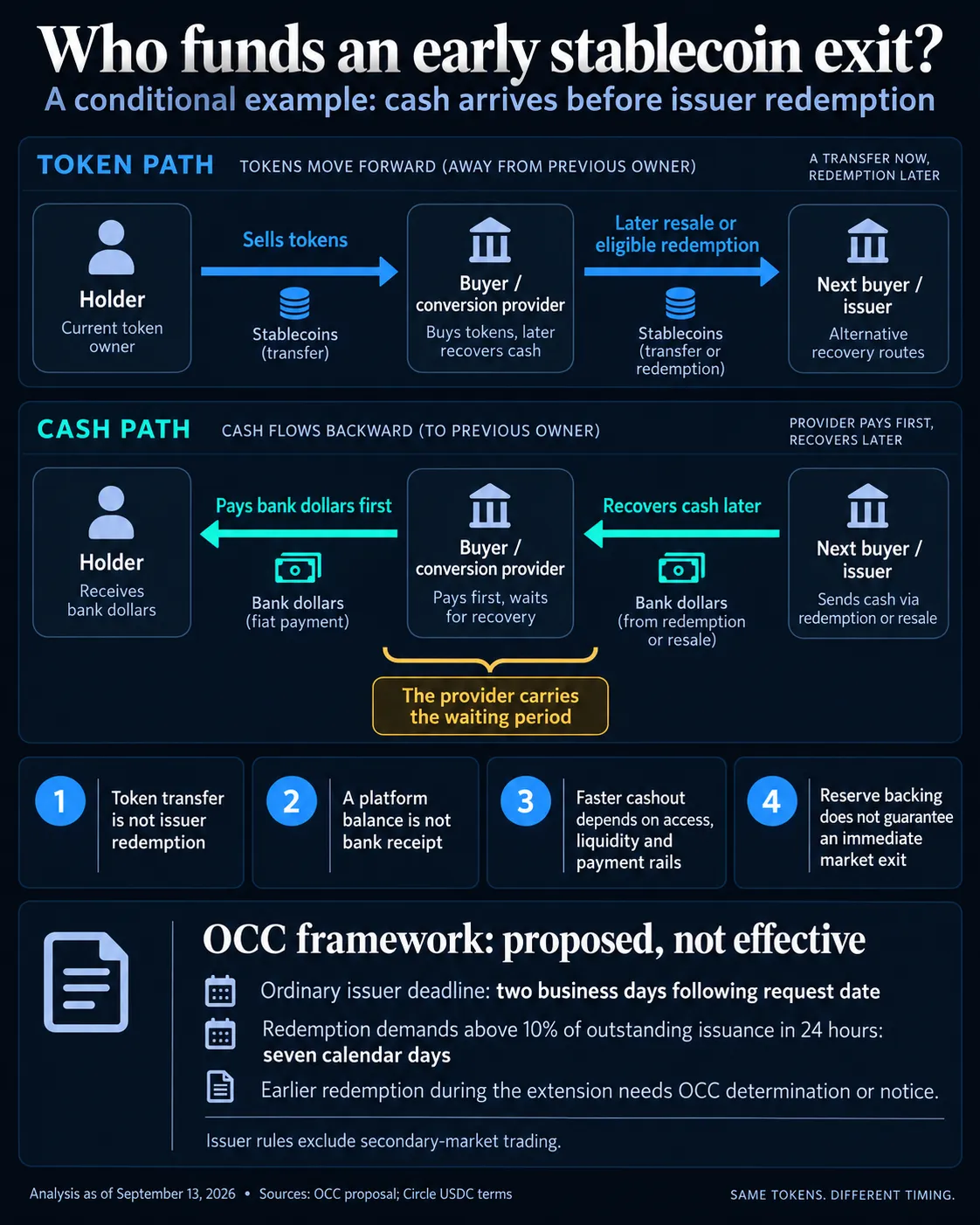
When a stablecoin holder receives spendable bank dollars before the issuer redeems the token, a buyer or conversion provider has funded the early exit. If that party keeps the token, it must wait until resale or redemption to get its cash back.  The Office of the Comptroller of the Currencys proposed redemption framework could give an issuer time to sell reserves in an orderly way while allowing secondary-market trading to continue.  A Sept. 4 Federal Reserve staff analysis clarifies the issue by separating round-the-clock blockchain payment functionality from conversion into bank dollars. Its authors describe redemption timeframes as unsettled.  The practical question for households and businesses is what happens between transferring a token and receiving money they can spend through their bank.  A longer redemption window leaves trading open  The OCCs proposed section 15.12 would set an ordinary redemption deadline of two business days following the request date, keeping faster redemption possible.  However, demands exceeding 10% of outstanding issuance value in one 24-hour period would automatically extend the period to seven calendar days for outstanding and subsequent requests.  During that extension, earlier redemption would require an OCC determination that it could proceed in an orderly, fair and transparent way, or notice that the extension no longer applied.

09-15Exchange

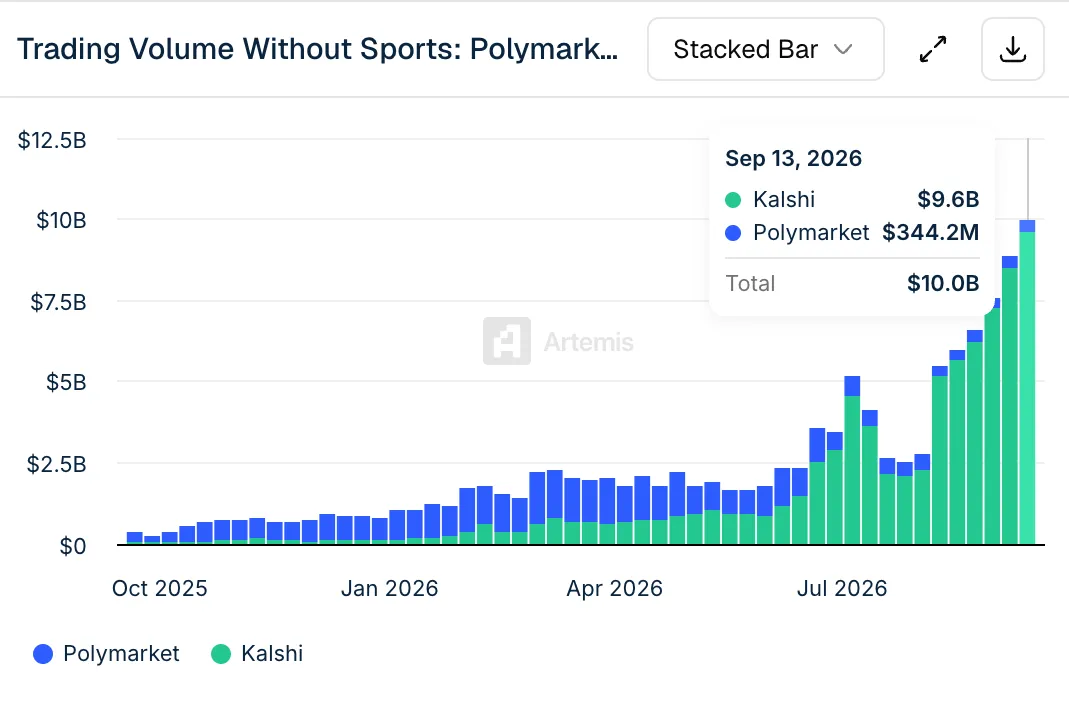
Non-Sports Prediction Market Volume Hits $10 Billion as Kalshi Pulls Away From Polymarket

Weekly trading volume in the non-sport categories across Kalshi and Polymarket reached a new high of $10 billion last week. Data from Artemis shows that this marked the sixth consecutive record week with Kalshi running away as clear leaders. Kalshi drew in $9.6 billion while Polymarket saw $344.2.  It wasnt always this one sided, though. In fact, this trend is quite recent. Up until early June, the stacked bars were actually even. Zoom out further to last year, the trend was actually reversed, with Polymarket firmly in the lead. Kalshi now controls 96% of this category, up from something close to a coin flip from just three months ago.  Four Retail Apps Do the Selling for Kalshi  Kalshi now has an impressive distribution channel across various retail platforms. Robinhood, Coinbase, Webull and Moomoo all carry its contracts to a massive user base that never went looking for Kalshi in the first place. Polymarket on the other still do not have these mainstream channels that cater to a much broader audience than just crypto natives.  What those brokerages merchandise under the non-sports tab matters more than the partner count. Webulls prediction markets page leads with Kalshi-powered hourly contracts on the S&P 500, Nasdaq, Bitcoin and

09-15Exchange

Binance launches 11-ETF wealth product for TradFi access

Binance has launched ETF Wealth Management on Sept. 15 with an initial lineup of 11 U.S.-listed funds focused mainly on Treasury securities and investment-grade bonds.  SummaryBinance launched ETF Wealth Management with 11 U.S.-listed ETFs focused on cash management investment strategies.Users hold actual ETF shares while Alpaca handles execution, clearing, settlement and custody through brokerage.Binance groups ETFs into three horizons covering under six months through more than one year.Nest Trading routes securities orders to Alpaca Securities while Binance says it does not custody.Binance says ETF Wealth Management is not savings and offers no fixed returns to investors.  According to Binances Sept. 15 announcement, the service sits within its Earn section and gives eligible users a dedicated channel for traditional-finance products focused on cash management and income-oriented strategies. Orders are placed through Binance Stock Trading, while customers receive the economic benefits attached to the ETF shares they hold.  The launch expands a stock-trading service Binance introduced in June, when it opened access to more than 7,000 U.S.-listed stocks and ETFs for eligible customers. ETF Wealth Management narrows that larger product universe into a smaller group organized around different holding periods and fixed-income strategies.  FT: CEE Energy Giant Orlen Lost $424 Million in Venezuela Oil Deal Involving

09-15Industry

CLARITY Act Odds Fall From 47% to 32% Across Senate Ladder

Clarity Act odds took a hit this week. Polymarket traders now assign a 53% probability that more than 50 senators will vote “Yes” on the first Senate final-passage vote for the CLARITY Act, down 8 points, according to the platforms “How many Senators will vote for the Clarity Act?” market. The odds of clearing 60 votes sit at 32%. Total volume is $39,633, with the market running through December 31, 2026.  This isn‘t simply a bet on whether the bill clears the Senate. It’s a read on how big a coalition traders expect, and the gap between 53% and 32% is the story.  How many Senators will vote for the Clarity Act? Polymarket  Supercharge Your Trading in 2026 With BloFin AI Trading BotsClarity Act Odds Slip: How The 60-Vote Wall Works  The contracts language is precise: “Above” means strictly greater, so Above 50 requires 51 senators and Above 60 requires 61.  The ladder falls off fast above the majority line. Above 55 prices at 39% and above 58 at 37%, both down more than 10 points: the steepest declines anywhere in the market. Traders aren‘t abandoning the bill; they’re trimming expectations for a broad bipartisan coalition. A simple majority and a filibuster-proof one are structurally

09-15Industry

Ethereum, Base wallet standards talks fail, Ethlabs researcher says

Ethereum and Base are set to implement different account abstraction standards after efforts to agree on a shared account abstraction standard broke down last week.  Interoperability standards became secondary to each chain‘s core goals, leading both to go their separate ways and “putting the burden on wallets,” Derek Chiang, founding member and researcher at Ethlabs, as well as a co-author of Ethereum’s EIP-8141 proposal, said in a Monday X post.  The divergence could require wallet developers to support separate transaction formats to provide a consistent experience across networks. Account abstraction allows programmable rules for authorizing transactions and paying fees.  Ethereum is now advancing Frame Transactions under EIP-8141 as a “headliner” item under its Hegotá upgrade, which would introduce native account abstraction and create a path toward post-quantum authentication. Separately, Base is developing native account abstraction via Keystore under EIP-8130, currently live on devnet.  The divergence also highlights different priorities between layer-1 and layer-2 blockchain networks. Chiang said L1s are increasingly focused on censorship, capture-resistance, open-source, privacy and security features, favoring different account standards, while scalability-focused L2s are more aligned with standards such as EIP-8130.  The researcher argued that the separation wont necessarily result in a bad outcome, as both Ethereum and Base are now “free

09-15Industry

Zcash (ZEC) Poised to Break Top-10 Barrier, Overtaking Hyperliquid (HYPE)

After its remarkable surge propelled ZEC into the top 10 of the cryptocurrency market, Zcash is about to reach another significant milestone. By market capitalization, the privacy coin is currently almost exactly behind Hyperliquid, with only a tiny difference between the two assets.  Can Zcash push Hype away?  As of today, Hyperliquids market capitalization is $19.87 billion, while ZECs is roughly $19.3 billion. Less than 3% of HYPEs current valuation, or roughly $570 million, separates the two. ZEC would need to trade between $1,178 and $1,180 to surpass HYPE if its capitalization stays the same.  ZEC/USDT Chart by TradingView  That target is not far away. At the moment, ZEC trades for about $1,144, and its 24-hour trading volume surpasses $1.07 billion. Over the past seven days, the token has also increased by about 1.15 percent, whereas HYPE has decreased by more than 6 percent. The capitalization gap is closing quickly as a result of this combination. The chart from Zcash demonstrates how aggressive the repricing has been.  ZEC stays up  As recently as August, ZEC was trading at about $500 before soaring to $600, $800, and ultimately $1,000. Before beginning its current erratic consolidation, the rally peaked at $1,280. Significantly, despite numerous corrections, ZEC has managed

09-15Industry
1
...
268270
...
1000