AFMRegulated
Netherlands Crypto Asset Exchange License (CEX)





Netherlands Crypto Asset Exchange License (CEX)

Exchanges with 24H trading volume exceeding 82%
Bitvavo makes trading cryptocurrencies simple and accessible. Our platform combines a wide selection of coins, transparent and fair fees, and high security standards for beginners and advanced users, in the app and the web version.
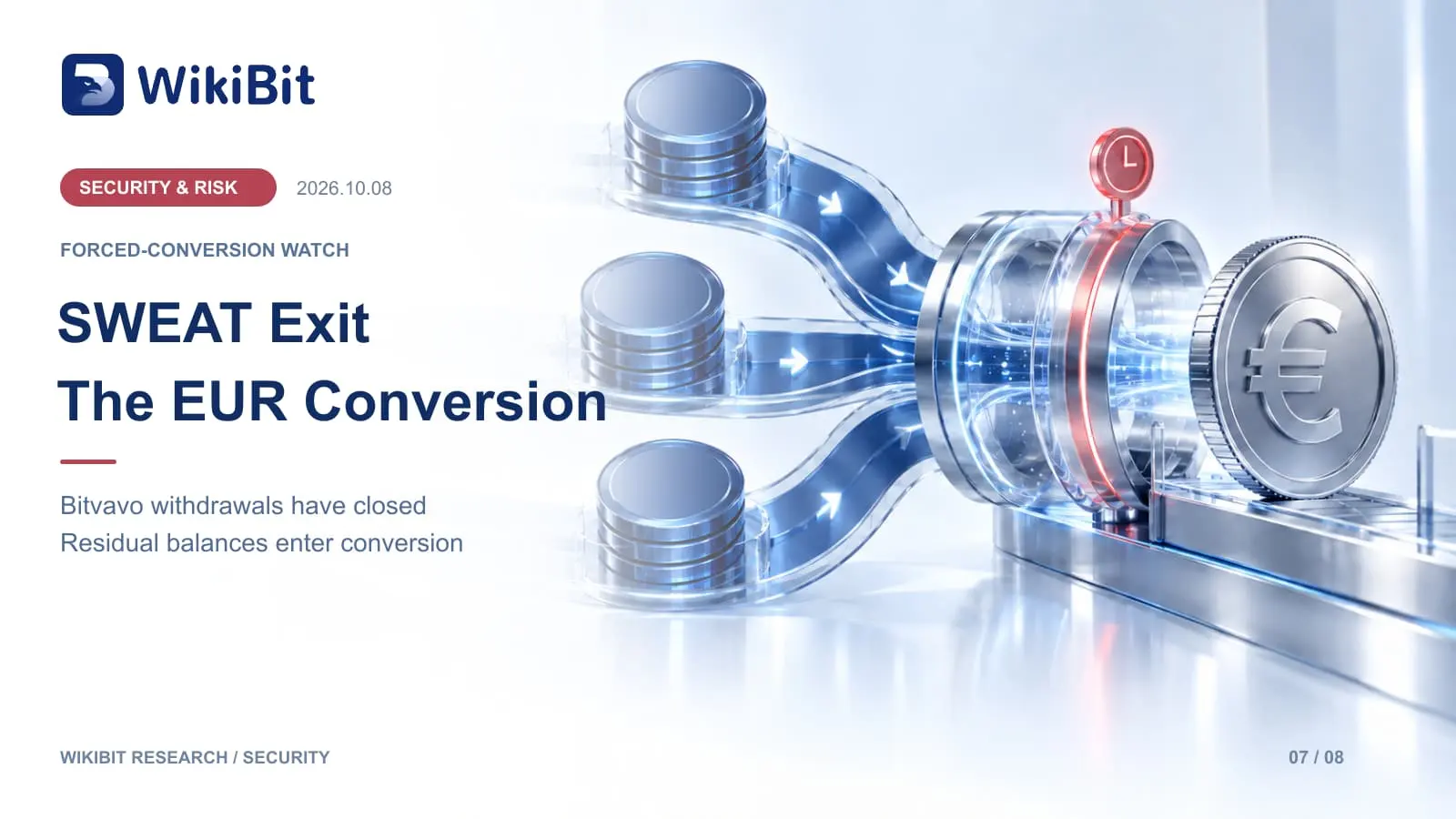
The most urgent near-term SWEAT risk has moved from a future withdrawal deadline into the platform-controlled conversion stage. Bitvavos published October 7 timetable ended deposits at 13:00 CEST, trading at 14:00 CEST and SWEAT withdrawals at 15:00 CEST. Those times have now elapsed. The exchange has not promised a guaranteed conversion rate for any residual holdings.What happens to SWEAT left on Bitvavo? Bitvavo says it will sell remaining SWEAT and credit EUR by October 15 or earlier. The operator will attempt an orderly sale, but spread, slippage and execution price are not guaranteed. This is a forced change in asset form: a customer may end up owning a euro account balance rather than the original SWEAT token. The platform warns that the displayed EUR value can temporarily show zero after the trading halt while the sale and crediting are processed. That processing state alone is not proof of confiscation; the economic questions are whether the eventual EUR credit arrives and what execution terms are applied.Project shutdown is a separate, later event The Sweat Foundations official wind-down guidance states that Sweat Wallet and SWEAT in their current form end December 30, 2026. Until then the app and current contract services are expected to run.
Preface: The Two Sides of a “Legacy Brand” In the previous 17 editions, we investigated a series of exchanges ranging from HashKey to BigONE. Today, in the 18th edition, we turn our attention to a true “ancient beast” of the crypto world — Poloniex. Its résumé could be described as a “living fossil among crypto exchanges”: “Founded in 2014,” “12 years of operating history,” “one of the earliest exchanges to introduce Proof of Reserves (PoR),” “maintaining a reserve ratio above 100% for 20 consecutive months,” “a $100 million user protection fund,” “daily trading volume exceeding $1.1 billion in April 2026, surpassing Bitget and MEXC,” “supporting more than 350 cryptocurrencies” — doesnt that sound like the perfect image of a “long-established and reliable major exchange”? But on the other side of the story: The Seychelles Financial Services Authority (FSA) issued a public warning in March 2026, stating that the company operating Poloniex had already been dissolved on January 1, 2022, and was no longer a legitimate legal entity. The U.S. SEC previously fined Poloniex $10 million, accusing it of knowingly operating an unregistered securities trading platform. Indias Financial Intelligence Unit (FIU-IND) ordered Poloniex to be blocked for violating anti-money laundering regulations. Trustpilot gave Poloniex a score of only 2.0/5,
Introduction: The A and B Sides of a “Living Fossil” in Crypto Over the first 16 editions, we dug into a series of exchanges ranging from HashKey to Hibt. Today, in the 17th edition, we turn to a genuine crypto “old-timer” — BigONE. Its résumé reads like a “living fossil” of the crypto industry: “Founded in 2017,” “the original Yunbi team,” “co-founded by Li Xiaolai and Old Cat (Yu Wenzhuo),” “incubated by INBlockchain (InBlockchain Capital),” “ranked No. 40 globally on CoinMarketCap,” “nine years of operating history,” and “approximately $426 million in Proof of Reserves (PoR).” Sounds like a veteran, legitimate crypto institution, right? But on the other side of the story — Japans Financial Services Agency (FSA) has repeatedly warned and cracked down on it for “continuing to operate without obtaining a license despite receiving multiple warnings.” On September 2, 2026, the Korea Digital Asset Exchange Alliance (DAXA) found that BigONE was allegedly operating in South Korea without registration and called for a police investigation. CoinPaprika labels it “not MiCA compliant,” with a confidence score of only 5.76%. WikiBit describes it as operating under “loose regulation.” CoinGecko gives it a Trust Score of 5/10, while Trustpilot rates it just 2/5. In July 2025, BigONE suffered a supply-chain